Stats
Actions
Available In
Tags

Automates the full lifecycle of agent-assisted social-science research: from vague topics to study design, data pipeline construction, statistical analysis, reproducibility auditing, and publication-ready outputs (LaTeX tables, slide decks, Markdown docs). Includes reviewer response planning, literature evidence matrices, and HPC job submission.
Source-grounded literature discovery and evidence-matrix skill for social-science research. Use when searching, screening, extracting, or updating literature tables from Google Scholar, Crossref, Semantic Scholar, journal pages, working-paper sites, Zotero libraries, PDFs, or user supplied bibliographies. Triggers: "literature matrix", "文献矩阵", "literature review search", "Zotero", "DOI", "screen papers", "extract identification strategy", "do not write prose yet", "source-grounded literature", "找文献", "文献综述前的检索", "文献检索", "引用核查", "建立文献矩阵".
Empirical methods review skill for auditing social-science research designs, scripts, model outputs, tables, figures, robustness checks, and reproducibility evidence. Use before submission, presentation, replication release, or reviewer response when the task is to find design, data, code, inference, reporting, or overclaiming issues. It reviews and structures problems; it does not decide substantive identification validity for the author. Triggers: "methods review", "audit empirical design", "review regression output", "check fixed effects", "cluster standard errors", "robustness audit", "reproducibility review", "submission checklist", "计量审查", "方法审查", "结果审查", "稳健性检查".
R 代码性能诊断与优化指南。帮助识别性能瓶颈、理解 R 底层机制、选择优化策略。 **触发场景:** - "这段代码跑得太慢了" - "帮我优化这个函数/循环的性能" - "如何加速这个包的某个函数" - "为什么这段 R 代码这么慢" - "如何在 HPC 上并行运行" - 用户询问 profvis、bench、future、并行计算相关问题
Social-science analysis execution skill for turning a study design brief and analysis-ready data into first-pass tables, figures, model outputs, coding outputs, logs, and an analysis run manifest. Use after study-design-builder and research-data-builder when the user asks to run the first analysis, produce baseline/descriptive outputs, execute an analysis plan, generate table or figure shells from data, or make results ready for methods review. Triggers: "run analysis", "first table", "baseline model", "descriptive table", "analysis runner", "execute analysis plan", "生成第一张表", "跑基准模型", "描述性统计", "结果清单".
Social-science data engineering skill for turning raw files into auditable analysis samples. Use when building or repairing data pipelines, panel datasets, merges, variable construction, sample-flow reports, missingness audits, text-to-structure extraction, or reproducible scripts for empirical research. Triggers: "build analysis sample", "data cleaning", "merge audit", "panel construction", "sample flow", "variable dictionary", "raw to analysis", "text extraction", "do not overwrite raw data", "reproducible data pipeline", "数据清洗", "样本构造", "合并检查", "变量构造", "样本流".
Own this plugin?
Verify ownership to unlock analytics, metadata editing, and a verified badge. GitHub access is read-only (username + org membership).
Sign in to claimOwn this plugin?
Verify ownership to unlock analytics, metadata editing, and a verified badge. GitHub access is read-only (username + org membership).
Sign in to claimnpx claudepluginhub siyaozheng/ai4ss-skills --plugin ai4ss-skillsBased on adoption, maintenance, documentation, and repository signals. Not a security audit or endorsement.
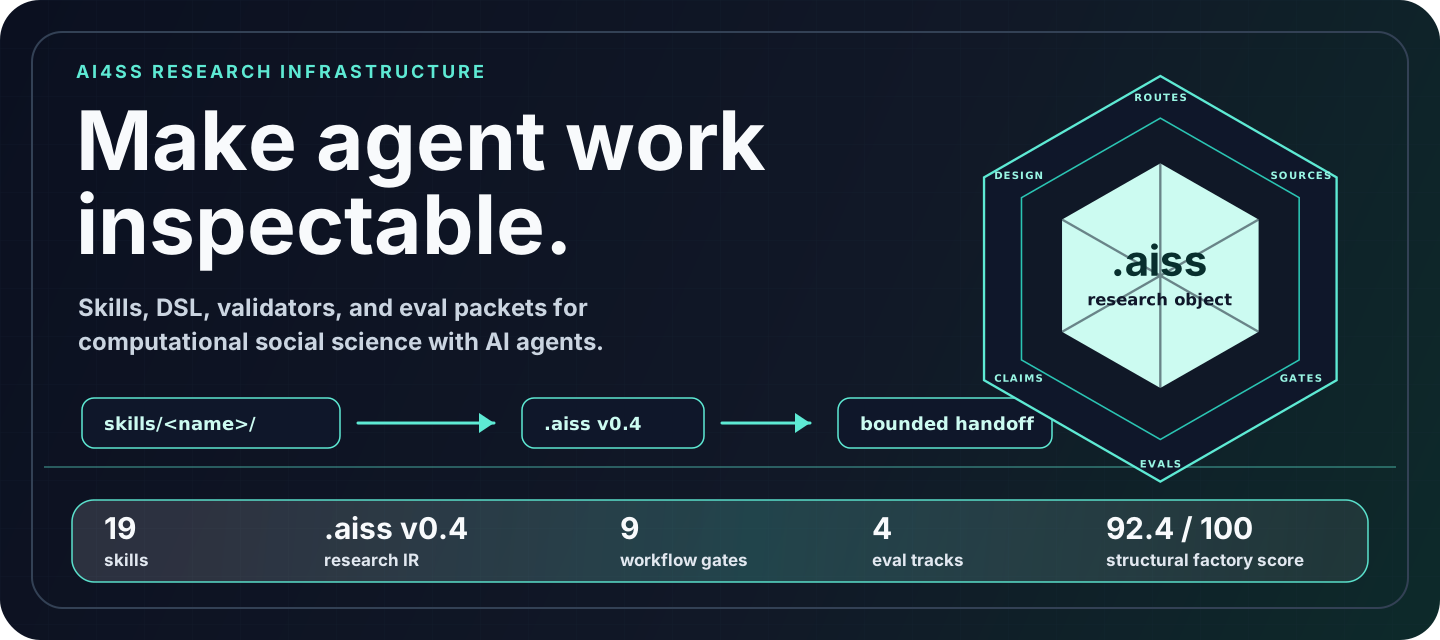
AI4SS turns agent work into durable research objects: route declarations, study designs, source ledgers, data contracts, analysis manifests, methods diagnostics, claim ledgers, slide maps, and reviewer-response matrices.
It treats the model as a worker inside a research operating system, not as the operating system itself.




Install | Workflow | Skills | Validation | Evidence | Boundaries
| 19 installable skills | .aiss v0.4 research object IR | 9 workflow gates | 4 evaluation tracks | 92.4 / 100 factory structural score |
AI agents are already good at producing fluent research-shaped text. That is not the hard part. The hard part is making agent work usable inside scholarship without losing the things research depends on: source status, design choices, data lineage, missingness decisions, analysis readiness, methods review, authorship boundaries, and revision traceability.
This repository is a working infrastructure layer for that problem. It combines
installable agent skills, a unified .aiss research object, sidecar schemas,
validators, examples, and evaluation packets. The goal is not to make an agent
sound like a scholar. The goal is to make its work inspectable enough that a
scholar can use, reject, revise, teach, and extend it.
| AI failure mode | AI4SS response |
|---|---|
| Plausible topic advice with no next action | Route cards, stop reasons, minimum viable study |
| "Research design" reduced to a slogan | MIDA declarations, decision registers, diagnosands |
| Literature review as unsourced synthesis | Discovery ledgers, screening matrices, source-status gates |
| Data cleaning remembered in prose | DDI metadata, cleaning contract, execution audit, sample flow |
| Tables detached from design | Analysis readiness gate, scripts, logs, run manifest |
| Methods issues found too late | Issue table, redesign routes, validation commands |
| Writing help that becomes ghostwriting | Claim ledger, paragraph slots, author decision points |
| Reviewer response without traceability | Revision matrix, manuscript locations, action status |
The core claim is infrastructural: agent-assisted social science needs durable research objects and quality gates, not only better prompts.
Clone the repository:
git clone https://github.com/SiyaoZheng/ai4ss-skills.git
cd ai4ss-skills
The Codex plugin wrapper lives at .codex-plugin/plugin.json and points at the
canonical skills/ tree. The local marketplace entry is
.agents/plugins/marketplace.json.
codex plugin marketplace add /path/to/ai4ss-skills
codex plugin add ai4ss-skills@ai4ss-skills-local
Validate the Codex wrapper:
python3 scripts/validate_codex_plugin.py
The Claude Code plugin wrapper lives at .claude-plugin/plugin.json and points
at the same canonical skills/ tree. The local marketplace entry is
.claude-plugin/marketplace.json.
claude plugin marketplace add /path/to/ai4ss-skills
claude plugin install ai4ss-skills@ai4ss-skills-local
Validate the Claude Code wrapper:
python3 scripts/validate_claude_plugin.py
claude plugin validate --strict .claude-plugin/plugin.json
claude plugin validate --strict .claude-plugin/marketplace.json
Plugin install is the preferred path. If a runtime only supports directory
skills, copy or symlink selected skills/<skill-name>/ directories into that
runtime's skill directory.
The repository-local .codex/skills and .agents/skills entries are symlinks
to ../skills. They are convenience links for local development, not a second
source tree.
The research-factory spine is:
Specialized research analysis agents for critical thinking, evidence verification, synthesis, and parallel paper analysis
 rpatrik96
Computational-science methodology for Claude Code: research framing, pre-registration, reproducible analysis, anomaly investigation, and red-team review
 K-Dense-AI
Claude Code skills for experimental social science and computational text analysis: conjoint design, diagnostics, and data cleaning, survey design, list experiments, cross-national design, topic modeling, LLM text classification, VLM-based OCR pipelines, post-OCR cleanup, paper pre-submission review, hypothesis building, narrative building, pre-registration, and methods reporting. Invoke as /skill-name or let Claude auto-trigger based on context.
 scdenney
Autonomous research orchestration: agents for hypothesis-driven investigation, experiment running, fresh-eyes review, and batch evaluation.
 Butanium
PhD-level research capabilities: literature review, multi-source investigation, critical analysis, hypothesis-driven exploration, quantitative/qualitative methods, and lateral thinking
 poemswe
Agents and skills for Research-Through-Design approach to research software design
 uw-ssec
'%20stop-opacity%3D'0.16'%2F%3E%3Cstop%20offset%3D'1'%20stop-color%3D'rgb(200%2C90%2C60)'%20stop-opacity%3D'0.03'%2F%3E%3C%2FlinearGradient%3E%3C%2Fdefs%3E%3Crect%20width%3D'320'%20height%3D'200'%20fill%3D'url(%23g)'%2F%3E%3Ccircle%20cx%3D'250'%20cy%3D'56'%20r%3D'92'%20fill%3D'rgb(200%2C90%2C60)'%20fill-opacity%3D'0.06'%2F%3E%3Ccircle%20cx%3D'64'%20cy%3D'172'%20r%3D'58'%20fill%3D'rgb(200%2C90%2C60)'%20fill-opacity%3D'0.05'%2F%3E%3C%2Fsvg%3E)
