Stats
Actions
Available In
Tags

23 engineering skills across 3 tiers (Engineering, Security & Operations, Intelligence) for AI IDEs. Includes code-review, architecture-review, security-review, threat-model, rag-review, document-extraction, hallucination-audit, task-decomposition, and more. Every skill follows a shared contract (machine_output + skill graph), works standalone, and gets supercharged when you connect your tools (see CONNECTORS.md and SKILL-CONTRACT.md).
Based on adoption, maintenance, documentation, and repository signals. Not a security audit or endorsement.
Design or review an AI agent or multi-agent system. Trigger with "design an agent for", "review this agent architecture", "should this be one agent or many?", or when defining an agent's tools, control loop, memory, guardrails, and where humans stay in the loop.
Design or review an API contract (REST or GraphQL). Trigger with "design an API for", "review this endpoint", "is this REST API well designed?", or when defining resources, methods, status codes, pagination, versioning, idempotency, and error shapes.
Evaluate a complete system architecture above the component level. Trigger with "review this architecture", "is this design going to scale?", "staff-level design review", or when assessing strengths, tradeoffs, and scalability/security/cost risks of a whole system rather than a single service.
Create or evaluate an architecture decision record (ADR). Use when choosing between technologies (e.g., Kafka vs SQS), documenting a design decision with trade-offs and consequences, reviewing a system design proposal, or designing a new component from requirements and constraints.
Review code changes for security, performance, and correctness. Trigger with a PR URL or diff, "review this before I merge", "is this code safe?", or when checking a change for N+1 queries, injection risks, missing edge cases, or error handling gaps.
A self-taught engineer hit the four problems that break every real agent system (memory, context, reliability, drift), solved each inside production code, then extracted the patterns into small repos you can run in a minute. This is the map.





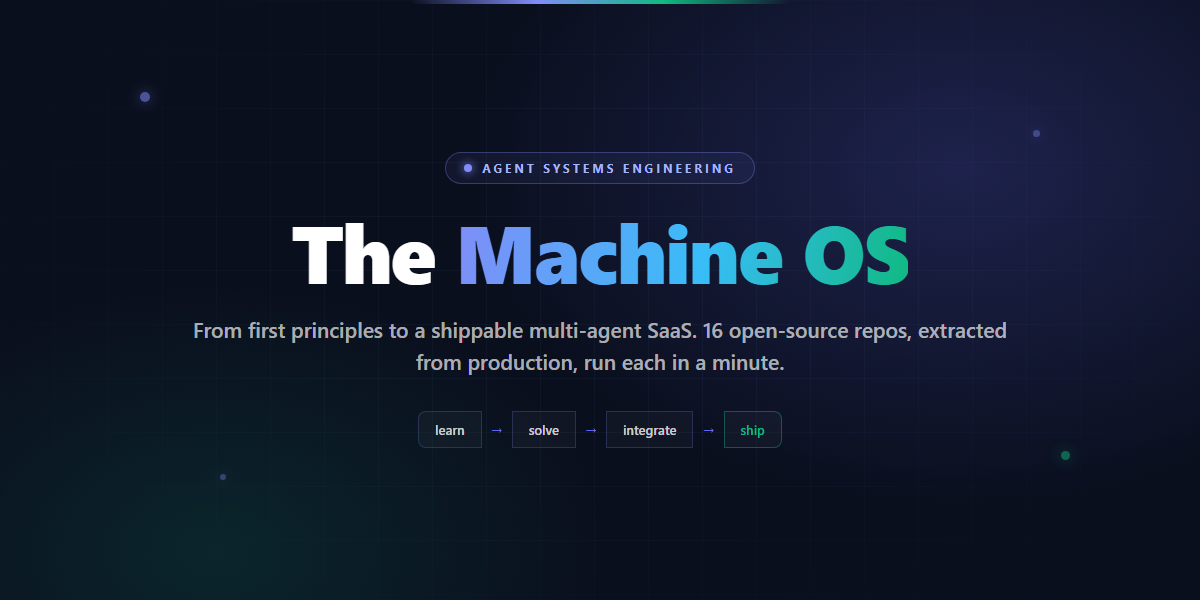
Turn your AI IDE into a senior engineer's workbench. There are two pieces, and you only need the first:
| For | You need |
|---|---|
| The skills (step 1) | Claude Code v2.1.3 or newer. Nothing else, no keys. |
| The optional tools (step 2) | Node.js 18+ for the Node spokes (run via npx), plus uv for the Python agent-extractor spoke (runs via uvx)[...] |
/plugin marketplace add shubham0086/the-machine-os
/plugin install ai-engineering@machine-os
/reload-plugins
The /reload-plugins step is what makes the skills appear (the install prints a
reminder for it). All 23 then show up namespaced as /ai-engineering:<skill>.
The skills are organized into three tiers. The tier is metadata (a tier: field), not a
folder, so install stays one step. Every skill follows the
skill contract: it produces a human-readable
artifact and appends a machine-readable machine_output block, so one skill's output feeds the
next (requires / produces / feeds). That turns the set from a skill library into a skill
network.
Tier 1 : Engineering (build it right)
| Skill | What it does |
|---|---|
/requirements-analysis | Turn a vague goal into testable functional + non-functional requirements |
/system-design | Design a scalable system with NFRs, data model, and a resiliency matrix |
/architecture | Write or evaluate an architecture decision record (ADR) |
/architecture-review | Staff-level review of a whole system, scored on scalability/reliability/security/cost/complexity |
/api-design | Design or review a REST/GraphQL contract (semantics, versioning, idempotency) |
/database-design | Model a schema; keys, relationships, indexing, SQL-vs-NoSQL fit |
/code-review | Security, performance, and correctness review of a diff or PR |
/performance-review | Find and impact-rank bottlenecks (N+1, complexity, hot paths) |
/testing-strategy | A test plan balancing coverage, speed, and maintenance |
/tech-debt | Audit and prioritize debt with WSJF scoring |
/debug | Structured reproduce, isolate, diagnose, and fix |
/documentation | READMEs, API docs, runbooks, and onboarding guides |
Tier 2 : Security & Operations (keep it safe and running)
| Skill | What it does |
|---|---|
/security-review | Audit code/API/design for injection, broken access control, and exposure |
/threat-model | STRIDE threat model: assets, trust boundaries, threats, mitigations |
/deploy-checklist | Pre-deploy verification with rollback triggers |
/incident-response | Triage, status updates, and a blameless postmortem |
/standup | Turn recent activity into a yesterday / today / blockers update |
Tier 3 : Intelligence (the autonomy / AI layer)
| Skill | What it does |
|---|---|
/task-decomposition | Break a goal into an ordered, dependency-aware task plan |
/agent-design | Design or review an agent: tools, control loop, guardrails, HITL |
/prompt-review | Treat a prompt as a contract: clarity, output shape, failure handling |
/rag-review | Decide the retrieval strategy first, then review the pipeline |
/document-extraction | Decide the extraction strategy, then turn messy PDFs into validated structured JSON |
/hallucination-audit | Claim-by-claim groundedness check on any generated text |
Own this plugin?
Verify ownership to unlock analytics, metadata editing, and a verified badge. GitHub access is read-only (username + org membership).
Sign in to claimOwn this plugin?
Verify ownership to unlock analytics, metadata editing, and a verified badge. GitHub access is read-only (username + org membership).
Sign in to claimnpx claudepluginhub shubham0086/the-machine-os --plugin ai-engineeringOptional MCP tool backends for the ai-engineering skills, powered by Machine OS engines. Spokes: code-graph blast radius (agent-context) supercharges /code-review and /tech-debt; agent-memory (mcp-agent-toolkit) gives /debug and /incident-response SCAR failure memory and /agent-design a shared blackboard; agent-extractor (Python, via uvx) gives /document-extraction real PDF→JSON extraction with validation. Install only if you want the tools; the skills work standalone without them.
 shubham0086
Harness-native ECC plugin for engineering teams - 67 agents, 271 skills, 92 legacy command shims, reusable hooks, rules, MCP conventions, and operator workflows for Claude Code plus adjacent agent harnesses
 affaan-m
Comprehensive skill pack with 66 specialized skills for full-stack developers: 12 language experts (Python, TypeScript, Go, Rust, C++, Swift, Kotlin, C#, PHP, Java, SQL, JavaScript), 10 backend frameworks, 6 frontend/mobile, plus infrastructure, DevOps, security, and testing. Features progressive disclosure architecture for 50% faster loading.
 Jeffallan
A growing collection of Claude-compatible academic workflow bundles. Covers scientific figures, manuscript writing and polishing, reviewer assessment, citation retrieval, data availability, paper reading, literature search, response letters, paper-to-PPTX conversion, and evidence-grounded Chinese invention patent drafting. Rules are organized as reusable skill folders with explicit workflows and quality checks.
 Yuan1z0825
Core skills library for Claude Code: TDD, debugging, collaboration patterns, and proven techniques
 obra
obraPlugin-safe Claude Code distribution of Antigravity Awesome Skills with 1,640 supported skills.
 sickn33
'%20stop-opacity%3D'0.16'%2F%3E%3Cstop%20offset%3D'1'%20stop-color%3D'rgb(200%2C90%2C60)'%20stop-opacity%3D'0.03'%2F%3E%3C%2FlinearGradient%3E%3C%2Fdefs%3E%3Crect%20width%3D'320'%20height%3D'200'%20fill%3D'url(%23g)'%2F%3E%3Ccircle%20cx%3D'250'%20cy%3D'56'%20r%3D'92'%20fill%3D'rgb(200%2C90%2C60)'%20fill-opacity%3D'0.06'%2F%3E%3Ccircle%20cx%3D'64'%20cy%3D'172'%20r%3D'58'%20fill%3D'rgb(200%2C90%2C60)'%20fill-opacity%3D'0.05'%2F%3E%3C%2Fsvg%3E)