Stats
Actions
Available In
Tags

Automates development workflows for Claude Code: agents decompose PRDs into stories and generate implementation plans; skills analyze code quality, generate git commits/PRs, and capture learnings as project context. Provides iterative improvement loops for skill prompts.
AI Product Owner agent. Reads AI project PRDs and produces user stories with inverted failure modes, AI safety stories, graceful degradation criteria, and human oversight checkpoints. Runs on a separate thread.
Build implementation plans from inversion analysis. Reads .plans/INVERT-*.md files and project context to produce structured, session-surviving plan files. Runs on a separate thread to keep the main context clean for coding.
Decompose PRDs into epics and user stories. Reads .plans/PRD-*.md files and produces structured story maps with dependencies and priorities. Runs on a separate thread to keep the main context clean.
Analyze code modules and files for refactoring opportunities, code smells, and architectural pattern violations in any language or framework. Use this skill when the user asks to "analyze code smells", "find refactoring opportunities", "check for code quality issues", or "review architecture" for a specific module or file.
Autonomously improve any skill prompt using a measure-change-test loop inspired by Karpathy's autoresearch. Runs the skill repeatedly, scores output against a yes/no checklist, makes one small change per round, keeps improvements, reverts regressions. Use when the user asks to "improve a skill", "optimize a skill", "autoimprove", "run autoresearch on a skill", or similar requests about iteratively improving skill quality.
Generate AI tool configuration for an existing project. Explores the codebase and produces context files, path-scoped pattern rules, landmine rules, and agents for Claude Code and VS Code Copilot. Run once per project.
Decompose a PRD into prioritized, dependency-mapped epics and user stories. Accepts pasted text, file path, or PDF.
Generate clear, descriptive git commit messages by analyzing staged changes. Use this skill when the user asks to "generate a commit message", "write a commit message", "create a commit message", or similar requests related to git commits.
Uses power tools
Uses Bash, Write, or Edit tools
Based on adoption, maintenance, documentation, and repository signals. Not a security audit or endorsement.
Executables (bin/) — files in this plugin's bin/directory are added to the Bash tool's PATH while the plugin is enabled.
You don't improve productivity by going faster — you improve it by improving control.
Claude Code (marketplace) · VS Code Copilot (Homebrew)
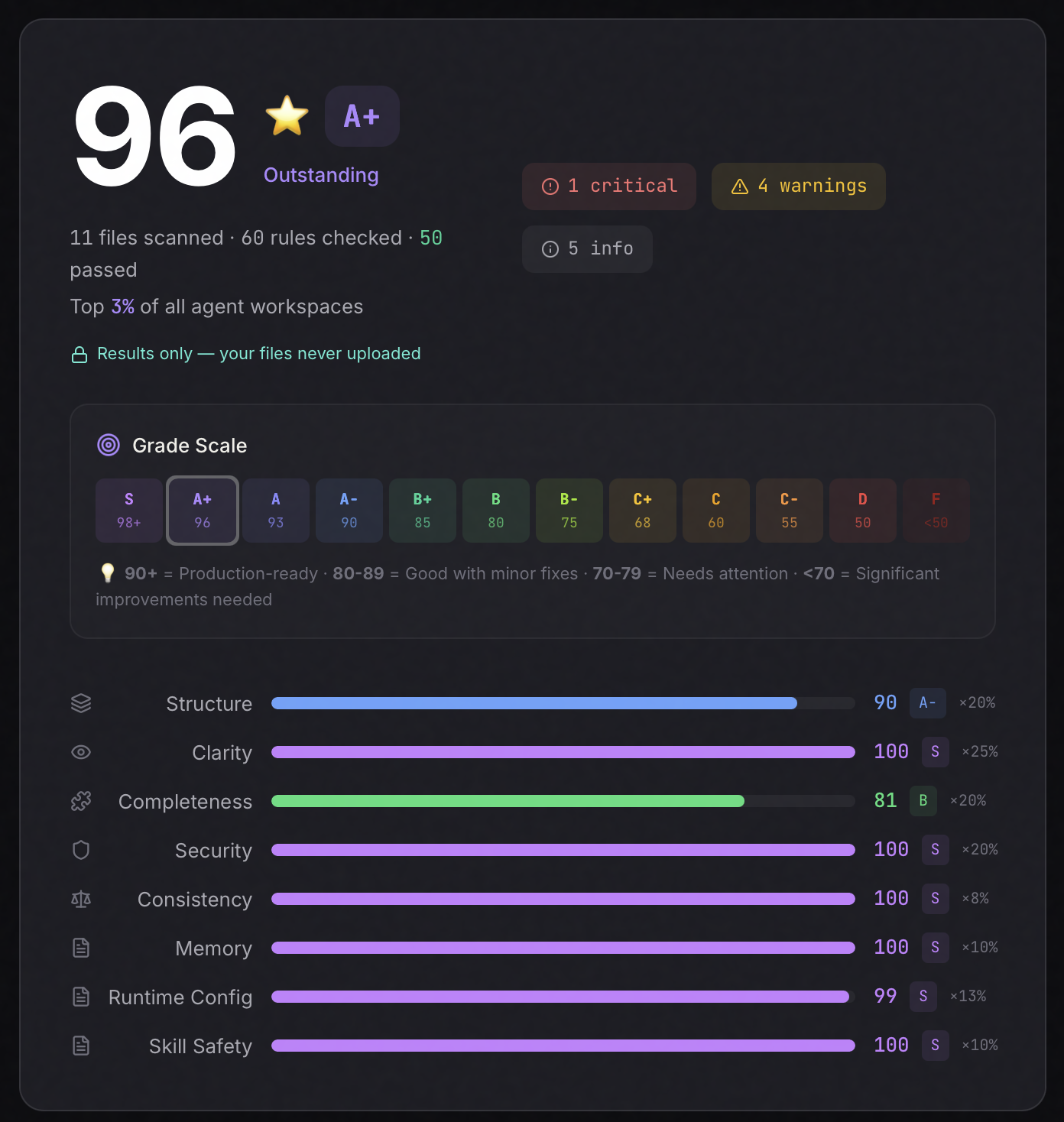
agentlinter.com/r/w7Jo9X0qVOV8
north-starr is inspired by Idea Flow by Janelle Arty Starr — a framework for making invisible friction visible in software development.
The core insight: you don't improve productivity by going faster, you improve it by improving control. north-starr applies this to AI-assisted development — your AI partner learns your patterns, remembers your landmines, and works with control, not just speed.
The book · Talk · Podcast · "The most underrated book in software engineering management"
Every task goes through a complexity gate. Simple tasks flow fast. Complex tasks get automatic risk analysis and structured planning. The AI decides — you approve.
Task given
    │
    ▼
Complexity Assessment
    │
    ├─ Low ──────────► State files → Wait for approval → Code
    │
    ├─ Medium/High ──► /invert (risk analysis)
    │                      │
    │                      ▼
    │                  layoutplan agent (separate thread)
    │                      │
    │                      ▼
    │                  Approval gate → Code
    │
    ▼
RED (failing tests) → GREEN (implementation)
    │
    ▼
Completion menu:
    ├─ /generate-commit
    ├─ /generate-pr
    ├─ /learn (capture patterns & landmines)
    └─ Done
Before any code change, the AI prints this assessment:
| # | Question | Answer |
|---|---|---|
| 0 | Is current behavior covered by tests? | Yes / No |
| 1 | How many files will this change? | 1-2 / 3+ |
| 2 | Am I creating new types or protocols? | No / Yes |
| 3 | Does this require cross-module integration? | No / Yes |
/invert automatically, then plan before codingNo configuration needed. This is built into every project north-starr bootstraps.
For full product specs, /decompose breaks the work into manageable pieces before the complexity gate kicks in:
PRD received
    │
    ▼
/decompose → Scan & detect AI project
    │
    ├─ Non-AI project ──► storymap agent → .plans/STORIES-<name>.md
    │
    ├─ AI project ──────► chief-ai-po agent → .plans/STORIES-AI-<name>.md
    │                      (inverted stories, safety stories SA.1-SA.6,
    │                       human oversight checkpoints, graceful degradation)
    │
    ▼
Optional: GitHub Issues script
    │
    ▼
Pick a story → /invert → layoutplan → Implement
Claude Code (marketplace):
/plugin marketplace add selcukyucel/north-starr
/plugin install north-starr
VS Code Copilot (Homebrew):
brew tap selcukyucel/north-starr https://github.com/selcukyucel/north-starr.git
brew install north-starr
cd your-project && north-starr init
Then run /bootstrap — north-starr explores your codebase and generates everything your AI needs.
/bootstrap generatesAll output is tool-native — the exact files each tool already reads:
| Artifact | Claude Code | VS Code Copilot |
|---|---|---|
| Project context | CLAUDE.md | AGENTS.md |
| Universal context | AGENTS.md | AGENTS.md |
| Pattern rules | .claude/rules/*.md | .github/instructions/*.instructions.md |
| Landmine rules | .claude/rules/*.md | .github/instructions/*.instructions.md |
| Agents | .claude/agents/layoutplan.md, storymap.md, chief-ai-po.md | .github/agents/layoutplan.agent.md, storymap.agent.md, chief-ai-po.agent.md |
| Module context | CLAUDE.md per module | — |
Pattern rules document how things are done in your codebase. Landmine rules document what to watch out for. Both are scoped by file path — they fire only when the AI touches matching files.
When your AI gets corrected, discovers a convention, or breaks something — /learn captures it as a pattern or landmine rule. These rules feed directly into how the AI operates next session.
npx claudepluginhub selcukyucel/north-starr --plugin north-starrAgentic AI development workflow for Claude Code — AI-specific skills, agents, hooks, and project context for teams building AI automations
 selcukyucel
Matt Pocock's agent skills for real engineering — grilling, spec/ticket flows, TDD, code review, domain modelling and more. Plug-and-play, not vibe coding.
 mattpocock
Reliable automation, in-depth debugging, and performance analysis in Chrome using Chrome DevTools and Puppeteer
 ChromeDevTools
Harness-native ECC plugin for engineering teams - 67 agents, 279 skills, 94 legacy command shims, reusable hooks, rules, MCP conventions, and operator workflows for Claude Code plus adjacent agent harnesses
 affaan-m
Access thousands of AI prompts and skills directly in your AI coding assistant. Search prompts, discover skills, save your own, and improve prompts with AI.
 f
fConsult multiple AI coding agents (Gemini, OpenAI, Grok, Perplexity, plus codex, antigravity, and grok CLIs when installed) to get diverse perspectives on coding problems
 hex
hexComplete developer toolkit for Claude Code
 rohitg00
'%20stop-opacity%3D'0.16'%2F%3E%3Cstop%20offset%3D'1'%20stop-color%3D'rgb(200%2C90%2C60)'%20stop-opacity%3D'0.03'%2F%3E%3C%2FlinearGradient%3E%3C%2Fdefs%3E%3Crect%20width%3D'320'%20height%3D'200'%20fill%3D'url(%23g)'%2F%3E%3Ccircle%20cx%3D'250'%20cy%3D'56'%20r%3D'92'%20fill%3D'rgb(200%2C90%2C60)'%20fill-opacity%3D'0.06'%2F%3E%3Ccircle%20cx%3D'64'%20cy%3D'172'%20r%3D'58'%20fill%3D'rgb(200%2C90%2C60)'%20fill-opacity%3D'0.05'%2F%3E%3C%2Fsvg%3E)