Stats
Actions
Available In
Tags

Audit Rust projects for supply chain security gaps, generate and verify CI/CD configs for SLSA L3 provenance, trusted publishing to crates.io, Scorecard checks, cargo-deny policies, fuzzing, and release automation, then migrate hardening levels from minimal to hardened.
Scan a Rust project and produce a supply chain security gap analysis
Check for outdated GitHub Action SHAs and CLI tool versions in deployed workflows
Generate a single supply chain security config file
Interactive wizard to generate missing supply chain security configs
Verify that generated supply chain configs are valid and functional
Cross-platform binary distribution for Rust — cargo-dist, cross, and manual CI matrix
Supply chain audits for third-party crates — human review attestation with cargo-vet
Automated changelog generation with git-cliff and conventional commits
Rust CI best practices — multi-job design, gate pattern, caching, SHA pinning
Three-layer dependency defense — cargo-deny, Dependabot, and osv-scanner
Own this plugin?
Verify ownership to unlock analytics, metadata editing, and a verified badge. GitHub access is read-only (username + org membership).
Sign in to claimOwn this plugin?
Verify ownership to unlock analytics, metadata editing, and a verified badge. GitHub access is read-only (username + org membership).
Sign in to claimBased on adoption, maintenance, documentation, and repository signals. Not a security audit or endorsement.
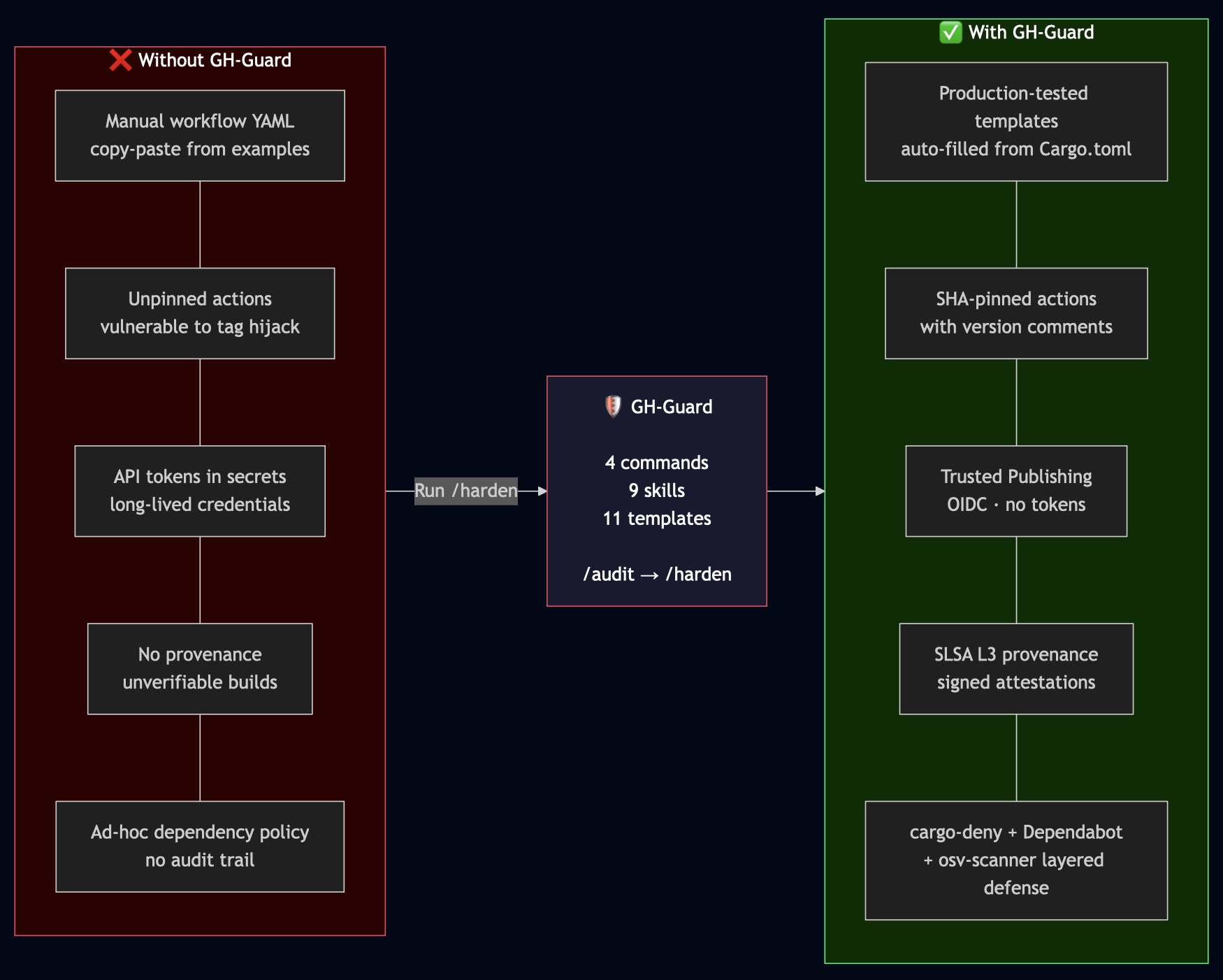
CI/CD supply chain hardening plugin for Claude Code, designed for Rust projects.
GH-Guard packages production-tested CI/CD security configurations into reusable templates and guided workflows. It helps Rust OSS maintainers achieve high OpenSSF Scorecard scores, set up Trusted Publishing, generate SLSA L3 provenance, and configure comprehensive dependency auditing.
From the Claude Code plugin registry:
/plugin install gh-guard
Or manually — add to your Claude Code settings (~/.claude/settings.json):
{
  "plugins": [
    "~/path/to/gh-guard"
  ]
}
# Audit your project's supply chain security posture
/audit

# Interactively harden your project
/harden

# Generate a specific config file
/generate ci-workflow
/generate publish-workflow
/generate deny-toml

# Check for outdated SHA pins
/check-updates

# Validate generated configs
/verify
/audit — Gap AnalysisScans your repository and produces a structured gap analysis:
pull_request_target, workflow_run with untrusted input, script injection via PR title/body)/harden — Interactive WizardGuides you through hardening at three levels:
| Level | Components |
|---|---|
| Minimal | CI workflow + cargo-deny + Dependabot + SECURITY.md |
| Standard | + Trusted Publishing + CodeQL + Scorecard + release script |
| Hardened | + SLSA L3 provenance + fuzz testing + osv-scanner |
Detects your current hardening level and offers upgrade mode — generating only the delta files needed to reach the next level. Supports workspace projects with per-crate Trusted Publishing guidance.
/check-updates — SHA Pin CheckerChecks deployed workflows for outdated action SHAs and CLI tool versions:
@tag, not SHA)/verify — Post-Generation ValidationValidates that generated configs are syntactically correct, internally consistent, and ready to deploy:
cargo-deny check dry run (if installed)release.sh --dry-run validation/generate <target> — File GeneratorGenerates a single file with auto-detected project values. Shows a unified diff before overwriting existing files.
| Target | Output Path |
|---|---|
ci-workflow | .github/workflows/ci.yml |
publish-workflow | .github/workflows/publish.yml |
codeql | .github/workflows/codeql.yml |
scorecard | .github/workflows/scorecard.yml |
fuzz | .github/workflows/fuzz.yml |
deny-toml | deny.toml |
rust-toolchain | rust-toolchain.toml |
dependabot | .github/dependabot.yml |
security-md | SECURITY.md |
release-script | scripts/release.sh |
osv-scanner | osv-scanner.toml |
Production-tested config files parameterized with {{PLACEHOLDER}} syntax. Values are auto-detected from Cargo.toml, git remote, and cargo metadata:
| Placeholder | Source | Example |
|---|---|---|
{{CRATE_NAME}} | Cargo.toml name field | my-tool |
{{MSRV}} | rust-version or rust-toolchain.toml | 1.82 |
{{REPO_OWNER}} | Git remote URL | my-org |
{{REPO_NAME}} | Git remote URL | my-tool |
{{CONTACT_EMAIL}} | Cargo.toml authors field | [email protected] |
{{FUZZ_TARGETS}} | fuzz/Cargo.toml bin entries | fuzz_parse,fuzz_decode |
{{WORKSPACE_CRATES}} | cargo metadata --no-deps (publishable, dependency order) | core,parser,cli |
All workflow templates follow these security practices:
npx claudepluginhub sbom-tool/gh-guardAudit and harden your software supply chain - packages, containers, GitHub Actions, IaC, AI/ML models, and IDE extensions. Action commands fix issues directly; walkthrough commands guide you through advanced setup.
 latiotech
Security scanning, dependency CVE audits, and exposure-aware risk prioritization.
 hrconsultnj
Rust development - cargo, clippy, testing, memory safety
 laurigates
Audit supply-chain threat landscape of project dependencies for exploitation or takeover risk
 trailofbits
Curator - Ancient guardian of code excellence. Orchestrates 5 quality gates (Static Analysis, Test Coverage, Security Scanning, Complexity Analysis, Dependency Health) in a unified flow. Ensures pristine code through Forerunner precision and automated enforcement.
 markus41
Security skills for AI coding agents — supply chain incident response, credential rotation, IOC detection, and dependency hardening across npm, PyPI, GitHub Actions, and more
 makash
'%20stop-opacity%3D'0.16'%2F%3E%3Cstop%20offset%3D'1'%20stop-color%3D'rgb(200%2C90%2C60)'%20stop-opacity%3D'0.03'%2F%3E%3C%2FlinearGradient%3E%3C%2Fdefs%3E%3Crect%20width%3D'320'%20height%3D'200'%20fill%3D'url(%23g)'%2F%3E%3Ccircle%20cx%3D'250'%20cy%3D'56'%20r%3D'92'%20fill%3D'rgb(200%2C90%2C60)'%20fill-opacity%3D'0.06'%2F%3E%3Ccircle%20cx%3D'64'%20cy%3D'172'%20r%3D'58'%20fill%3D'rgb(200%2C90%2C60)'%20fill-opacity%3D'0.05'%2F%3E%3C%2Fsvg%3E)