Stats
Actions
Available In
Tags

Always-on universal engineering rules + project-aware domain rules with PECK v3 level-aware advisory guidance (never blocks or denies — every check approves and injects context) and a Grounded-Generation Layer that traces every external API call back to a researched source (UNVERIFIED flag when it can't), reducing hallucination. Detects 41 domains across 12 lifecycle phases via weighted signal scoring. Modular pattern architecture with per-pattern severity (WARN/STRICT/CRITICAL) mapped to levels (solo/team/prod). Ships 28 tech-stack-aware department subagents (ground-truth-backed, research-before-code) that realize the CLAUDE.md routing map out of the box.
LLM application layer — RAG pipelines, agents/tool-use, prompt engineering, evaluation harnesses, and LLM safety (prompt-injection defense, output sanitization, token budgets, content filtering). Owns the llm-safety domain. Distinct from ml-engineer (model training/serving) — this agent builds reliable systems on top of model APIs. Use for RAG, agent design, prompt/eval work, and securing LLM-in-the-loop features.
Server-side services, REST/GraphQL APIs, business logic, queues, and integrations. Before locking patterns it forces the key questions — read/write ratio and QPS forecast, tenancy model, sync vs async, data sensitivity, and the SLO. Use for new backend features once contracts exist, API design review, and concurrency/idempotency questions.
Smart contracts and on-chain systems — Solidity/Vyper development, the Checks-Effects-Interactions pattern, reentrancy and overflow safety, access control, gas optimization, upgrade safety, and pre-mainnet audit discipline. Owns the blockchain domain. Use for contract development/review, on-chain security, and deployment gating.
Cloud architecture, Kubernetes, networking, multi-region design, instance sizing, and cost optimization across AWS/GCP/Azure. Designs for availability and cost together, right-sizes resources, sets autoscaling and budgets, and enforces least-privilege IAM and network segmentation. Use for platform-level cloud/scaling work and cloud cost reviews.
Read-only compliance assessment before launch and whenever data-handling features change — maps the system against applicable frameworks (SOC 2, GDPR, HIPAA, PCI DSS, ISO 27001) and flags gaps with the specific control cited. Assesses and reports; never writes product code. Use for pre-launch reviews, new sensitive-data features, and verifying data-subject-rights handling end to end.
Modifies files
Hook triggers on file write and edit operations
Uses power tools
Uses Bash, Write, or Edit tools
Based on adoption, maintenance, documentation, and repository signals. Not a security audit or endorsement.



Automatic quality rules for Claude Code. Like a spell-checker, but for engineering best practices.
When you use Claude Code to write software, enforce-mode runs quietly in the background and nudges Claude toward good engineering habits — researching before coding, testing before shipping, never committing secrets, and following security best practices for your project type.
Think of it as a safety net that reminds Claude of the right thing to do at the right moment.
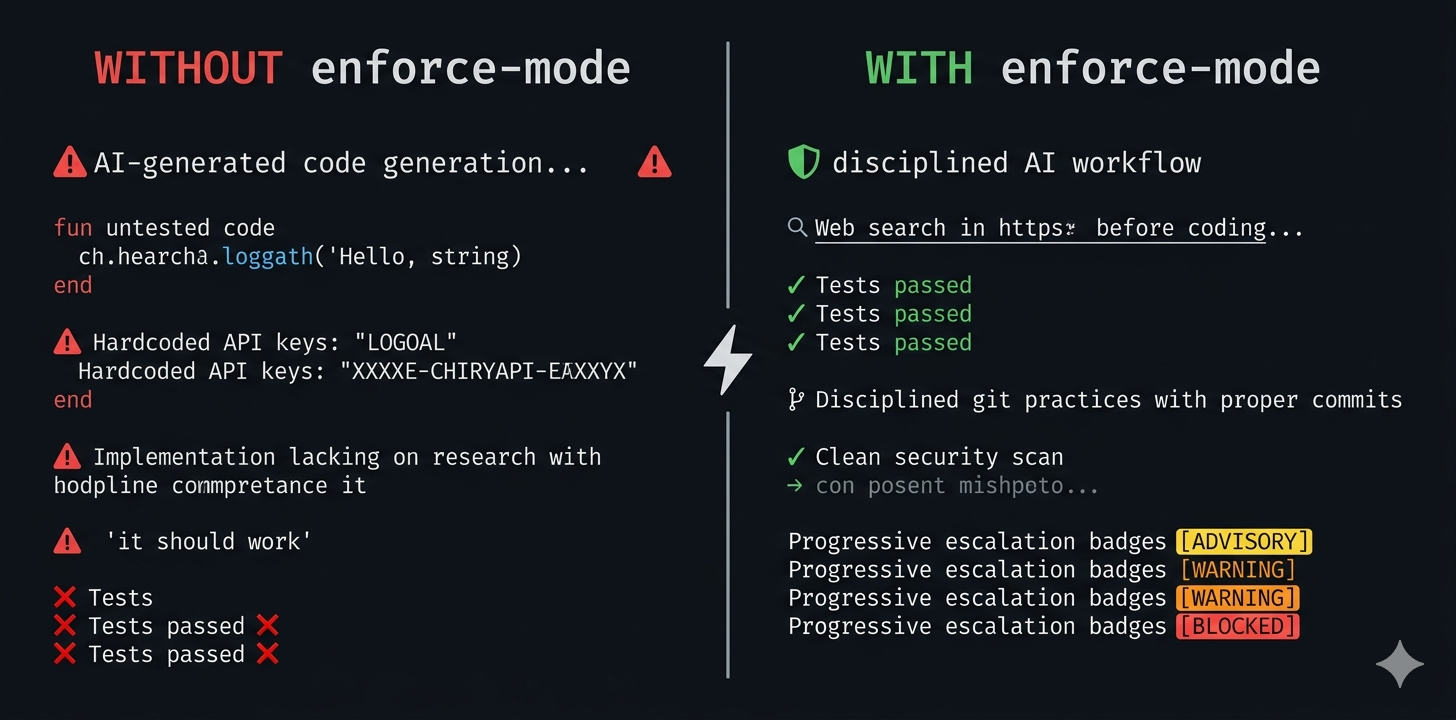
Without enforce-mode, Claude Code might:
With enforce-mode, Claude is guided to:
enforce-mode installs as a Claude Code plugin. Pick one of the two options below.
Run these two commands inside Claude Code:
/plugin marketplace add Rutvik552k/enforce-mode
/plugin install enforce-mode@enforce-mode
The first command tells Claude Code where to find the plugin (this GitHub repo). The second installs it. After that it activates automatically on every session — no further setup.
Keep it up to date: open
/plugin→ Marketplaces tab → select enforce-mode → enable auto-update.
Use this if you prefer to wire the hooks into your ~/.claude/settings.json
directly. You only need Node.js installed (the hooks are plain Node, zero
dependencies).
Mac / Linux:
git clone https://github.com/Rutvik552k/enforce-mode.git
cd enforce-mode
bash hooks/install.sh
Windows (PowerShell):
git clone https://github.com/Rutvik552k/enforce-mode.git
cd enforce-mode
powershell -ExecutionPolicy Bypass -File hooks\install.ps1
The installer copies the hook scripts to ~/.claude/hooks/, the rules to
~/.claude/rules/, and registers everything in ~/.claude/settings.json. It is
idempotent — safe to run again — and backs up your existing settings.json
before changing it. Re-run with --force to reinstall.
To remove a manual install later, run /enforce-uninstall (or
node hooks/enforce-uninstall.js), which removes only what the installer added.
Once installed, enforce-mode runs automatically. No configuration needed.
/enforce solo    # Light rules — solo prototyping
/enforce team    # Stricter — team projects
/enforce prod    # Full security stack — production code
/enforce off     # Turn it off
Or just say it in chat:
"stop enforce"   # turns it off
"normal mode"    # turns it off
The level you pick is remembered across sessions — set it once.
| Level | Best for | What it adds |
|---|---|---|
| solo | Personal projects, learning | Core rules: research before coding, test before shipping, no secrets |
| team | Shared codebases | + documentation, parallel tasks, dependency tracking |
| prod | Production systems | + full security audit, performance checks, monitoring rules |
/enforce-init "<your goal>"
This detects your tech stack, captures your requirements, and writes a small
managed block into your project's CLAUDE.md (between
<!-- enforce-anchor:start/end --> markers — your own content is left
untouched). Claude re-reads this anchor to stay on the goal as work progresses.
When the goal, stack, or task list changes, the anchor is kept in sync.
npx claudepluginhub rutvik552k/enforce-mode --plugin enforce-modeConsult multiple AI coding agents (Gemini, OpenAI, Grok, Perplexity, plus codex, antigravity, and grok CLIs when installed) to get diverse perspectives on coding problems
 hex
hexv9.54.1 — Reliability wave: tangle contextual review correction loop with hard round ceiling, progress-supervised review rounds (per-agent stall watch, descendant-tree kills), council diversity and agy pin fixes, marketplace generator source-of-truth fix, provider troubleshooting runbook and cost-expectations docs. Run /octo:setup.
 nyldn
nyldnUpstash Context7 MCP server for up-to-date documentation lookup. Pull version-specific documentation and code examples directly from source repositories into your LLM context.
 upstash
Comprehensive startup business analysis with market sizing (TAM/SAM/SOM), financial modeling, team planning, and strategic research
 wshobson
Complete creative writing suite with 10 specialized agents covering the full writing process: research gathering, character development, story architecture, world-building, dialogue coaching, editing/review, outlining, content strategy, believability auditing, and prose style/voice analysis. Includes genre-specific guides, templates, and quality checklists.
 greyhaven-ai
Persistent coding companion for Claude Code, Pi, and Oh My Pi. MCP-based terminal pet with ASCII art, stats, reactions, and personality.
 ramarivera
'%20stop-opacity%3D'0.16'%2F%3E%3Cstop%20offset%3D'1'%20stop-color%3D'rgb(200%2C90%2C60)'%20stop-opacity%3D'0.03'%2F%3E%3C%2FlinearGradient%3E%3C%2Fdefs%3E%3Crect%20width%3D'320'%20height%3D'200'%20fill%3D'url(%23g)'%2F%3E%3Ccircle%20cx%3D'250'%20cy%3D'56'%20r%3D'92'%20fill%3D'rgb(200%2C90%2C60)'%20fill-opacity%3D'0.06'%2F%3E%3Ccircle%20cx%3D'64'%20cy%3D'172'%20r%3D'58'%20fill%3D'rgb(200%2C90%2C60)'%20fill-opacity%3D'0.05'%2F%3E%3C%2Fsvg%3E)