Stats
Actions
Available In
Tags

Manage Torque agent sessions and tasks: view agent status and task boards, create checkpoints and worktree diffs, dispatch tasks to agents, and rename agents — all from within Claude Code.
Own this plugin?
Verify ownership to unlock analytics, metadata editing, and a verified badge. GitHub access is read-only (username + org membership).
Sign in to claimOwn this plugin?
Verify ownership to unlock analytics, metadata editing, and a verified badge. GitHub access is read-only (username + org membership).
Sign in to claimBased on adoption, maintenance, documentation, and repository signals. Not a security audit or endorsement.
Executables (bin/) — files in this plugin's bin/directory are added to the Bash tool's PATH while the plugin is enabled.



Torque is a local agent-orchestration workspace built on top of Claude Code and Codex. Chat with an orchestrator agent, run coding agents in isolated git worktrees, dispatch work from a kanban board, and watch tasks ship — from a native desktop window or your browser. Because Torque is a harness over the CLIs you already use, all the work runs through your existing Claude and Codex subscription plans.
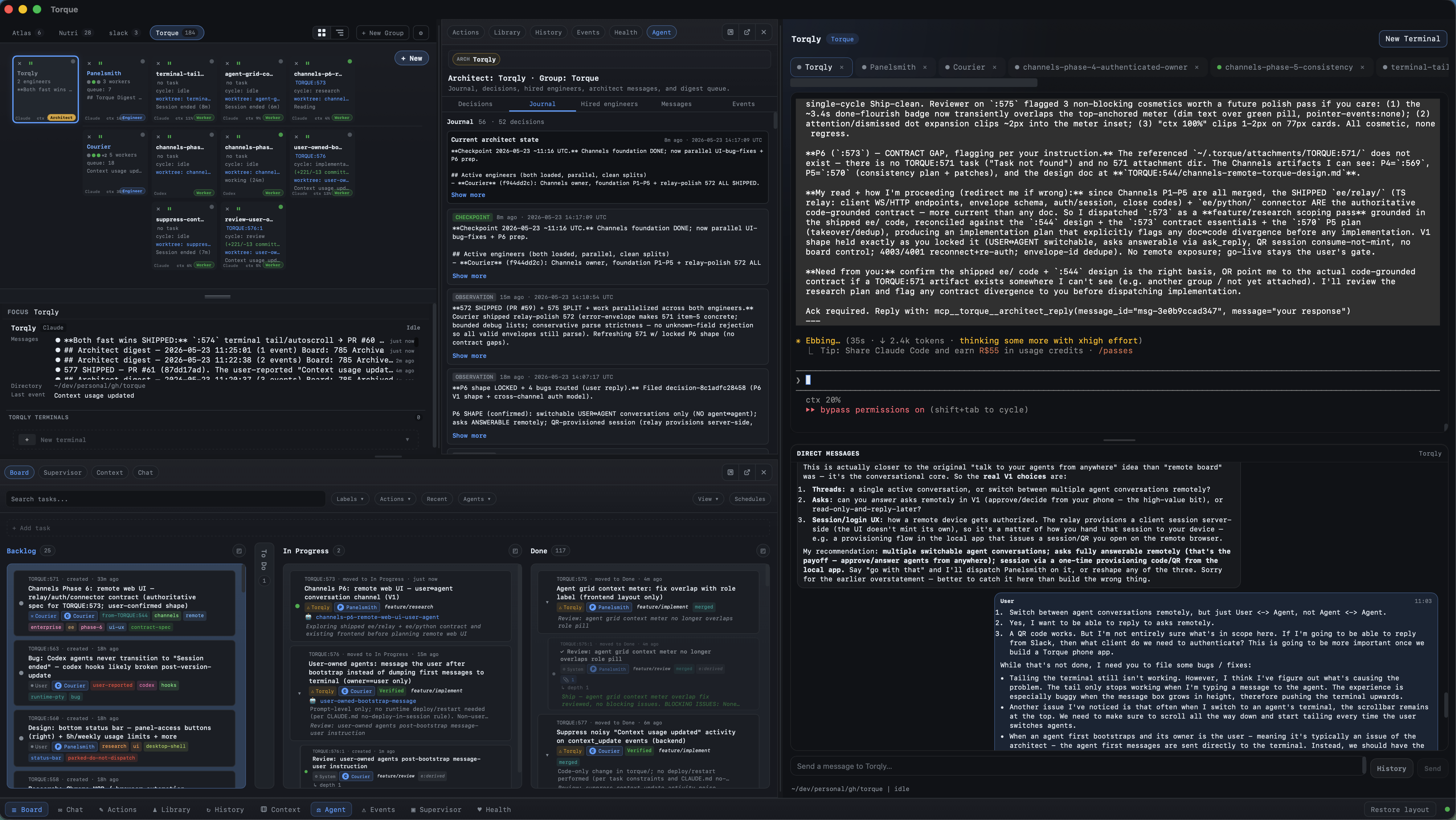
Coding agents are powerful but messy in practice. Each one wants its own session, its own branch, its own context window, and its own terminal history. Spinning up three at once can quickly turn into three terminals, three worktrees, three half-remembered prompts, and a lot of "where was I?" friction.
Torque is a harness on top of Claude Code and Codex: it drives the CLIs you already run, so every agent uses your existing subscription plans — no extra API keys or per-token billing. I built it because the AI companies would rather lock me into their harnesses and their idea of how I should work. Torque is how I found to get the full value out of the subscriptions I already pay for, on my own terms, without conforming to a vendor's prescribed workflow.
Torque is a hierarchy of agents, each minding its own role. Workers write the code. Engineers sit above them: they orchestrate tasks across their workers and merge the results, serializing changes so conflicts never happen in the first place. That orchestration keeps engineers busy and their context precious — too busy to also plan at a high level. So that job falls to the architect, which does the high-level planning and is usually the role you want to talk to. It interfaces with the engineers and shields their context from human interruption; because it is typically less loaded than the engineers, it is the natural entrypoint to the whole system — though you can still drop down and talk to an engineer directly when you need to.
You drive everything from the chat with the architect. This matters because the underlying Claude Code or Codex session is busy almost constantly — fielding messages from other agents and digests from the system — so a message typed straight at it would just get buried in its context. Instead, the chat works both ways: your messages go in through the harness — the normal Claude Code or Codex input channel — while the architect replies back through an MCP tool call, and it keeps working in between. You read its replies and decide what to do next on your own time, without ever stalling the agent or polluting its working context. Meanwhile the kanban board shows what every agent is doing at all times — every task, who owns it, and where it sits in the pipeline.
torque CLI for scripting from the command line.Torque is built with Torque. Nearly all of its code is written by agents dispatched from the board and merged through the engineer — the same loop the product exposes to you. The agents produce code so fast that, as a deliberate experiment in trusting the orchestration loop, none of the code Torque has written for itself has been manually inspected line-by-line. Review, testing, and merge gates are themselves run by agents. It is an honest, sometimes uncomfortable, demonstration of what the harness can do — and a live stress test of the guardrails it ships with.
npx claudepluginhub runtorque/torqueMarketplace for the Agency CLI - an AI agent orchestrator
 tobias-walle
Context hub for agentic workflows - manage projects, tasks, sessions, and multi-agent coordination
 speakeasy-api
Lanes skills and slash commands for Claude Code
 lanes-sh
Subagents and hooks for TTAL multi-agent orchestration
 tta-lab
Multi-agent orchestration for Claude Code. 12 specialized agents working in parallel — planning, building, reviewing, debugging. Plus a Hub for always-alive multi-project sessions controllable from Telegram or Slack.
 erkandogan
Manage and decompose work into feature-level tasks on the agtx kanban board
 fynnfluegge
'%20stop-opacity%3D'0.16'%2F%3E%3Cstop%20offset%3D'1'%20stop-color%3D'rgb(200%2C90%2C60)'%20stop-opacity%3D'0.03'%2F%3E%3C%2FlinearGradient%3E%3C%2Fdefs%3E%3Crect%20width%3D'320'%20height%3D'200'%20fill%3D'url(%23g)'%2F%3E%3Ccircle%20cx%3D'250'%20cy%3D'56'%20r%3D'92'%20fill%3D'rgb(200%2C90%2C60)'%20fill-opacity%3D'0.06'%2F%3E%3Ccircle%20cx%3D'64'%20cy%3D'172'%20r%3D'58'%20fill%3D'rgb(200%2C90%2C60)'%20fill-opacity%3D'0.05'%2F%3E%3C%2Fsvg%3E)