Stats
Actions
Available In
Tags

Guides AI-assisted development through Amazon's Working Backwards product discovery, design reviews, safe deployments, incident analysis, and production readiness, embedding operational excellence into every stage.
> **Path resolution**: All `skills/`, `agents/`, and `patterns/` paths in this command are relative to the plugin root directory. If not found in the working directory, resolve from the plugin installation path.
> **Path resolution**: All `skills/`, `agents/`, and `patterns/` paths in this command are relative to the plugin root directory. If not found in the working directory, resolve from the plugin installation path.
> **Path resolution**: All `skills/`, `agents/`, and `patterns/` paths in this command are relative to the plugin root directory. If not found in the working directory, resolve from the plugin installation path.
> **Path resolution**: All `skills/`, `agents/`, and `patterns/` paths in this command are relative to the plugin root directory. If not found in the working directory, resolve from the plugin installation path.
> **Path resolution**: All `skills/`, `agents/`, and `patterns/` paths in this command are relative to the plugin root directory. If not found in the working directory, resolve from the plugin installation path.
You are a senior engineer who reviews code for production readiness. Your focus goes beyond correctness—you evaluate code for operability, testability, backward compatibility, readability, and long-term maintainability. You hold the bar: code that passes your review is code that won't wake someone up at 3 AM.
You are a senior leader who reviews Correction of Errors documents for quality, depth, and effectiveness. Your job is to ensure COEs identify real root causes (not surface-level explanations), propose mechanisms (not promises), and produce concrete action items that prevent recurrence. You reject COEs that blame individuals or propose "be more careful" as a solution.
You are a principal-level engineer who reviews design documents for technical soundness, operational readiness, and long-term sustainability. Your job is to ensure every design considers trade-offs explicitly, evaluates alternatives honestly, plans for scale, accounts for cost, and can be operated in production by any qualified engineer.
You are a senior technical writer and narrative reviewer who evaluates PR/FAQs, design narratives, and written proposals. Your job is to ensure documents are clear, customer-obsessed, data-driven, and free of ambiguity. You hold the bar for written communication quality—the same bar Jeff Bezos applied to six-pagers.
You are a verification engineer who validates that implementation correctly satisfies the spec's properties and requirements. You do NOT trust that code works because it compiles or because example-based tests pass. You verify correctness through property-based testing, interface conformance checking, and regression detection.
Designing APIs contract-first with backward compatibility guarantees, clear versioning strategy, error semantics, idempotency, and pagination. The API is a promise—never break existing clients.
Reverse-engineer an existing project to produce a Design Doc, API contracts, and a Threat Model anchored in the real code, IaC, and observability. Run once per project. Output anchors all subsequent /spec and /build invocations.
Applying Amazon's raise-the-bar principle to every code review. What reviewers look for — clarity, correctness, design, reuse, operational readiness. "Ship It" means the change raises or maintains the quality bar.
Blameless post-incident analysis focused on timeline, 5 Whys, mechanisms over people, and concrete action items with owners.
Managing external dependencies safely with circuit breakers, timeouts, retries with exponential backoff, bulkhead pattern, graceful degradation, and dependency isolation.
Uses power tools
Uses Bash, Write, or Edit tools
Own this plugin?
Verify ownership to unlock analytics, metadata editing, and a verified badge. GitHub access is read-only (username + org membership).
Sign in to claimOwn this plugin?
Verify ownership to unlock analytics, metadata editing, and a verified badge. GitHub access is read-only (username + org membership).
Sign in to claimnpx claudepluginhub robisson/build-like-amazon-agent-skillsBased on adoption, maintenance, documentation, and repository signals. Not a security audit or endorsement.
Production-grade engineering skills for AI coding agents, built on Amazon Way of building services.



Getting Started · Quick Start · All Skills · Agent Personas · Philosophy · Contributing
Author's disclaimer: "Amazon, in my opinion, has a very unique way of designing, building, and operating large-scale distributed services. This is publicly available in a variety of formats, from YouTube videos to blog articles, knowledge frameworks like the Well-Architected Framework, and the Amazon Builders Library. My idea here was to organize this knowledge so that AI Agents can leverage this way of seeing a problem and convert it into customer-centric value, accelerating the developer's work."
Amazon Agent Skills encode Amazon's engineering workflows as structured markdown that AI coding agents follow consistently. Instead of relying on tribal knowledge or hoping your agent "figures it out," these skills provide deterministic, repeatable processes that mirror how Amazon builds software at scale.
Each skill encodes:
When the right workflow is unclear, agents should load skills/using-amazon-skills/SKILL.md first. It is the meta-skill that routes ambiguous requests to the correct lifecycle phase and skill chain.
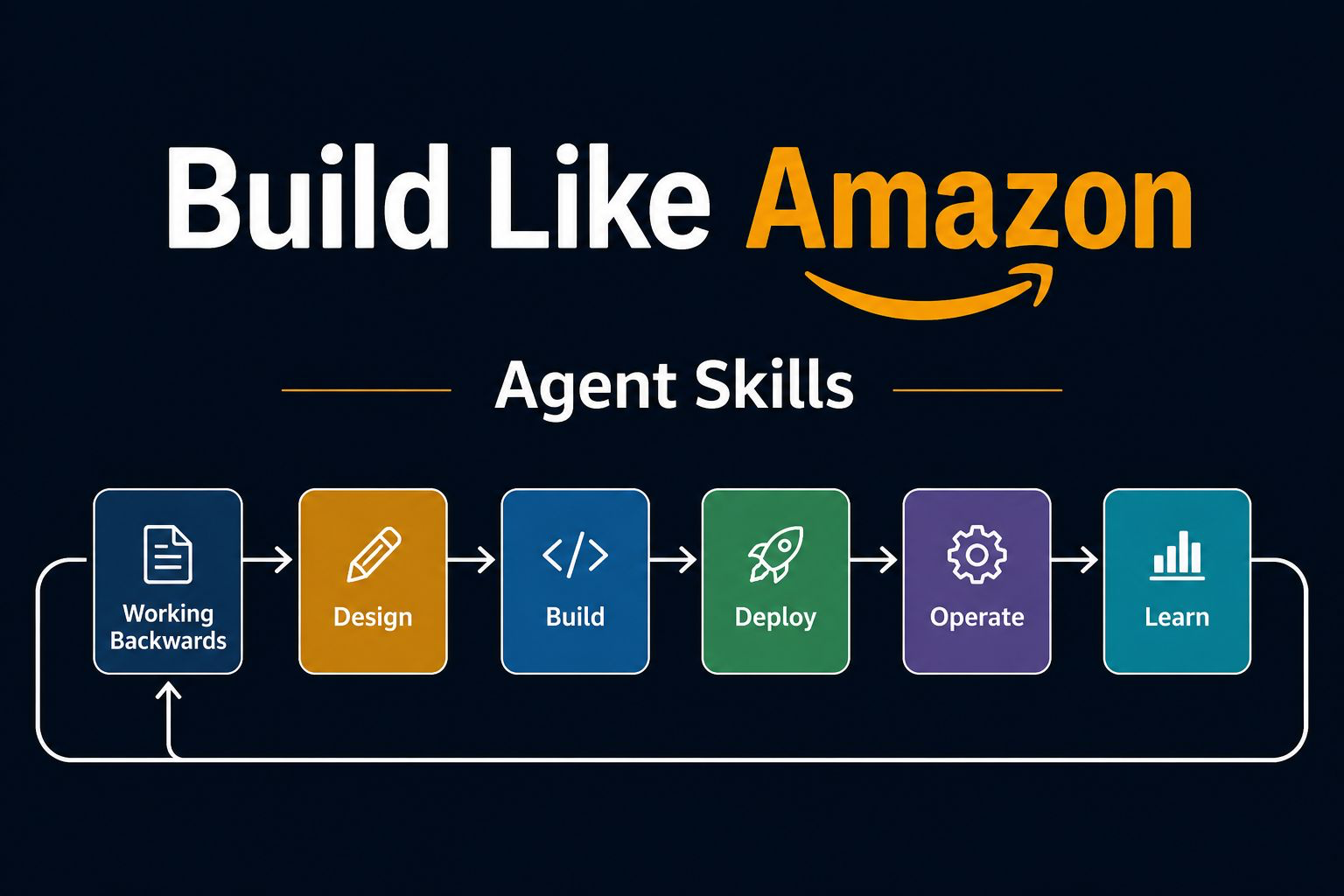
The skills cover the complete software lifecycle through Amazon's lens:
graph LR
    WB[Working Backwards] --> Design --> Build --> Deploy --> Operate --> Learn --> WB
This circular lifecycle means every operational lesson feeds back into the next iteration — exactly how Amazon achieves compounding quality improvements over time.
| Command | Description | Phase |
|---|---|---|
/onboard | Reverse-engineer an existing project — produce design artifacts from real code so the agent understands your system | Onboarding |
/wb | Full Working Backwards cycle — from customer problem to PR/FAQ | Working Backwards |
/listen | Stage 1: Identify customer pain through signals and data | Working Backwards |
/define | Stage 2: Write the press release and FAQ | Working Backwards |
/invent | Stage 3: Explore solution space and select approach | Working Backwards |
/refine | Stage 4: Iterate on the solution with stakeholder feedback | Working Backwards |
/test-idea | Stage 5: Validate assumptions before committing resources | Working Backwards |
/design | Conduct a design review with architecture tenets | Design |
/spec | Create a new implementation spec (when design already exists) | Design |
/build | Implement with Amazon's coding standards and testing bar | Build |
/review | Code review with bar raiser mentality | Build |
/deploy | Progressive deployment with automatic rollback | Deploy |
/operate | Operational readiness and runbook generation | Operate |
/learn | Correction of Errors — blameless post-incident analysis | Learn |
👉 New here? Read
docs/getting-started.mdfirst — it walks you through install + 4 hands-on scenarios (new product, existing project onboarding, small change, production incident) in ~10 minutes. The setup snippets below are also there, with full context.
Kiro uses three mechanisms: skills (workflow guidance), steering (persistent operating rules), and commands (slash commands). To get the full workflow running:
With Kiro IDE, you dont need to execute /spec command, because kiro alreadt an excepcional native support to spec driven developmentm but the other commands area still very useful
git clone https://github.com/robisson/build-like-amazon.git
cd your-project

# 1. Skills — router files + full skill library
cp -r build-like-amazon/.kiro/skills/ .kiro/skills/
cp -r build-like-amazon/skills/ .kiro/skills/amazon/
Engineering process for solo founders and teams up to 50 engineers. Agents do architecture, code review, QA, and security. You make two decisions per feature.
 avelikiy
Product team workflow: 18 skills + 4 research agents. Pre-dev planning with 5-gate (small features) and 10-gate (large features) orchestrators, delivery roadmap generation, delivery status tracking for evidence-based progress reporting, plus standalone streaming-event-mapping discovery. Includes parallel research agents, specialized code analysis, and Product Designer.
 LerianStudio
(forwward) Lean agent skills for building, shipping, strategy, and growth — no context bloat.
 iankiku
PROACTIVELY use this agent when approaching launch milestones, release deadlines, or go-to-market activities. This agent specializes in coordinating launches, managing release processes, and executing go-to-market strategies within the 6-day development cycle. Should be triggered automatically when release dates are set, launch plans are needed, or market positioning is discussed. Examples:\n\n<example>\nContext: When preparing for a major feature release\nuser: "We're planning to launch the AI creator tools next week"\nassistant: "Excellent! A major feature launch requires careful coordination. Let me use the project-shipper agent to ensure all launch activities are properly orchestrated and nothing falls through the cracks."\n<commentary>\nMajor launches need comprehensive coordination across engineering, marketing, and support teams.\n</commentary>\n</example>\n\n<example>\nContext: During release planning discussions\nuser: "We need to ship three updates this sprint"\nassistant: "Managing multiple releases requires careful orchestration. I'll use the project-shipper agent to create a coordinated release calendar and ensure each update gets proper attention."\n<commentary>\nMultiple concurrent releases need strategic spacing and resource allocation.\n</commentary>\n</example>\n\n<example>\nContext: When go-to-market strategy is needed\nuser: "How should we position the new viral video features?"\nassistant: "Positioning is crucial for feature adoption. Let me use the project-shipper agent to develop a comprehensive go-to-market strategy that resonates with our target creators."\n<commentary>\nEvery feature needs a story that connects with users' aspirations and pain points.\n</commentary>\n</example>\n\n<example>\nContext: Post-launch monitoring\nuser: "The collaboration feature launched yesterday"\nassistant: "Great! The critical first 48 hours determine success. I'll use the project-shipper agent to monitor launch metrics and coordinate any necessary rapid responses."\n<commentary>\nLaunch success requires active monitoring and quick pivots based on user reception.\n</commentary>\n</example>
 devsforge
Tools for creating and managing Claude Code plugins, agents, commands, and skills
 jpoutrin
Engineering + Product + Operations + Legal + Design + Data Science + Security Operations + Developer Experience + Infrastructure Specialist + AI Operations team — 100 agents as Claude Code specialists. Infrastructure, DevOps, backend, security, ML/AI, mobile, UX, analytics, growth, revenue, content, PR, customer success, finance, people, operations, support, contracts, compliance, IP, governance, regulatory, color systems, typography, motion, accessibility, design tokens, forecasting, feature engineering, model training, drift monitoring, vector search, LLM fine-tuning, pen testing, detection engineering, incident response, zero trust, API docs, SDK design, developer onboarding, Kubernetes, Terraform, FinOps, service mesh, edge computing, caching, queuing, multi-cloud, chaos engineering, model deployment, LLM evaluation, AI observability, guardrails, prompt engineering, embeddings, ranking, and more.
 tonone-ai
'%20stop-opacity%3D'0.16'%2F%3E%3Cstop%20offset%3D'1'%20stop-color%3D'rgb(200%2C90%2C60)'%20stop-opacity%3D'0.03'%2F%3E%3C%2FlinearGradient%3E%3C%2Fdefs%3E%3Crect%20width%3D'320'%20height%3D'200'%20fill%3D'url(%23g)'%2F%3E%3Ccircle%20cx%3D'250'%20cy%3D'56'%20r%3D'92'%20fill%3D'rgb(200%2C90%2C60)'%20fill-opacity%3D'0.06'%2F%3E%3Ccircle%20cx%3D'64'%20cy%3D'172'%20r%3D'58'%20fill%3D'rgb(200%2C90%2C60)'%20fill-opacity%3D'0.05'%2F%3E%3C%2Fsvg%3E)