Stats
Actions
Available In
Tags

Get deep codebase intelligence for Claude: understand architecture, ownership, risk hotspots, and why code is built the way it is. Analyze code health scores, detect dead code, review diffs with risk scoring, and manage architectural decision records.
Report unreachable files, unused exports, and zombie packages, tiered by confidence.
Work with architectural decisions — list, inspect health, add, or confirm auto-proposed decisions.
Diagnose the Repowise setup — install, API keys, index/store drift — and optionally repair it.
Show Repowise code-health — KPIs, lowest-scoring files, refactoring targets, trends, or per-file markers.
Set up Repowise for this codebase. Installs if needed, asks about your preferences, and runs the indexing.
Use when reviewing a set of changes before they merge — a PR, a branch diff, or the working-tree changes you just made — in a Repowise-indexed codebase (.repowise/ directory exists). Activates for "review this PR", "is this safe to merge", "what's the blast radius of these changes", "did I miss anything", or "what else should change with this".
Use when the user asks about code health, code quality, complexity, technical debt, which files are risky or hard to maintain, what to refactor next, untested hotspots, or coverage gaps in a Repowise-indexed codebase (.repowise/ directory exists). Also use to get a before/after health read when planning or finishing a refactor.
Use when encountering questions about WHY code is built a certain way, when about to make architectural changes (new patterns, restructuring, choosing between approaches), or when the user asks about design rationale in a Repowise-indexed codebase (.repowise/ directory exists). Also activates when commit messages or code comments contain decision signals like "WHY:", "DECISION:", "TRADEOFF:", "ADR:".
Use when exploring, understanding, or answering questions about a codebase that has Repowise indexed (a .repowise/ directory in the project root). Activates for "how does X work", "explain the architecture", "where is Y implemented", "what does this module do", or any task that needs an understanding of structure before diving into source files.
Use when the user asks about cleanup, removing unused code, refactoring, reducing bundle size, or identifying dead code in a Repowise-indexed codebase (.repowise/ directory exists). Also activates when discussing technical debt, code hygiene, or repository maintenance.
Executes bash commands
Hook triggers when Bash tool is used
Modifies files
Hook triggers on file write and edit operations
Own this plugin?
Verify ownership to unlock analytics, metadata editing, and a verified badge. GitHub access is read-only (username + org membership).
Sign in to claimOwn this plugin?
Verify ownership to unlock analytics, metadata editing, and a verified badge. GitHub access is read-only (username + org membership).
Sign in to claimBased on adoption, maintenance, documentation, and repository signals. Not a security audit or endorsement.
Five intelligence layers · Ten MCP tools · 15 languages · Multi-repo workspaces · One pip install







Hosted for teams → · Docs · Discord · Contact
Layers · Learns from you · Code Health · Refactoring · Benchmarks · Languages · Quickstart · MCP tools · Comparison · Hosted
measure, locate, and fix what your AI ships
code health that predicts real bugs · ROC AUC 0.74 across 21 repos · 2.3× CodeScene's defects under a fixed review budget
graph-aware refactoring plans your agent can execute · up to −96% context tokens · −70% agent tool calls at answer-quality parity
Measured, reproducible, on public codebases. See the benchmarks ↓
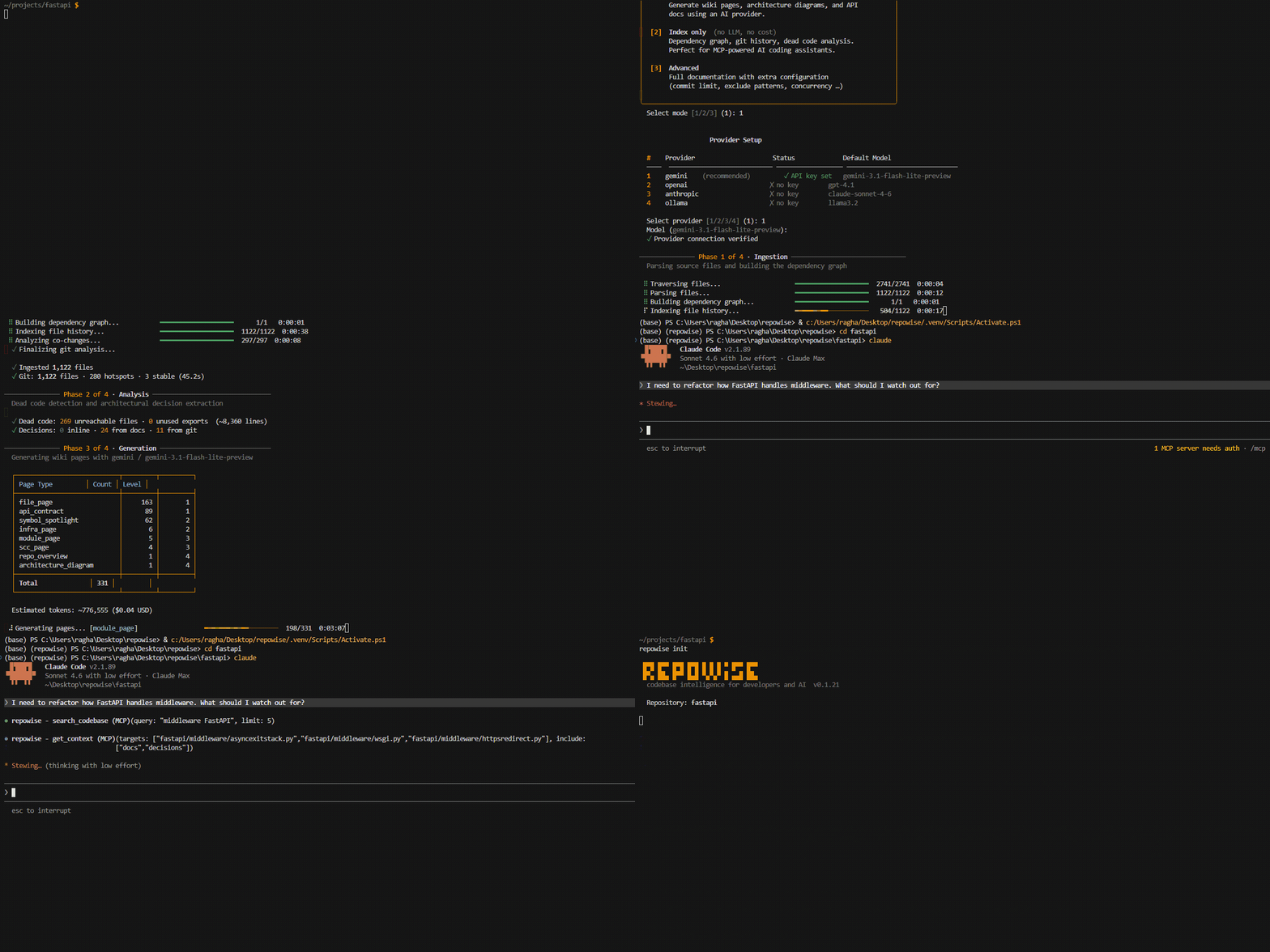
AI now writes a large and growing share of the code, and the humans accountable for it have to trust what ships. A score that says "this file is risky" isn't enough: you need to know where the risk concentrates and how to fix it.
repowise closes that loop. It indexes your codebase once and scores every file for defect risk, maintainability, and performance from 25 deterministic markers, calibrated against a real defect corpus, no LLM, in under 30 seconds (the proof ↓). The same index then locates the risk through a real dependency graph and git history, and generates the fix: concrete, graph-aware refactoring plans (split this god class, move this method, break this dependency cycle, dedup this clone) that your coding agent can execute.
And because it is all one index, your agent gets the rest for free: five
intelligence layers: dependency graph, git history, auto-generated docs,
architectural decisions, and code health, exposed to Claude Code, Codex, and any
MCP-compatible agent through ten task-shaped tools. Your agent answers "why
does auth work this way?" instead of "here is what auth.ts contains", with
fewer tool calls, fewer file reads, and lower cost per query, at comparable
answer quality (benchmarks ↓). One index: context your agent can
use, signals your team can trust, and the fix it can apply.
npx claudepluginhub repowise-dev/repowise --plugin repowiseCodebase vital signs — hotspot detection, ROI-ranked diagnosis, co-change coupling, knowledge risk, and AI provenance tracking
 chopratejas
Local codebase intelligence + change-safety gates for coding agents. Pre-indexes your repo's symbols, call graph, deps, and git history into SQLite (28 languages, 100% local, zero API keys), then exposes a lean 16-tool MCP core preset: graph-precise search, callers/impact blast radius, coupling, dead code, taint reachability, and pre-merge verify/critique gates that catch regressions, broken references, AI-slop duplication, and convention drift before they ship.
 Cranot
Codebase exploration, refactoring, and quality analysis
 Uniswap
Codebase intelligence for AI agents. The /devlens skill teaches your agent to query a precomputed code graph (nodes, typed edges, technical/business/security summaries) via the DevLens CLI instead of grepping and reading whole files — with subcommands for architecture, diagrams, security analysis, impact, summaries, and more.
 devlensio
Live codebase visualization and structural quality gate — 14 health dimensions graded A-F, dependency analysis, and architecture governance via MCP
 sentrux
Data-driven code generation strategies powered by TeaRAGs git signals
 artk0de
'%20stop-opacity%3D'0.16'%2F%3E%3Cstop%20offset%3D'1'%20stop-color%3D'rgb(200%2C90%2C60)'%20stop-opacity%3D'0.03'%2F%3E%3C%2FlinearGradient%3E%3C%2Fdefs%3E%3Crect%20width%3D'320'%20height%3D'200'%20fill%3D'url(%23g)'%2F%3E%3Ccircle%20cx%3D'250'%20cy%3D'56'%20r%3D'92'%20fill%3D'rgb(200%2C90%2C60)'%20fill-opacity%3D'0.06'%2F%3E%3Ccircle%20cx%3D'64'%20cy%3D'172'%20r%3D'58'%20fill%3D'rgb(200%2C90%2C60)'%20fill-opacity%3D'0.05'%2F%3E%3C%2Fsvg%3E)