Stats
Actions
Available In
Tags

Navigate TypeScript/JavaScript codebases via a PageRank-ranked import graph with compiler-accurate call graph, BM25 lexical search, and Mermaid/DOT export, while a pre-tool-use hook nudges you to use grep for faster structural queries.
Executes bash commands
Hook triggers when Bash tool is used
npx claudepluginhub raymondchins/agentmap --plugin agentmapBased on adoption, maintenance, documentation, and repository signals. Not a security audit or endorsement.
Code graph navigation and semantic search for LLM coding agents
 jrollin
Type-aware TypeScript navigation — 14 MCP tools for go-to-definition, find-references, dependency graphs, cycle detection, and impact analysis
 guyowen
Graph-first code intelligence for AI agents. SurrealDB knowledge graph + 52 MCP tools replace Read/Grep/Glob with deterministic graph traversal. 80–95% fewer tokens on code context. Rust-native, fully local.
 onur-gokyildiz-bhi
Codebase intelligence for AI agents. The /devlens skill teaches your agent to query a precomputed code graph (nodes, typed edges, technical/business/security summaries) via the DevLens CLI instead of grepping and reading whole files — with subcommands for architecture, diagrams, security analysis, impact, summaries, and more.
 devlensio
Structural codebase indexing for efficient navigation. Reduces token consumption by 60-80% through targeted line-range reads instead of full file scans.
 AZidan
Lumin Repo Lens: evidence-backed TS/JS repo structure lens for Claude Code.
 annyeong844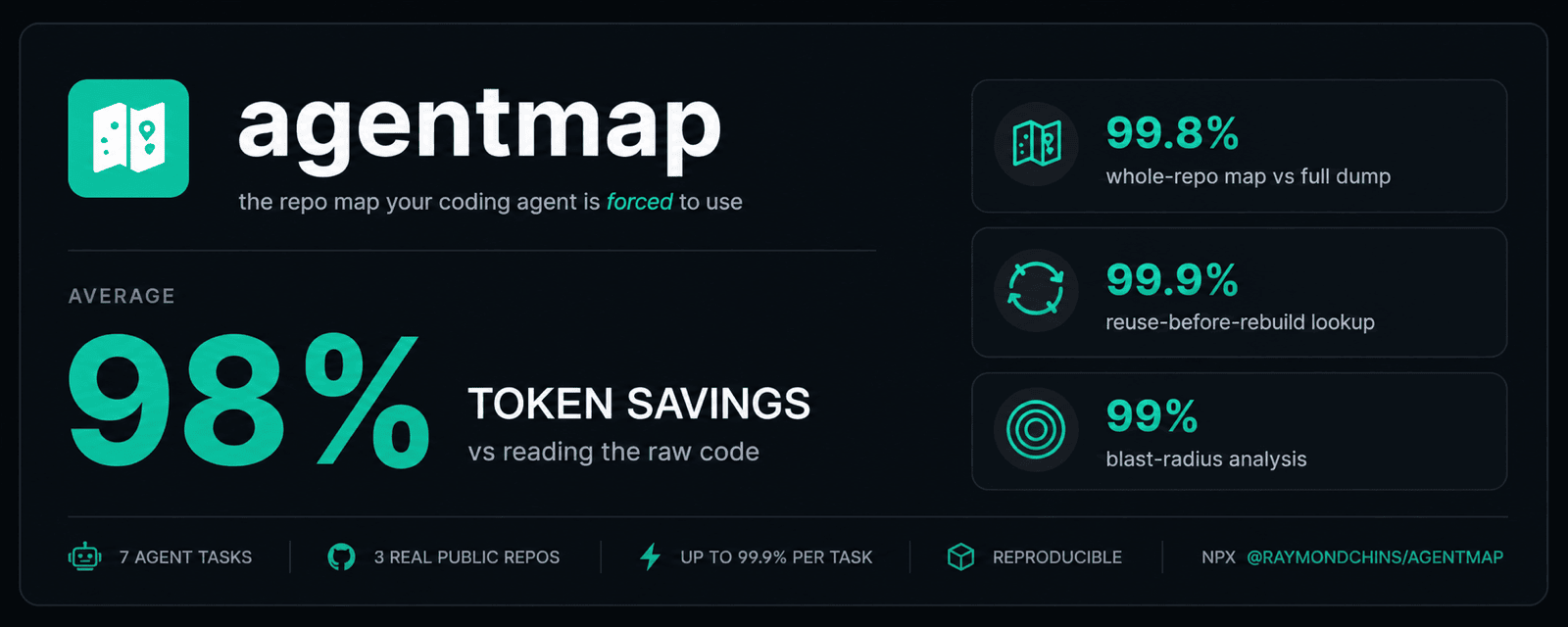


'%20stop-opacity%3D'0.16'%2F%3E%3Cstop%20offset%3D'1'%20stop-color%3D'rgb(200%2C90%2C60)'%20stop-opacity%3D'0.03'%2F%3E%3C%2FlinearGradient%3E%3C%2Fdefs%3E%3Crect%20width%3D'320'%20height%3D'200'%20fill%3D'url(%23g)'%2F%3E%3Ccircle%20cx%3D'250'%20cy%3D'56'%20r%3D'92'%20fill%3D'rgb(200%2C90%2C60)'%20fill-opacity%3D'0.06'%2F%3E%3Ccircle%20cx%3D'64'%20cy%3D'172'%20r%3D'58'%20fill%3D'rgb(200%2C90%2C60)'%20fill-opacity%3D'0.05'%2F%3E%3C%2Fsvg%3E)