Stats
Actions
Available In
Tags

A divide-and-conquer wiki of system-design skills. Reason about a design problem one part at a time -- requirements, capacity, APIs, storage, caching, load balancing, messaging, consistency, resilience, delivery, and scaling -- each with generic recipes, cloud-provider variants (AWS/Azure/GCP/Temporal), explicit trade-offs, and failure-mode analysis. Optimizes for reasoning over memorized architectures.
Uses power tools
Uses Bash, Write, or Edit tools
Own this plugin?
Verify ownership to unlock analytics, metadata editing, and a verified badge. GitHub access is read-only (username + org membership).
Sign in to claimOwn this plugin?
Verify ownership to unlock analytics, metadata editing, and a verified badge. GitHub access is read-only (username + org membership).
Sign in to claimBased on adoption, maintenance, documentation, and repository signals. Not a security audit or endorsement.
This skill should be used when the user needs to "design the API", do "endpoint design", pin down a "request/response shape", choose a "pagination" strategy (cursor vs offset), add an "idempotency key" to a write, plan "API versioning", an "error contract", or pick between "REST vs gRPC vs GraphQL" or "WebSocket vs polling". Use it whenever a design has reached the interface — the concrete request, response, primary access path, and how clients page, retry, and version — even if the user only said "the boxes talk to each other".
This skill should be used when a system design needs a diagram — "draw the architecture", "diagram this system", "show the components", "make an architecture/infrastructure/topology diagram", or visualizing boxes-and-arrows, data flow, regions, or failure paths for a design. It generates a self-contained dark-theme HTML + SVG diagram (with PNG/PDF export). Use it whenever the `system-design` orchestrator or a building block reaches the "draw it" step, even if the user doesn't say "diagram".
This skill should be used when the user needs to "estimate QPS", "back-of-the-envelope" (BOTEC) numbers, "how much storage / bandwidth", "how many servers", "peak load", "capacity planning", or wants the standard latency / throughput / availability numbers to ground a design (latency table, QPS rates, powers of two, nines). Use it whenever a design decision hinges on scale — convert any "high traffic" / "huge data" phrase into concrete numbers before choosing components, even if the user doesn't say "estimate".
This skill should be used when the user wants a "blob store" or "object storage", names "S3" or an S3-compatible store, needs to "store images / video / files", asks about "multipart upload" or "resumable upload", "signed / presigned URLs", "media storage", "unstructured data at scale", object "versioning", storage "tiering" (hot/cold/archive), or "erasure coding" vs replication for durability. Use it whenever a design must hold large unstructured objects (photos, video, backups, logs, ML datasets) and serve them cheaply and durably, even if the user just says "where do we put the files".
This skill should be used when the user asks about a "caching strategy", "cache invalidation", "what to cache", "read-through vs write-through vs write-back", "cache eviction" (LRU/LFU/TTL), "Redis vs Memcached", "stale reads", or hits "thundering herd", "cache stampede", "cache penetration", or "hot key" problems. Use it whenever a design is read-heavy or a datastore is overloaded by reads, even if the user doesn't say "cache".
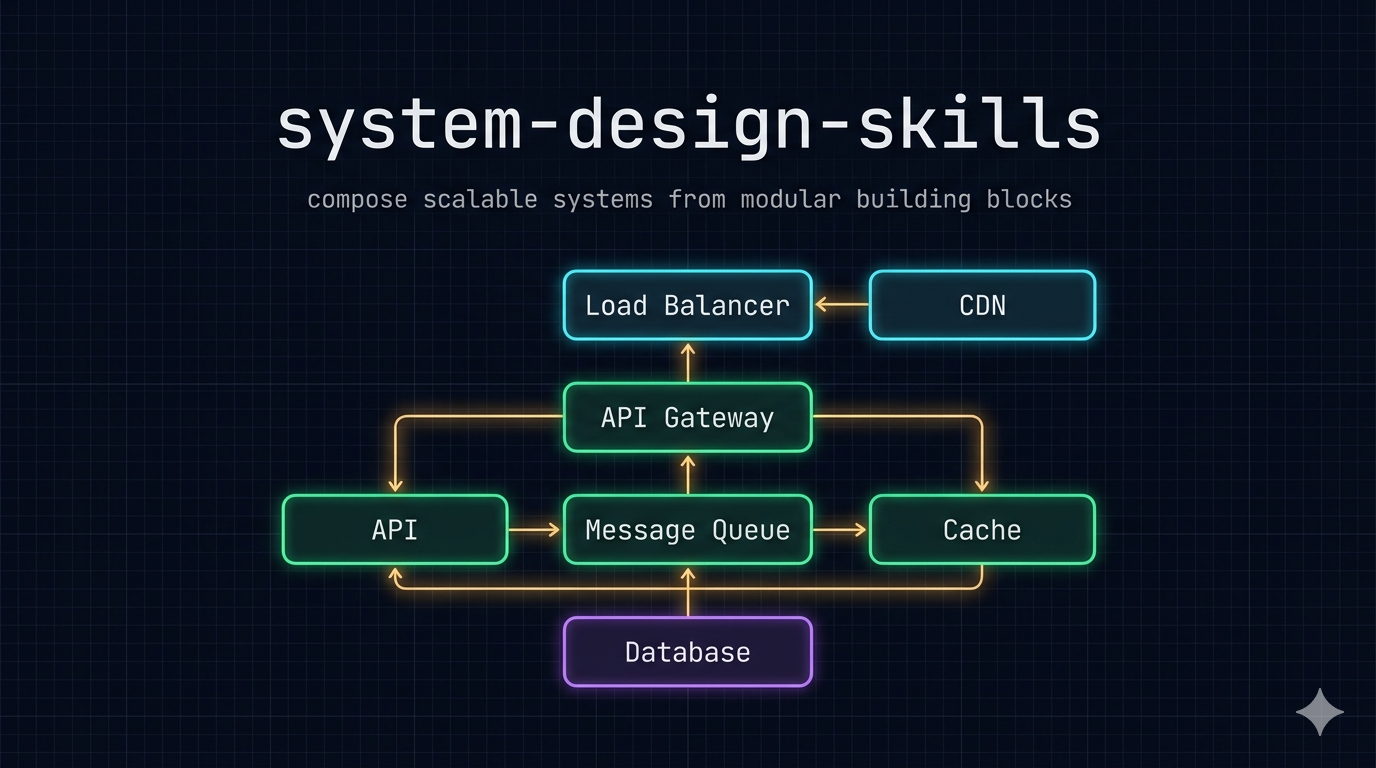




Design scalable systems the way strong engineers actually do — by reasoning, not by memorizing diagrams. A divide-and-conquer wiki of composable building-block skills for Claude Code: clarify requirements, size with numbers, compose the right components, justify every trade-off, and stress-test for failure — then score and persist the design. Works in Claude Code, and any agent that can run skills.
flowchart TB
    U["🧑 "design X" · system-design interview"]
    U --> ENTRY["/design command  ·  system-design-orchestrator agent"]
    ENTRY --> LOOP

    subgraph LOOP["Reasoning loop — GUIDE-driven, iterative (reason, don't memorize)"]
      direction LR
      C["1· Clarify"] --> E["2· Estimate"] --> H["3· Design"] --> T["4· Trade-offs"] --> F["5· Failure modes"] --> I["6· Iterate"]
      I -.-> C
    end

    LOOP -->|"invoke the owning skill (Skill tool)"| BB

    subgraph BB["Building-block skills — bottom-up catalog · compose, justify every choice"]
      direction TB
      L0["L0 Frame  · requirements-scoping · back-of-the-envelope"]
      L1["L1 Edge   · dns · load-balancing · content-delivery"]
      L2["L2 Services · api-design · service-decomposition"]
      L3["L3 State  · data-storage · caching · blob-store · sequencer · sharded-counters · distributed-search"]
      L4["L4 Async  · messaging-streaming · task-scheduling"]
      L5["L5 Correctness · consistency-coordination"]
      L6["L6 Ops    · resilience-failure · observability · distributed-logging"]
      L7["L7 Growth · scaling-evolution"]
      L0 --- L1 --- L2 --- L3 --- L4 --- L5 --- L6 --- L7
    end

    BB -->|"each carries: options · trade-offs · stress · provider variants"| DIAG["architecture-diagram · self-contained HTML+SVG"]
    LOOP --> OUT["📄 Scored design doc → docs/design/  +  diagram"]
    DIAG --> OUT

    style U fill:#0b1220,stroke:#8aa8ff,color:#fff
    style ENTRY fill:#0b1220,stroke:#a78bfa,color:#fff
    style LOOP fill:#0b1220,stroke:#22d3ee,color:#fff
    style BB fill:#0b1220,stroke:#34d399,color:#fff
    style DIAG fill:#0b1220,stroke:#fbbf24,color:#fff
    style OUT fill:#0b1220,stroke:#4caf50,color:#fff
Most system-design material teaches you to memorize finished architectures. That is exactly the trap that makes strong engineers fail design discussions: the moment a constraint changes, a memorized diagram falls apart and there is no reasoning underneath to rebuild it. This plugin ships building blocks — one skill per part of a system, each a reusable recipe with explicit trade-offs, behavior under stress, the numbers that matter, and cloud-provider variants — that you compose to fit the problem in front of you.
Use npx skills to install the skills directly:
npx skills add proyecto26/system-design-skills
This installs into your .claude/skills/ directory.
# Add the marketplace
/plugin marketplace add proyecto26/system-design-skills

# Install the plugin (skills + the /design command + the orchestrator agent)
/plugin install system-design-skills
SSH errors? The marketplace clones via SSH. If you don't have SSH keys on GitHub, force HTTPS:
/plugin marketplace add https://github.com/proyecto26/system-design-skills.git
/plugin install system-design-skills
git clone https://github.com/proyecto26/system-design-skills.git
cp -r system-design-skills/skills/* .claude/skills/
git clone https://github.com/proyecto26/system-design-skills.git
claude --plugin-dir ./system-design-skills
Fork the repo, add your own building blocks or provider files (follow meta/SKILL-CONTRACT.md), and point your projects at your fork.
No configuration, API keys, or runtime dependencies — just describe what you want:
"/design a URL shortener that handles billions of reads and 10k writes/sec"
npx claudepluginhub proyecto26/system-design-skillsGenerate NotebookLM artifacts (slides, audio, video, mind maps, quizzes, flashcards, infographics, reports, data tables) from your notebooks. Use when the user wants to create any NotebookLM Studio output from their uploaded sources.
 proyecto26
Research & Implementation Supercharged with a curated list of AI skills for academic paper analysis, code generation, comic creation, visual schemas, and deep research.
proyecto26Professional presentation generator for HTML (with GSAP animations) and PPTX formats. Creates conference talks, pitch decks and tech presentations with curated style presets and validation.
proyecto26Autonomous experiment loop that edits code, runs benchmarks, measures metrics, and keeps improvements or reverts — repeating forever. Works for any optimization target: LLM training loss, test speed, bundle size, build time, Lighthouse scores, and more.
proyecto26Independent plan/spec reviewer. Reads a plan, verifies claims against the workspace, and returns a structured verdict (approve, approve_with_changes, request_major_revision) with confidence score and findings. Pluggable judges: Anthropic, OpenAI, Codex.
proyecto26System design interview preparation and architecture review — structured frameworks for distributed systems
 ryanthedev
Technical architecture skills for system design, API design, database design, event-driven systems, and migration planning.
 heaptracetechnology
Architecture patterns, system decomposition, distributed systems, and scalability design. Build resilient, scalable systems through proven architectural patterns.
 sethdford
Senior Architect persona with system design, ADR writing, scalability analysis, tech stack evaluation, migration planning, cost modeling, threat modeling, capacity planning, and cloud architecture (AWS, GCP, Azure) expertise.
 rnavarych
Thinking partner for design decisions and architecture brainstorming. Transforms Claude from a solution-provider into a senior engineer thinking partner.
 yungjurick
Infrastructure engineer — cloud services, networking, IaC, cost optimization
 tonone-ai
'%20stop-opacity%3D'0.16'%2F%3E%3Cstop%20offset%3D'1'%20stop-color%3D'rgb(200%2C90%2C60)'%20stop-opacity%3D'0.03'%2F%3E%3C%2FlinearGradient%3E%3C%2Fdefs%3E%3Crect%20width%3D'320'%20height%3D'200'%20fill%3D'url(%23g)'%2F%3E%3Ccircle%20cx%3D'250'%20cy%3D'56'%20r%3D'92'%20fill%3D'rgb(200%2C90%2C60)'%20fill-opacity%3D'0.06'%2F%3E%3Ccircle%20cx%3D'64'%20cy%3D'172'%20r%3D'58'%20fill%3D'rgb(200%2C90%2C60)'%20fill-opacity%3D'0.05'%2F%3E%3C%2Fsvg%3E)
