Stats
Actions
Available In
Tags
Audits and maintains a markdown-based second brain knowledge system, enforcing consistency, fixing broken links, detecting contradictions, and enabling knowledge search. Also provides a setup wizard for Obsidian wikis.
Process raw source documents into wiki pages. Use when the user adds files to raw/ and wants them ingested, says "process this source", "ingest this article", "I added something to raw/", or wants to incorporate new material into their knowledge base.
Health-check the wiki for contradictions, orphan pages, stale claims, and missing cross-references. Use when the user says "audit", "health check", "lint", "find problems", or wants to improve wiki quality.
Answer questions against the knowledge base wiki. Use when the user asks a question about their collected knowledge, wants to explore connections between topics, says "what do I know about X", or wants to search their wiki.
Set up a new Obsidian knowledge base with the LLM Wiki pattern. Use when the user wants to create a second brain, initialize a vault, set up a personal knowledge base, or says "onboard". Guides through an interactive wizard to configure vault name, location, domain, agent support, and tooling.
Own this plugin?
Verify ownership to unlock analytics, metadata editing, and a verified badge. GitHub access is read-only (username + org membership).
Sign in to claimOwn this plugin?
Verify ownership to unlock analytics, metadata editing, and a verified badge. GitHub access is read-only (username + org membership).
Sign in to claimBased on adoption, maintenance, documentation, and repository signals. Not a security audit or endorsement.
An LLM-maintained personal knowledge base built on the LLM Wiki pattern. Drop raw sources into a folder, let the LLM compile them into a structured wiki, and browse it all in Obsidian.
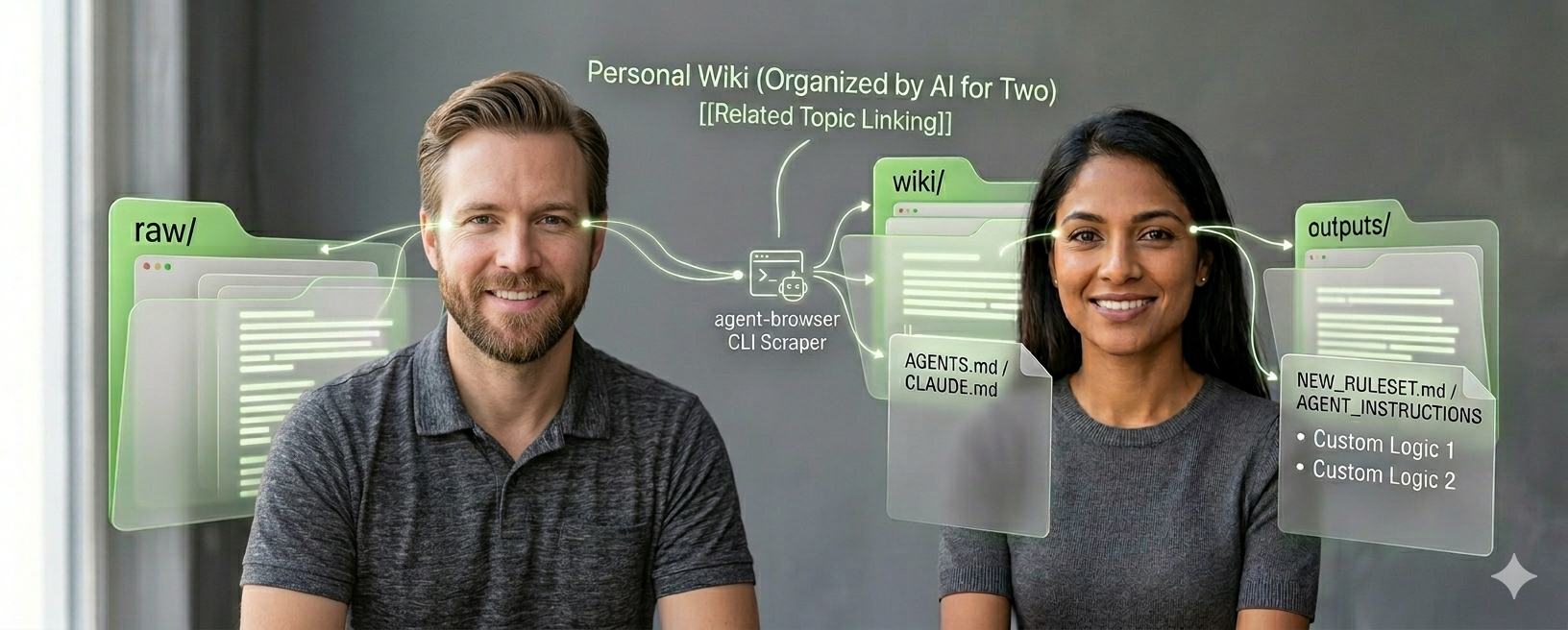
You feed raw material (articles, papers, notes, transcripts) into a raw/ folder. The LLM reads everything, writes structured wiki pages, creates cross-references, and maintains an index. You browse the results in Obsidian — following links, exploring the graph view, and asking questions.
The LLM is the librarian. You're the curator.
npx skills add NicholasSpisak/second-brain
This installs four skills into your AI agent (Claude Code, Codex, Cursor, Gemini CLI, and 40+ others):
| Skill | What it does |
|---|---|
/second-brain | Set up a new vault (guided wizard) |
/second-brain-ingest | Process raw sources into wiki pages |
/second-brain-query | Ask questions against your wiki |
/second-brain-lint | Health-check the wiki |
/second-brain in your AI agent — it walks you through naming, location, domain, and toolingraw/ folderraw/, then run /second-brain-ingest — the LLM will discuss key takeaways and build wiki pages[[wikilinks]], explore the graph view, check wiki/index.md/second-brain-query to ask questions, /second-brain-lint to health-checkyour-vault/
├── raw/ # Your inbox — drop sources here
│ └── assets/ # Images and attachments
├── wiki/ # LLM-maintained wiki
│ ├── sources/ # One summary per ingested source
│ ├── entities/ # People, orgs, products, tools
│ ├── concepts/ # Ideas, frameworks, theories
│ ├── synthesis/ # Comparisons, analyses, themes
│ ├── index.md # Master catalog of all pages
│ └── log.md # Chronological operation record
├── output/ # Reports and generated artifacts
└── CLAUDE.md # Agent config (varies by agent)
The wizard offers to install these. All optional but recommended:
The wizard failed or I need to re-run setup.
Run /second-brain again — the onboarding script is idempotent. It won't overwrite existing files, so your data is safe. If you need a fresh start, delete the vault folder and re-run.
I accidentally modified a file in raw/.
That's OK. The wiki was built from the original content. If you need the original back, check your git history (if the vault is a git repo) or re-clip the source. The wiki pages are unaffected.
wiki/index.md is out of sync with actual pages.
Run /second-brain-lint — it checks index consistency and offers to fix mismatches.
Wikilinks are broken after renaming a page.
Run /second-brain-lint — it scans for broken [[wikilinks]] and reports which files need updating.
The wiki is getting large and queries are slow.
Install qmd (npm i -g @tobilu/qmd). The query skill uses it automatically when available. It provides fast hybrid search across your wiki files.
Can I use this with multiple AI agents? Yes. The wizard generates config files for each agent you select. They all follow the same wiki schema, so multiple agents can work on the same vault.
How do I handle images in clipped articles?
In Obsidian, set Settings → Files and links → Attachment folder path to raw/assets/. After clipping an article, use "Download attachments for current file" to save images locally.
npx claudepluginhub nicholasspisak/second-brainKarpathy-style local-first LLM Wiki / Knowledge Compiler for Claude Code. Ingest sources, build a structured markdown knowledge base, and maintain it with AI-powered workflows.
 bradduy
Persistent, compounding knowledge base maintained by LLMs in Obsidian — agent-first edition. Four task-oriented agents (Researcher / Advisor / Curator / Scribe) with citations, confidence, supersession, and rolling session cache. Inspired by Karpathy's LLM Wiki pattern.
 ignromanov
Build and maintain LLM-powered knowledge bases as Obsidian wikis with compile, query, lint, and evolve workflows
 rvk7895
Personal LLM-managed wiki: ingest sources, cross-reference pages, query with citations, and lint your markdown knowledge base
 sametbrr
LLM-powered personal wiki — autonomous knowledge base with research-on-miss, ingestion, search, a browsable web UI, and universal data gravity. Saves and retrieves knowledge automatically whenever relevant.
 Oshayr
Claude + Obsidian knowledge companion. Sets up a persistent, compounding wiki vault (Karpathy's LLM Wiki pattern). v1.7 "Compound Vault" + v1.8 methodology modes close 5 of 5 priority gaps from the May 2026 compass artifact. Ships: substrate alignment with kepano/obsidian-skills, default Obsidian CLI transport, hybrid retrieval (contextual prefix + BM25 + cosine rerank per Anthropic's Sept 2024 research), per-file advisory locking for multi-writer safety, pre-commit verifier agent, AND methodology modes (LYT / PARA / Zettelkasten / Generic) for first-class organizational support no other Claude+Obsidian competitor offers. v1.7.x audit closure: every BLOCKER + HIGH + MEDIUM + LOW finding from the v1.7.0 audit is CLOSED or DEFERRED-with-rationale. Optional DragonScale Memory extension (log folds, deterministic addresses, semantic tiling lint, boundary-first autoresearch).
 AgriciDaniel
'%20stop-opacity%3D'0.16'%2F%3E%3Cstop%20offset%3D'1'%20stop-color%3D'rgb(200%2C90%2C60)'%20stop-opacity%3D'0.03'%2F%3E%3C%2FlinearGradient%3E%3C%2Fdefs%3E%3Crect%20width%3D'320'%20height%3D'200'%20fill%3D'url(%23g)'%2F%3E%3Ccircle%20cx%3D'250'%20cy%3D'56'%20r%3D'92'%20fill%3D'rgb(200%2C90%2C60)'%20fill-opacity%3D'0.06'%2F%3E%3Ccircle%20cx%3D'64'%20cy%3D'172'%20r%3D'58'%20fill%3D'rgb(200%2C90%2C60)'%20fill-opacity%3D'0.05'%2F%3E%3C%2Fsvg%3E)