Stats
Actions
Available In
Tags

Manage cookie consent compliance end-to-end: configure consent banners, audit cookies, integrate TCF v2.2 and GPC, implement server-side tracking, and set up automated validation for GDPR, CNIL, CCPA, and other privacy regulations.
Managing consent for analytics cookies and implementing privacy-preserving measurement. Covers GA4 privacy configuration, consent mode fallback behavior, aggregate reporting alternatives, and cookieless measurement approaches.
Designing and implementing CNIL-compliant cookie consent banners for French and EU audiences. References the EUR 100M Google LLC fine and EUR 150M Meta Platforms fine for non-compliant cookie practices. Covers equal prominence, reject-all buttons, cookie walls prohibition, and 6-month reconsent cycles.
Comprehensive methodology for auditing website cookies and tracking technologies. Covers automated scanning, cookie categorization, lifecycle documentation, and compliance gap analysis referencing the Planet49 CJEU ruling (C-673/17).
Automated cookie consent validation using Selenium and Playwright. Covers banner interaction testing, consent state verification, tag firing audit after consent choices, regression testing for cookie compliance, and CI/CD pipeline integration.
Auditing cookie lifetimes against regulatory recommendations and browser policies. Covers CNIL 13-month maximum recommendation, session vs persistent classification, third-party cookie phase-out impact, and Safari ITP duration caps.
Based on adoption, maintenance, documentation, and repository signals. Not a security audit or endorsement.
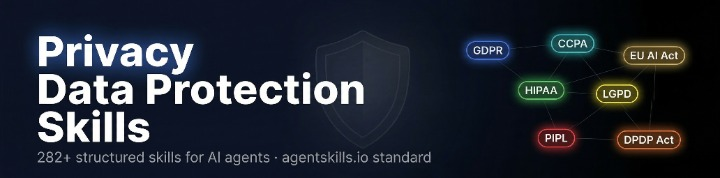
The first structured, machine-readable privacy skills database for AI agents. 282+ open-source privacy compliance procedures covering GDPR, CCPA, EU AI Act, HIPAA, LGPD, PIPL, and India's DPDP Act — following the agentskills.io open standard. Works with Claude Code, GitHub Copilot, OpenAI Codex CLI, Cursor, Gemini CLI, and 26+ AI platforms.






git clone https://github.com/mukul975/Privacy-Data-Protection-Skills.git
cd Privacy-Data-Protection-Skills/skills/privacy/conducting-gdpr-dpia
cat SKILL.md
Or install via Claude Code Plugin Marketplace:
/plugin marketplace add mukul975/Privacy-Data-Protection-Skills
/plugin install privacy-skills-complete@privacy-data-protection-skills
| Jurisdiction | Regulation | Skills | Status |
|---|---|---|---|
| EU | GDPR (Regulation 2016/679) | 50+ | Full |
| EU | EU AI Act (Regulation 2024/1689) | 15+ | Full |
| EU | ePrivacy Directive | 12+ | Full |
| US | CCPA/CPRA | 13+ | Full |
| US | HIPAA Privacy and Security Rules | 11+ | Full |
| US | 13 State Privacy Laws | 13+ | Full |
| Brazil | LGPD | 3+ | Yes |
| China | PIPL | 3+ | Yes |
| India | DPDP Act 2023 | 3+ | Yes |
| Japan | APPI | 3+ | Yes |
| South Korea | PIPA | 3+ | Yes |
| Singapore | PDPA | 3+ | Yes |
| Thailand | PDPA | 3+ | Yes |
| South Africa | POPIA | 3+ | Yes |
| Australia | Privacy Act 1988 | 3+ | Yes |
| Canada | PIPEDA | 3+ | Yes |
| Cross-border | APEC CBPR, SCCs, BCRs, EU-US DPF | 12+ | Full |
AI agents are increasingly used for privacy compliance tasks but operate with zero structured knowledge of privacy regulations, leading to:
Each skill provides structured, verified regulatory knowledge that AI agents load on demand, replacing hallucination with precision.
Real-world use cases:
Disclaimer: These skills are educational reference materials, not legal advice. Consult qualified legal counsel for compliance decisions.
| Category | Skills | Example |
|---|---|---|
| GDPR Compliance | 18 | gdpr-compliance-audit |
| Privacy Impact Assessment | 18 | conducting-gdpr-dpia |
| Data Subject Rights | 15 | dsar-processing |
| AI Privacy Governance | 15 | ai-dpia |
| Consent Management | 14 | gdpr-valid-consent |
| Privacy Engineering | 14 | differential-privacy-prod |
| Privacy by Design | 13 | implementing-homomorphic-encryption |
| Data Breach Response | 13 | breach-72h-notification |
| US State Privacy Laws | 13 | ccpa-cpra-compliance |
| Cross-Border Transfers | 12 | scc-implementation |
| Cookie and Consent | 12 | tcf-v2-implementation |
| Data Classification | 12 | pii-detection-pipeline |
| Data Retention | 12 | retention-schedule |
| Global Regulations | 12 | china-pipl |
| Vendor Management | 11 | vendor-risk-scoring |
| Healthcare Privacy | 11 | hipaa-risk-analysis |
| Employee Privacy | 11 | employee-monitoring-dpia |
| Privacy Audit | 11 | iso-27701-pims |
| Records of Processing | 10 | controller-ropa-creation |
| Children's Privacy | 10 | coppa-compliance |
Every skill follows the agentskills.io open standard:
npx claudepluginhub mukul975/privacy-data-protection-skills --plugin cookie-consent-skills817 cybersecurity skills covering web security, pentesting, DFIR, threat intelligence, cloud security, malware analysis, and more.
 mukul975
Complete collection of 282+ privacy and data protection skills covering GDPR, CCPA, HIPAA, LGPD, PIPL, and 15+ regulations
mukul97511 healthcare privacy skills: HIPAA Privacy/Security Rules, risk analysis, BAA management, de-identification, telehealth
mukul97514 consent management skills: valid consent, consent withdrawal, preference centers, consent for research, children, mobile apps
mukul97513 US state privacy law skills: CCPA/CPRA, VCDPA, CPA, CTDPA, TDPSA, multi-state compliance, universal opt-out
mukul97514 consent management skills: valid consent, consent withdrawal, preference centers, consent for research, children, mobile apps
mukul975GDPR compliance assistant — code and system audits, privacy notice drafting, DPAs, DPIAs, data flow reviews, and authoritative article-cited Q&A.
 Sushegaad
PolicyStack AI skill pack — scaffold, audit, jurisdiction posture, and data-flow instrumentation for privacy-first apps. Resolves against the frozen 1.0 SDK surface.
 jamiedavenport
Use this agent when you need to implement data privacy engineering, GDPR compliance, data protection frameworks, and privacy-by-design principles for B2B applications. This agent specializes in privacy engineering, data minimization, consent management, and global privacy regulation compliance for enterprise platforms. Examples:
 devsforge
Implement GDPR-compliant data handling with consent management, data subject rights, and privacy by design. Use when building systems that process EU personal data, implementing privacy controls, or conducting GDPR compliance reviews.
 wshobson
Regulatory compliance verification for GDPR, SOC2, and HIPAA
 rohitg00
'%20stop-opacity%3D'0.16'%2F%3E%3Cstop%20offset%3D'1'%20stop-color%3D'rgb(200%2C90%2C60)'%20stop-opacity%3D'0.03'%2F%3E%3C%2FlinearGradient%3E%3C%2Fdefs%3E%3Crect%20width%3D'320'%20height%3D'200'%20fill%3D'url(%23g)'%2F%3E%3Ccircle%20cx%3D'250'%20cy%3D'56'%20r%3D'92'%20fill%3D'rgb(200%2C90%2C60)'%20fill-opacity%3D'0.06'%2F%3E%3Ccircle%20cx%3D'64'%20cy%3D'172'%20r%3D'58'%20fill%3D'rgb(200%2C90%2C60)'%20fill-opacity%3D'0.05'%2F%3E%3C%2Fsvg%3E)