Stats
Actions
Available In
Tags
Graph-first threaded memory for agentic coding teams. Lets you recall project context, decisions, and history via semantic search; navigate and filter threads by topic, status, or role; refactor CLAUDE.md from decision entries; run health checks on memory subsystems; and bootstrap memory for a new repository by inspecting code, docs, CI, and git history.
Find discussions and entries related to a specific topic or entry. Use to discover connected context across threads.
Recall project context or answer questions about history and decisions. Use before starting work, when investigating unfamiliar code, or asking "What was decided about X?" / "Why did we choose Y?"
Search threads with filters. Supports filters like role:planner, type:Decision, after:2024-01, thread:topic-name, status:OPEN
List and navigate watercooler threads. Use to see active discussions, find specific threads, or get an overview of project threads.
This skill should be used to keep CLAUDE.md, AGENTS.md, and the skill files themselves compact, current, and internally consistent. It runs in three phases: Phase 1 performs a one-time structural refactor of CLAUDE.md using a Karpathy-inspired behavioral scaffold and derives AGENTS.md from it by stripping Claude Code-specific sections. Phase 2 extracts durable project conventions from Watercooler Decision entries since the last update and patches a bounded generated section. Phase 3 audits the local skill surface against the live MCP tool surface and the in-process alias registry (`TOOL_ALIASES` in `aliases.py`), surfacing skill files that reference retired or renamed tools. Use when CLAUDE.md has grown verbose or stale, when AGENTS.md has drifted from CLAUDE.md, when significant project decisions have accumulated since the last refresh, or after a watercooler-cloud tool-surface consolidation lands.
External network access
Connects to servers outside your machine
Own this plugin?
Verify ownership to unlock analytics, metadata editing, and a verified badge. GitHub access is read-only (username + org membership).
Sign in to claimOwn this plugin?
Verify ownership to unlock analytics, metadata editing, and a verified badge. GitHub access is read-only (username + org membership).
Sign in to claimBased on adoption, maintenance, documentation, and repository signals. Not a security audit or endorsement.
Git-native shared reasoning for human-AI coding teams — the decisions, critique, and rationale behind the code, preserved alongside it.
Hosted version available at watercoolerdev.com.



Quick Start • Documentation • Workflow Examples • Tools Reference • Contributing
Watercooler is an MCP server that gives agentic coding teams a git-backed place for the reasoning behind the code — durable records of decisions, critique, and rationale, versioned alongside it.
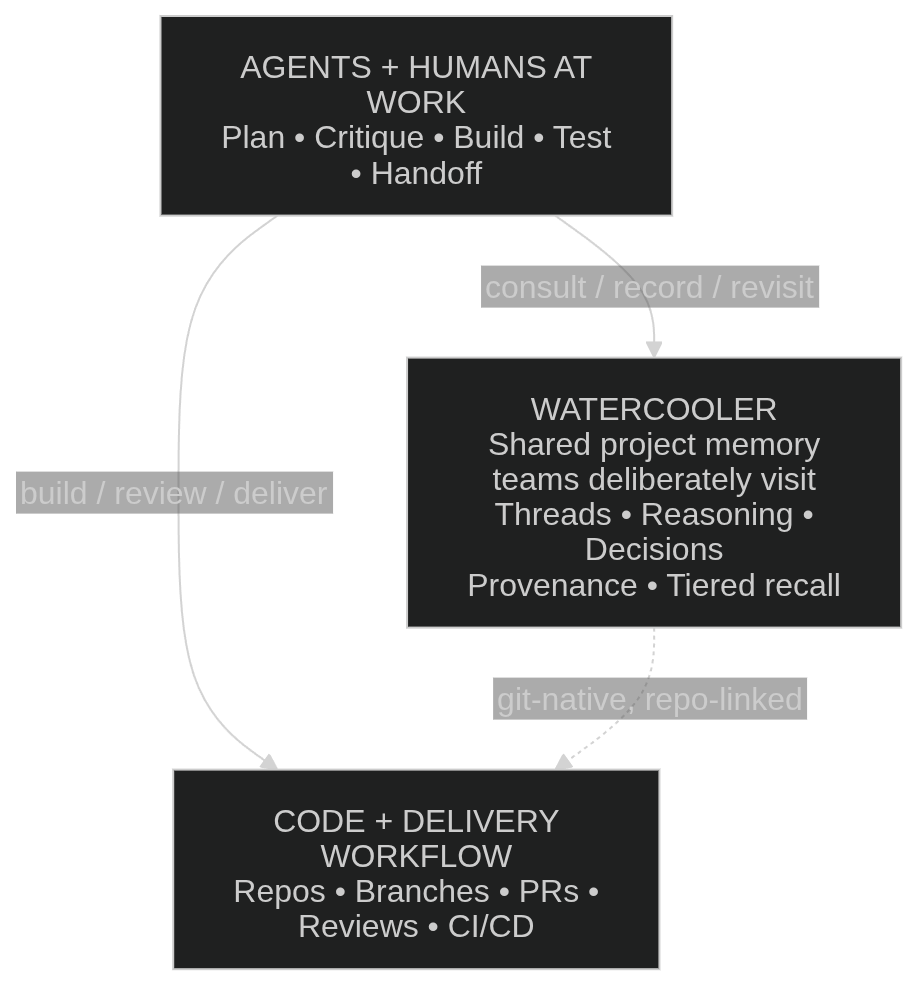
Git stores what changed. Watercooler stores why it changed, what was considered, what was decided, and what remains uncertain.
Collaboration was already difficult before agents entered the loop. Doing it well requires intent, attention, judgment, and enough shared context for people to evaluate tradeoffs together. Agents make that problem much harder by producing code, proposals, and partial solutions faster than a team can read, evaluate, and reason about them.
Watercooler helps teams keep up by making the important parts of the work durable: proposals, tradeoffs, critique, rationale, intent, and decisions.
People decide what belongs at the watercooler. Agents usually do the writing. Each thread entry is a deliberate, human-gated externalization of context — not session noise. Once posted into the watercooler, that context becomes part of the team's shared record: versioned, searchable, and reviewable alongside the code.
Example workflow:
  Jay w/ Codex: "Let's put the new team permissions model at the watercooler."
+    Codex (jay, planner): posts proposal with tradeoffs -> ball passed
  Caleb w/ Claude: reads thread, critiques proposal, suggests revision -> ack
+    Claude (caleb, critic): confirms design, surfaces a Decision candidate
  Caleb: approves the candidate -> Decision recorded -> files GitHub issue
+  Git: proposal, critique, rationale, and decision are versioned with the code
You choose what to externalize. The agent writes it. Git keeps it durable.
Agents propose. People decide. Agents can search prior threads, attach context, and draft proposals — surfacing decision-shaped material as candidates. Turning a candidate into a committed decision is a human act. Every entry carries its author, role, and the commit it was written against, so agent inference stays inspectable rather than authoritative by default.
Watercooler does not passively record every agent interaction. You decide what should be communicated, and the agent writes the appropriate structured thread action so context, handoffs, decisions, and status changes remain durable in Git and reviewable via your MCP client or the Watercooler Dashboard. This keeps threads focused and intentional.
| Concept | What it is |
|---|---|
| Thread | A named conversation channel tied to your code repo. Each thread has a topic slug, a status, and a ball. |
| Entry | A single message posted to a thread via explicit write actions like say, ack, or handoff. Every entry has an author, role, type, and timestamp. |
| Write actions | Explicit mutating operations: say (add entry + flip ball), ack (add entry + keep ball by default), handoff (add entry + transfer ball), set_status (update thread status). |
| Ball | Who is accountable for driving the work forward. The ball holder owns the next move — drop it and the thread stalls. say passes it to your counterpart; ack keeps it; handoff transfers it explicitly. |
| Agent identity | Who authored the entry. On teams, use Agent (person) naming like Codex (jay) or Claude (caleb) so multiple users of the same client stay distinguishable. |
topic | The slug identifier for a thread, e.g. feature-auth. Used in all tool calls; distinct from the display title. |
Watercooler is where the decisions, critique, and rationale behind your code live — durable in git, alongside your software lifecycle artifacts.
npx claudepluginhub mostlyharmless-ai/watercooler --plugin watercoolerHand off context to any AI coding agent. Creates comprehensive handoff documents that capture the current task, progress, modified files, and all relevant context needed to seamlessly continue work in any AI assistant (Claude Code, Cursor, Copilot, Aider, etc.).
 willseltzer
Git-as-knowledge-graph workflow for traceability across issues, branches, commits, reviews, and PRs.
 devallibus
対話コンテキストのexport/importスキル。会話で共有された目的・意図・設計判断・制約条件を .dev/contexts/ に書き出し、別セッションやレビューで読み込む。1対多のコンテキスト共有により、複数のsub PRをまとめたfeature PRのレビューやコードの自動改善に便利。
 shokai
Custom slash command set for Claude Code automating PR creation, code review, and commit management workflows.
 syou6162
Corca Workflow Framework — consolidated hooks and skill orchestration for structured development sessions
 corca-ai
Repowire mesh usage skills for AI coding agents: cross-agent review and planning, delegate, usage patterns, and install/update. Backend-agnostic and parameterised on the agent you choose.
 prassanna-ravishankar
'%20stop-opacity%3D'0.16'%2F%3E%3Cstop%20offset%3D'1'%20stop-color%3D'rgb(200%2C90%2C60)'%20stop-opacity%3D'0.03'%2F%3E%3C%2FlinearGradient%3E%3C%2Fdefs%3E%3Crect%20width%3D'320'%20height%3D'200'%20fill%3D'url(%23g)'%2F%3E%3Ccircle%20cx%3D'250'%20cy%3D'56'%20r%3D'92'%20fill%3D'rgb(200%2C90%2C60)'%20fill-opacity%3D'0.06'%2F%3E%3Ccircle%20cx%3D'64'%20cy%3D'172'%20r%3D'58'%20fill%3D'rgb(200%2C90%2C60)'%20fill-opacity%3D'0.05'%2F%3E%3C%2Fsvg%3E)