Stats
Actions
Available In
Tags

Automate civil legal aid workflows: eligibility screening, structured intake, jurisdiction-aware drafting, managing-attorney review, case transfers, deadline tracking, funder reporting, and client communications — all configured for ABA and LSC rules.
Help a managing attorney author a per-practice-area guide that configures how staff-facing skills behave — intake questions specific to this practice area, escalation posture (handle / escalate / refer), review gates, funder-restriction overrides, cross-area watch list, local rules, and practice-area draft templates. Use when a managing attorney wants to build or revise a per-practice-area guide, tune how the skills behave for a specific practice area, or set the office's escalation philosophy as plugin configuration.
Per-case handoff memo for rolling staff transitions — departure, role change, leave coverage, intake-to-staff routing. Status snapshot, what's pending, what's next, deadlines, conflict re-check for the incoming attorney, open questions for the supervisor. Use when a case is moving between staff for any reason, when a staffer is going on leave, or when intake hands a matter to a staff attorney for the first time.
Log a client or prospective-client communication — call, email, text, letter, in-person, voicemail. Append-only per-case record with dated entries, direction, medium, summary, action items. Rule 1.18-aware for prospective clients (even declined matters); VAWA-aware for confidentiality with DV survivors. Works alongside /client-letter and /status client. Use when logging a call or client email, reviewing a communication log, or asking "what did we tell [client] last time".
Structured intake on a matter that has cleared eligibility screening. Pulls upstream conversation context if LIA-MCP or VIA-MCP is connected, routes to practice-area template, spots cross-area issues, runs full conflict check, propagates funder-source matrix and funding-restriction flags from screening, classifies urgency, and produces a formatted case summary the staff attorney analyzes and the managing attorney reviews. Does NOT decide case acceptance. Use after /eligibility-screening, when starting a new client intake, or writing up a new client's situation.
Routine client correspondence from templates — appointment confirmations, document requests, brief "we filed it" updates, engagement letters, eligibility-decline letters (with referral), case-closing letters. Plain language (6th-grade target), language-served-aware (per CLAUDE.md), required elements, supervision routing. NOT substantive advice; use /status client for that, or a conversation. Use when a staffer needs to send routine correspondence to a prospective client, current client, or declined-matter caller.
Search messages, read channels, find discussions across your workspace.
Search, read, and fetch documents from Google Drive.
Free Law Project's legal research platform — U.S. court opinions, PACER dockets, judge profiles, citation verification.
Jurisdiction-aware guidance for self-represented litigants — case intake, deadline calculations, procedural next steps.
Primary law research — search cases by concept or wording, find cases from citations, extract authorities, verify quoted language.
External network access
Connects to servers outside your machine
Own this plugin?
Verify ownership to unlock analytics, metadata editing, and a verified badge. GitHub access is read-only (username + org membership).
Sign in to claimOwn this plugin?
Verify ownership to unlock analytics, metadata editing, and a verified badge. GitHub access is read-only (username + org membership).
Sign in to claimBased on adoption, maintenance, documentation, and repository signals. Not a security audit or endorsement.
Supercharging access to justice through AI-enabled civil legal aid practice.
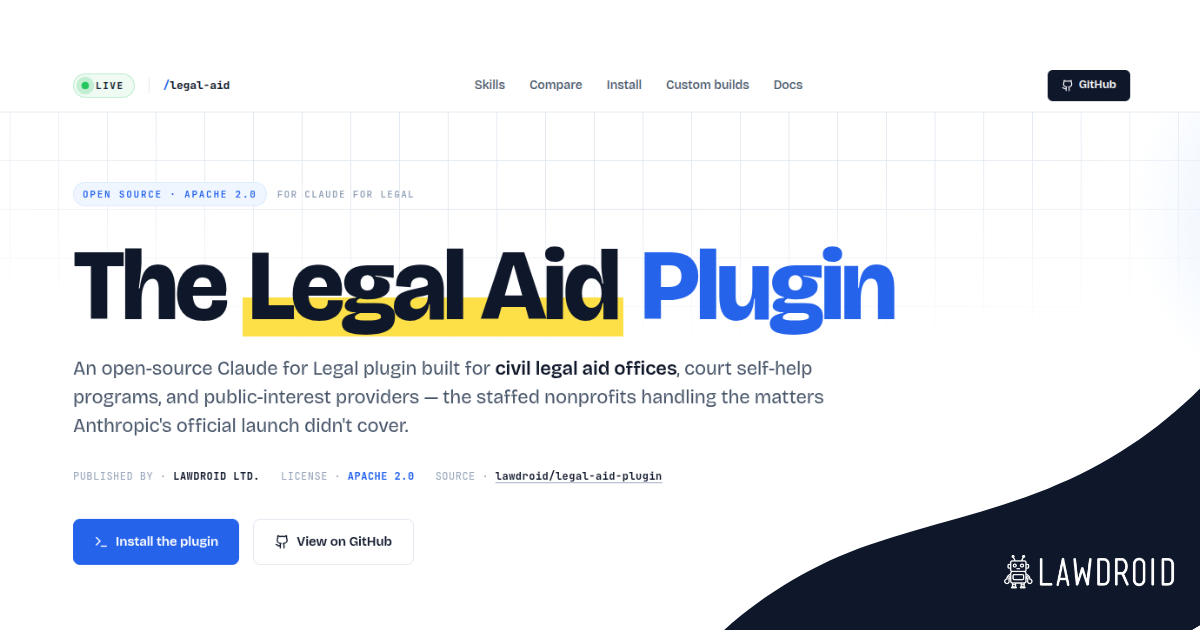
A plugin for civil legal aid organizations, court self-help centers, and public-interest legal services providers — the staffed nonprofits that handle housing, family, consumer, immigration, public benefits, and civil rights matters for people who cannot afford counsel.
Every output is a draft for staff analysis and managing-attorney review: marked, gated, and logged. The plugin scaffolds the work; staff reason through it; a managing attorney reviews. Nothing leaves the office without going through the supervision model the organization set at setup.
[!IMPORTANT] Every output from this plugin is not legal advice, not a legal conclusion, not a substitute for a lawyer. A lawyer must review, verify, and take professional responsibility for all work product, even that created with the aid of this plugin. This plugin is intended to help, not replace lawyers nor their professional judgment.
Civil legal aid is structurally capacity-constrained. A managing attorney supervises 5–20 staff. Each staff attorney carries 40–80 active matters. Intake volume routinely exceeds capacity by 3x to 5x. Eligibility screening, intake write-up, first drafts, status updates, referral letters, court self-help triage — the administrative load consumes hours that could go to advising clients. The result: long intake queues, declined cases, people who give up waiting.
This plugin cuts the time cost of everything around the lawyering, so the same staff and managing attorney serve meaningfully more clients, and staff spend more time on the analysis and strategy that actually moves cases.
It accelerates the non-analytical parts. It preserves the lawyering. That's the design principle.
| Role | Runs | Gets |
|---|---|---|
| Executive Director / Managing attorney | /cold-start-interview (once), /build-guide (per practice area), /managing-attorney-review (if formal review enabled) | Office context configured, staff work reviewed |
| Staff attorneys & paralegals | /onboard (joining staff), then /eligibility-screening, /client-intake, /draft, /memo, /research-start, /status, /client-letter | Starting points — never final work product |
| Intake specialists | /eligibility-screening, /client-intake, /client-comms-log | Structured screening + referral leads |
| Command | What it does | What it doesn't do |
|---|---|---|
/cold-start-interview | ED/Managing attorney. One-time office config: funding sources, practice areas, eligibility guidelines, jurisdictions, supervision style, conflict-check process | — |
/build-guide | Managing attorney. Author a per-practice-area guide: intake questions, escalation posture (handle / escalate / refer), review gates, cross-practice checks | Doesn't replace /cold-start-interview — this tunes skills for one practice area |
/onboard | New staff. Onboarding flow: office procedures, tool walkthrough, jurisdiction-specific basics, practice exercises | Doesn't replace the office's formal training |
/eligibility-screening | Funding-source-aware screening: income, assets, residency, citizenship/immigration status, conflicts, case-type priority | Doesn't decide acceptance — produces a recommendation for managing-attorney review |
/client-intake | Structured intake after eligibility clears: practice-area templates, cross-area issue spotting, conflict flags, urgency triage | Doesn't decide whether to take the case |
/draft [doc] | First draft: eviction answers, protective orders, demand letters, benefits appeals, asylum apps — jurisdiction-aware | Doesn't produce final work product |
/memo | IRAC-scaffolded case analysis with research gaps flagged | Doesn't write the analysis — scaffolds it |
/research-start [issue] | Research roadmap: statutes, case law areas, agency guidance, search terms | Leads, not authoritative citations — verify everything |
/status [audience] | Case status summary: client-facing, internal, court-ready, funder-ready | Doesn't file anything |
/client-letter [type] | Routine correspondence: appointment confirms, doc requests, brief updates, referral letters | Doesn't do substantive advice — that's /status client or a conversation |
/deadlines | Track case deadlines — add, cross-case rollup with warnings at 14/7/3/1 days, overdue flags | Doesn't calculate deadlines from triggering events; staff do the math per local rules |
/client-comms-log [case] | Append-only per-case communication log | Doesn't store substantive legal analysis; comm record only |
npx claudepluginhub lawdroidai/legal-aid-pluginDraft memos, demand letters, contracts, motions, deposition summaries, case timelines, and AI risk memos
 alexclowe
Speed up contract review, NDA triage, and compliance workflows for in-house legal teams. Draft legal briefs, organize precedent research, and manage institutional knowledge.
 Kromer-Group
Swiss Legal Intelligence -- BGE/ATF/DTF precedent research, case strategy, legal drafting, and citation verification across all 26 Swiss cantons with Anwaltsgeheimnis privacy protection.
 fedec65
Drills Socratically, briefs cases, builds outlines, runs bar prep sessions tuned to your jurisdiction, grades IRAC practice, and plans the study schedule — without ever writing it for you.
 anthropics
Upstash Context7 MCP server for up-to-date documentation lookup. Pull version-specific documentation and code examples directly from source repositories into your LLM context.
 upstash
Permanent coding companion for Claude Code — survives any update. MCP-based terminal pet with ASCII art, stats, reactions, and personality.
 1270011
'%20stop-opacity%3D'0.16'%2F%3E%3Cstop%20offset%3D'1'%20stop-color%3D'rgb(200%2C90%2C60)'%20stop-opacity%3D'0.03'%2F%3E%3C%2FlinearGradient%3E%3C%2Fdefs%3E%3Crect%20width%3D'320'%20height%3D'200'%20fill%3D'url(%23g)'%2F%3E%3Ccircle%20cx%3D'250'%20cy%3D'56'%20r%3D'92'%20fill%3D'rgb(200%2C90%2C60)'%20fill-opacity%3D'0.06'%2F%3E%3Ccircle%20cx%3D'64'%20cy%3D'172'%20r%3D'58'%20fill%3D'rgb(200%2C90%2C60)'%20fill-opacity%3D'0.05'%2F%3E%3C%2Fsvg%3E)