Stats
Actions
Available In
Tags

Scaffold, author, deploy, release, and connect a superlore knowledge base — write once in MDX for both human-readable documentation and agent-accessible MCP. Start by saying "Make me a docs using superlore" to scaffold a new KB, then author pages with interactive components, migrate from other docs platforms, generate release notes, and deploy via Vercel or managed cloud.
Author and edit content into an existing superlore knowledge base — "vibe your docs". Turns intent ("add a page about X", "document our onboarding", "make a roadmap") into well-structured MDX with dual-representation components (cards, timelines, boards, entity cards, tables, a Canvas), so humans get a clean page and agents get a typed knowledge face from one source. Use when adding, writing, editing, or restructuring pages, components, or a Canvas in a superlore KB.
Author rich, well-structured superlore Canvas diagrams — the `superlore-canvas` block in MDX that renders as a FigJam-grade interactive whiteboard AND a typed knowledge graph. Use whenever creating or editing a visual, diagram, whiteboard, board, architecture map, flow, mind-map, or brainstorm in a superlore knowledge base, or when asked to "visualize", "draw", "diagram", "map out", or "whiteboard" a concept.
Register a superlore knowledge base's MCP server with the user's Claude (or other MCP client) so their agent can read the corpus directly — search, get_page, list, navigate, get_component_data. Configures it at the USER level via `claude mcp add` (or the client's mcp.json). ALWAYS asks permission before modifying the user's Claude config, and ASKS for the URL / any credential / any missing detail rather than guessing. Use when someone wants to connect, add, hook up, or point their agent / Claude at a superlore KB or its MCP.
Get a superlore knowledge base live. superlore Cloud (managed hosting, SSO, team features) is in private beta — this skill guides the user to the waitlist, and gives the full self-host / Vercel manual path so they can ship today for free. Use when someone asks to deploy, publish, host, or "put my superlore docs online", or runs into `superlore deploy`.
Migrate an existing docs site or a set of Markdown/MDX files (Mintlify, Docusaurus, Fumadocs, Nextra, GitBook, plain .md — any framework) into a superlore knowledge base. First produces a detailed migration PLAN authored as a superlore doc (with a Canvas of the migration) that the user reviews and comments on in the editor preview or the Viewer; on approval it converts every page to superlore MDX with dual-representation components, verifies the build + key pages with Playwright, and writes a post-migration summary doc with screenshots and per-item status. Use when someone wants to move / convert / port / migrate their docs to superlore, or says "migrate my Mintlify/Docusaurus/markdown docs to superlore".
External network access
Connects to servers outside your machine
Based on adoption, maintenance, documentation, and repository signals. Not a security audit or endorsement.

Your agents turn specs, transcripts, and brainstorms into rich, structured docs — canvases, boards, timelines — that compound into one company knowledge base every agent can read over MCP.
One corpus. Humans and agents.




Open source · MCP-native · Deploy anywhere
Let your agent build it — three quick pastes into Claude (run each on its own, in order):
1 · Add the marketplace (one time)
/plugin marketplace add KrishnanSG/superlore
2 · Install the plugin
/plugin install superlore@superlore
3 · Ask for your knowledge base — in a fresh chat
Make me a docs site with superlore
That's it. Claude scaffolds the project, seeds a page or two, wires up the MCP, sets up your editor, and previews it — then you keep talking to it to author. No framework to learn.
Prefer the terminal?
curl -fsSL https://superlore.vercel.app/install.sh | sh
superlore init my-kb && cd my-kb && superlore dev
Adding superlore to an existing Next.js app? See Getting started.
Half your docs are read by agents now, not people — and every other tool just bolts an MCP onto the old way of writing them, serving scraped, lossy HTML. superlore rethinks the document for a world where AI writes, reads, and maintains it: every component is dual-representation. You author once, and the same block renders a beautiful, interactive surface for humans and serializes to clean, typed data an agent reads over MCP — provably one source, no drift.
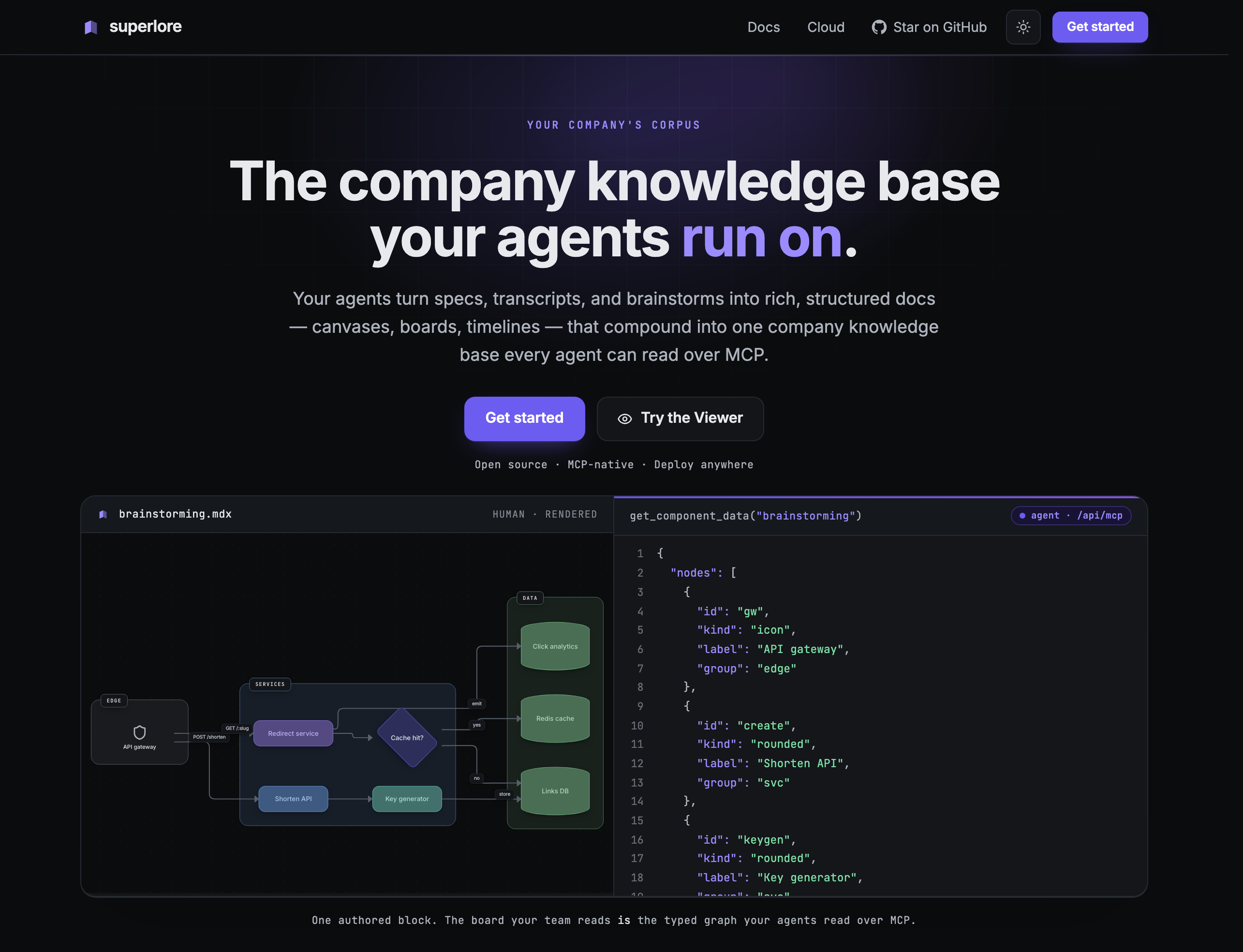
The board a human sees is the typed graph an agent reads — queryable structure, not a flat image.
/api/mcp over the same content the site renders — search, get_page, list, navigate, get_component_data..mdx and see it render live, with comments and export. Try it →Shipped a KB with superlore? Add the badge:

[](https://superlore.vercel.app)
superlore is open source and built to grow a community. Read CONTRIBUTING.md
and the CODE_OF_CONDUCT.md; report a vulnerability via
SECURITY.md. PRs welcome.
npx claudepluginhub krishnansg/superlore --plugin superloreUpstash Context7 MCP server for up-to-date documentation lookup. Pull version-specific documentation and code examples directly from source repositories into your LLM context.
 upstash
Comprehensive skill pack with 66 specialized skills for full-stack developers: 12 language experts (Python, TypeScript, Go, Rust, C++, Swift, Kotlin, C#, PHP, Java, SQL, JavaScript), 10 backend frameworks, 6 frontend/mobile, plus infrastructure, DevOps, security, and testing. Features progressive disclosure architecture for 50% faster loading.
 Jeffallan
v9.54.1 — Reliability wave: tangle contextual review correction loop with hard round ceiling, progress-supervised review rounds (per-agent stall watch, descendant-tree kills), council diversity and agy pin fixes, marketplace generator source-of-truth fix, provider troubleshooting runbook and cost-expectations docs. Run /octo:setup.
 nyldn
nyldnPersistent coding companion for Claude Code, Pi, and Oh My Pi. MCP-based terminal pet with ASCII art, stats, reactions, and personality.
 ramarivera
Memory compression system for Claude Code - persist context across sessions
 thedotmack
'%20stop-opacity%3D'0.16'%2F%3E%3Cstop%20offset%3D'1'%20stop-color%3D'rgb(200%2C90%2C60)'%20stop-opacity%3D'0.03'%2F%3E%3C%2FlinearGradient%3E%3C%2Fdefs%3E%3Crect%20width%3D'320'%20height%3D'200'%20fill%3D'url(%23g)'%2F%3E%3Ccircle%20cx%3D'250'%20cy%3D'56'%20r%3D'92'%20fill%3D'rgb(200%2C90%2C60)'%20fill-opacity%3D'0.06'%2F%3E%3Ccircle%20cx%3D'64'%20cy%3D'172'%20r%3D'58'%20fill%3D'rgb(200%2C90%2C60)'%20fill-opacity%3D'0.05'%2F%3E%3C%2Fsvg%3E)