Stats
Actions
Available In
Tags

Spec-Driven Development workflow: /sdd:* commands, portable skill, machine-checked gate. Bilingual EN/ES. No code before approved spec and consistent plan.
Validate and close the session with the SDD output contract / Valida y cierra la sesión con el contrato de salida SDD
Record one architecture decision in the decision log (what, why, what was rejected, when to revisit) / Registra una decisión de arquitectura en la bitácora de decisiones
Run the SDD gate (policy + approval + consistency) and record consent before implementation / Ejecuta la compuerta SDD y registra consentimiento antes de implementar
Diagnose the current SDD stage and tell the user the exact next step / Diagnostica la etapa SDD actual y da el siguiente paso exacto
Start a project with SDD - capture the idea and prepare the first spec / Inicia un proyecto con SDD - captura la idea y prepara la primera spec
Own this plugin?
Verify ownership to unlock analytics, metadata editing, and a verified badge. GitHub access is read-only (username + org membership).
Sign in to claimOwn this plugin?
Verify ownership to unlock analytics, metadata editing, and a verified badge. GitHub access is read-only (username + org membership).
Sign in to claimBased on adoption, maintenance, documentation, and repository signals. Not a security audit or endorsement.
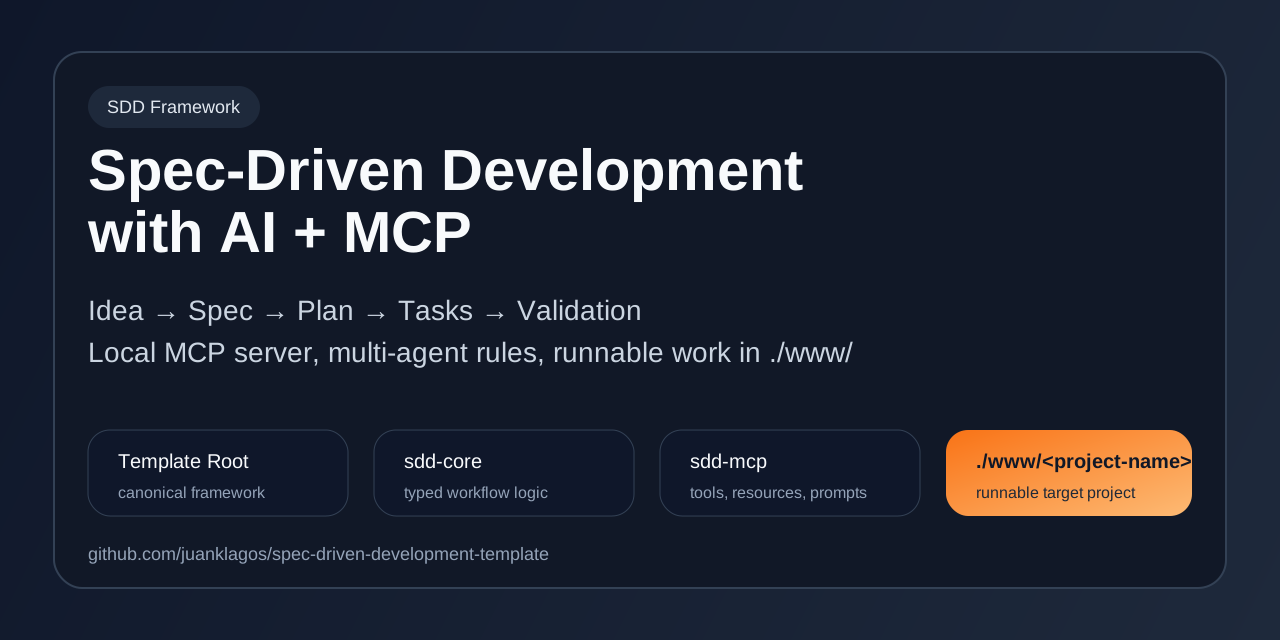
Learn Spec-Driven Development, then use it on real projects.
One rule, and a gate that stays shut until you approve a spec — and tells you on every run exactly what it checked.
🇺🇸 English · 🇪🇸 Español






Non-technical start · Quickstart · AI agent start · Commands · Community
Spec-Driven Development (SDD) means writing and approving a clear specification before any code exists, so that scope and decisions outlive the chat window they were born in. By 2026 it is how most people build software with AI agents.
This repo does double duty.
It is a school: a bilingual (EN/ES) path that starts from zero, with guides, an interactive course and a tutor you can talk to. You do not need to know how to program to get through it.
It is also a toolkit for real work: enforcement scripts, rules your agent reads, an MCP server, and a compact spec/ sidecar you drop into a codebase that already exists.
The workflow engine underneath is GitHub Spec Kit. This repo is the practical layer around it.
The flow in action — create a spec, validate, pass the gate (regenerated on every release):

What changes in practice: decisions stop living in chat history and move into specs/. The gate stays closed until spec.md and plan.md exist, agree, and you record your consent — a script checks that, not somebody's memory. A new teammate or a new agent lands in a folder layout they already recognize. And bitacora/ keeps the session log, so six months later you can still find out why something was done the way it was.
Want the industry map? Read SDD in 2026: state of the art and how this template compares.
Then pick your learning level. Every guide on the docs site carries its level badge:
[!TIP] If you would rather learn by doing, take the interactive course (GitHub Skills format): 4 steps, ~35 min, auto-graded by Actions. Your exam is the real SDD gate.
Copy/paste this prompt into your AI assistant (Claude, Cursor, Copilot, Gemini...):
Using https://github.com/juanklagos/spec-driven-development-template, guide me step by step with SDD for my project.
My project is: [describe your project in plain language].
If my project is new, initialize from this template and GitHub Spec Kit as the base workflow.
If it already exists, adapt it without breaking current behavior.
No code before approved spec and consistent plan.
npx claudepluginhub juanklagos/spec-driven-development-template --plugin sddSpec-driven development methodology for full-stack teams
 LiorCohen
Specification-Driven Development with Process Discipline for AI Agents
 rhuss
rhussSpec-Driven Development, adaptación de Dominicode — genera spec.md + plan.md + tasks.md (TDD) antes de escribir código.
 bezael
Spec-driven development methodology for Claude Code. Provides skills for requirements engineering (EARS format), design documentation, task breakdown, AI prompting strategies, quality assurance, and troubleshooting.
 jasonkneen
Spec Driven Development toolkit - structured specification, planning, and implementation workflows for systematic feature development
 athola
Spec-Driven Development Workflow for Claude Code. A 6-step pipeline: Requirements → Code Analysis → Design → Implement → Verify → Self-Improve. Specifications are the source of truth, code is a verified artifact.
 sermakarevich
'%20stop-opacity%3D'0.16'%2F%3E%3Cstop%20offset%3D'1'%20stop-color%3D'rgb(200%2C90%2C60)'%20stop-opacity%3D'0.03'%2F%3E%3C%2FlinearGradient%3E%3C%2Fdefs%3E%3Crect%20width%3D'320'%20height%3D'200'%20fill%3D'url(%23g)'%2F%3E%3Ccircle%20cx%3D'250'%20cy%3D'56'%20r%3D'92'%20fill%3D'rgb(200%2C90%2C60)'%20fill-opacity%3D'0.06'%2F%3E%3Ccircle%20cx%3D'64'%20cy%3D'172'%20r%3D'58'%20fill%3D'rgb(200%2C90%2C60)'%20fill-opacity%3D'0.05'%2F%3E%3C%2Fsvg%3E)
