Stats
Actions
Available In
Tags

Ferrox Core is a meta-prompting, context engineering, and spec-driven development system for AI coding agents.
Generate tests for a completed phase based on UAT criteria and implementation
Generate an AI-SPEC.md design contract for phases that involve building AI systems.
Autonomous audit-to-fix pipeline — find issues, classify, fix, test, commit
Audit milestone completion against original intent before archiving
Cross-phase audit of all outstanding UAT and verification items
Researches a single gray area decision and returns a structured comparison table with rationale. Spawned by discuss-phase advisor mode.
Researches a chosen AI framework's official docs to produce implementation-ready guidance — best practices, syntax, core patterns, and pitfalls distilled for the specific use case. Writes the Framework Quick Reference and Implementation Guidance sections of AI-SPEC.md. Spawned by /ferrox:ai-integration-phase orchestrator.
Deeply analyzes codebase for a phase and returns structured assumptions with evidence. Spawned by discuss-phase assumptions mode.
Applies fixes to code review findings from REVIEW.md. Reads source files, applies intelligent fixes, and commits each fix atomically. Spawned by /ferrox:code-review --fix.
Reviews source files for bugs, security issues, and code quality problems. Produces structured REVIEW.md with severity-classified findings. Spawned by /ferrox:code-review.
Generate tests for a completed phase based on UAT criteria and implementation
Generate an AI-SPEC.md design contract for phases that involve building AI systems.
Autonomous audit-to-fix pipeline — find issues, classify, fix, test, commit
Audit milestone completion against original intent before archiving
Cross-phase audit of all outstanding UAT and verification items
Executes bash commands
Hook triggers when Bash tool is used
Modifies files
Hook triggers on file write and edit operations
Own this plugin?
Verify ownership to unlock analytics, metadata editing, and a verified badge. GitHub access is read-only (username + org membership).
Sign in to claimOwn this plugin?
Verify ownership to unlock analytics, metadata editing, and a verified badge. GitHub access is read-only (username + org membership).
Sign in to claimnpx claudepluginhub ferroxlabs/ferrox-factory --plugin ferrox-coreBased on adoption, maintenance, documentation, and repository signals. Not a security audit or endorsement.
Executables (bin/) — files in this plugin's bin/directory are added to the Bash tool's PATH while the plugin is enabled.
Uses power tools
Uses Bash, Write, or Edit tools
Uses power tools
Uses Bash, Write, or Edit tools
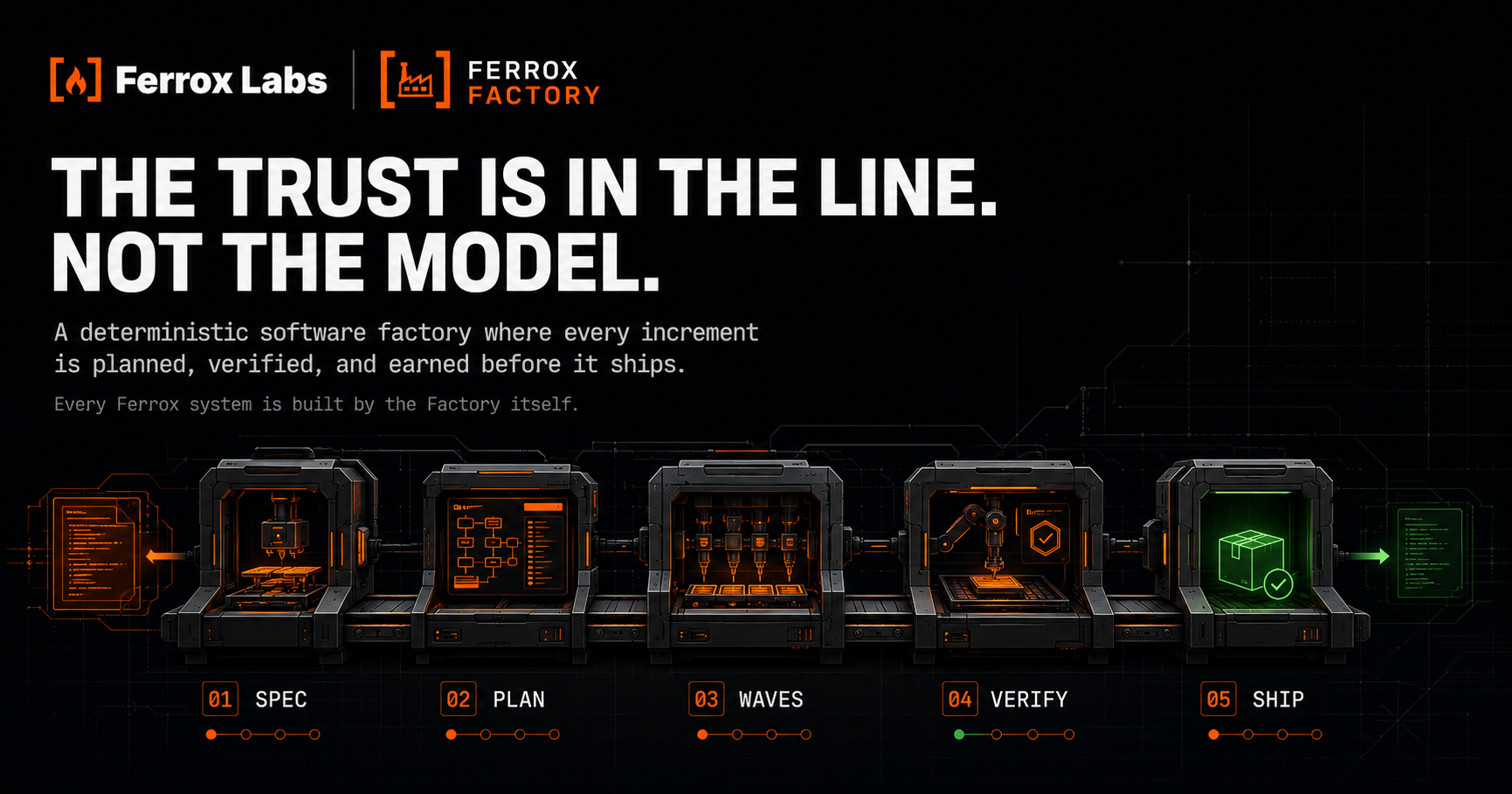
Go Build Something Awesome.
An agentic build line that turns specs into verified, shipped software: planned phases, parallel waves, machine gates at every station.



Every developer running coding agents has felt the same sickening moment: the agent declares victory, you open the diff, and it is confident garbage. The model wrote fast, marked its own homework, and moved on. Ferrox Factory exists to kill that moment. It is an agentic build line where trust does not come from the model at all. It comes from the line itself: structure, discipline, and machine gates that no agent can talk its way past. Work goes in as a spec. It comes out as verified, committed, working software. There is no third state.
The line runs the way a real factory runs. A project becomes a roadmap, the roadmap becomes planned phases, and each phase executes as waves of parallel sub-agents, each building in its own isolated worktree under enforced rules: tests before code, atomic commits per task, deviations recorded instead of improvised. Verification then works backward from the goal, checking that the phase delivered what it promised, not that a checklist got ticked. Plans, state, and handoffs live on disk, so the discipline survives context loss, session breaks, and model swaps.
The whole line is hardened station by station: a context-engineered lifecycle (new-project → plan → execute → verify → ship) fused with anti-loop forcing functions, a fail-closed merge gate, adaptive discipline depth, 3-lineage cross-auditing on risky work, a universal gate-first executor running the Anvil method natively, and a runtime-agnostic model backbone. Fleets of parallel sub-agents build real work without the infinite audit → fix → re-plan loop that stalls naive agent systems.
It runs as markdown skills + a Node CLI (ferrox-tools.cjs) inside your existing agent:
Claude Code, Codex, Cursor, Kimi CLI, and 15+ other runtimes. No new runtime, no lock-in.
The proof is the shipping record. This factory built Wayland Desktop, Wayland Core, and the Anvil engine, whose gated climb now runs natively as the line's default execution path. Then it built its own v1.8 through its own phases, gates enforcing, 714 checks green.
The one guarantee, above all others: the build line always terminates and always moves forward. Every working session ends in either a landed, coverage-advancing increment or an explicit, bounded stop (rescope, descope, or escalate to a human). Whatever else happens, the build never enters an unbounded loop.
Every good spec-driven system gives you plan → build → verify. That is table stakes, and on a clean, well-scoped task, table stakes are enough. Ferrox Factory is built for everything else: the machinery that matters when work goes wrong or gets big, the failure modes that cost you days, not minutes:
That's the offer: a structural safety net for exactly the paths where autonomous agents usually fall apart, enforced by the line instead of promised by the model.
Every planned increment is risk-graded, and the process depth scales to the grade. Not a mode you toggle; a decision the system makes and can audit:
GSD Core is a meta-prompting, context engineering, and spec-driven development system for AI coding agents.
 open-gsd
Multi-agent development workflow (/crew) — planning, implementation, review, documentation, evals, and audit gates. Commands, agents, and skills are auto-discovered from the repo.
 Spiris-Innovation-Tech-Dev
Production-grade engineering skills for AI coding agents — covering the full software development lifecycle from spec to ship.
 ishandutta2007
Per-feature development lifecycle: design, launch, build, wrap.
 memorysaver
Multi-agent orchestration for code that matters.
 ShankarKakumani
HelloAGENTS — The orchestration kernel that makes any AI CLI smarter. Adds intelligent routing, unified QA gates, safety guards, and notifications.
 hellowind777
'%20stop-opacity%3D'0.16'%2F%3E%3Cstop%20offset%3D'1'%20stop-color%3D'rgb(200%2C90%2C60)'%20stop-opacity%3D'0.03'%2F%3E%3C%2FlinearGradient%3E%3C%2Fdefs%3E%3Crect%20width%3D'320'%20height%3D'200'%20fill%3D'url(%23g)'%2F%3E%3Ccircle%20cx%3D'250'%20cy%3D'56'%20r%3D'92'%20fill%3D'rgb(200%2C90%2C60)'%20fill-opacity%3D'0.06'%2F%3E%3Ccircle%20cx%3D'64'%20cy%3D'172'%20r%3D'58'%20fill%3D'rgb(200%2C90%2C60)'%20fill-opacity%3D'0.05'%2F%3E%3C%2Fsvg%3E)
