Stats
Actions
Available In
Tags
Orchestrate full-spectrum bug bounty hunting and external red-team engagements across web, mobile, cloud, and infrastructure targets with 80+ specialized skills for vulnerability detection, recon, exploit chaining, and report generation.
Run autonomous hunt loop on a target — scope check → recon → rank surface → hunt → validate → report with configurable checkpoints. Usage: /autopilot target.com [--paranoid|--normal|--yolo]
Build an exploit chain — given bug A, finds B and C to combine for higher severity and payout. Knows common chain patterns: IDOR→ATO, SSRF→cloud metadata, XSS→ATO, open redirect→OAuth theft, S3→bundle→secret→OAuth. Usage: /chain
Active vulnerability hunting. Two-track dispatcher — asks Red Team vs WAPT, hands off to hunt-dispatch skill and sibling commands. Usage: /hunt target.com | /hunt *.target.com | /hunt targets.txt [--vuln-class X] [--source-code P] [--chrome]
On-demand intelligence fetch for a target — CVEs, disclosed reports, new features. Pulls NVD/GitHub-Advisory CVEs + bundled disclosed reports + hunt memory context. Usage: /intel target.com
Inspect or rotate hunt-memory JSONL files (audit.jsonl, patterns.jsonl, journal.jsonl). Caps file size and keeps N rotated backups so memory does not grow unbounded.
Security payloads, bypass tables, wordlists, gf pattern names, always-rejected bug list, and conditionally-valid-with-chain table. Use when you need specific payloads for XSS/SSRF/SQLi/XXE/NoSQLi/command injection/SSTI/IDOR/path-traversal/HTTP smuggling/WebSocket/MFA bypass, or bypass techniques. Submittability and the always-rejected / what-NOT-to-submit decision are owned by triage-validation.
End-to-end Android APK red-team pipeline — automated APK acquisition (Play Store + apkpure + apkmirror fallback), jadx decompilation, secret/URL/JWT/Firebase grep, pinned-cert extraction, exported-component enumeration, Frida runtime instrumentation templates, intent-injection probes. Built from an authorized external red-team engagement where 7 APKs were pulled manually, 4 download attempts truncated, and a hardcoded JWT + 30 internal API endpoints were recovered from one of the apps. Use when target has a mobile app catalogue (Play Store developer page), when you find an APK URL hosted on a web server, or when post-recon mentions "mobile app" in scope.
Use at the START of any bug bounty hunting session, when switching targets, or when feeling lost about what to do next. Master orchestrator that combines the 5-phase non-linear hunting workflow with the critical thinking framework (developer psychology, anomaly detection, What-If experiments). Routes to all other skills based on current hunting phase. Also use when asking "what should I do next" or "where am I in the process."
Bugcrowd-specific reporting tactics complementing report-writing: VRT category search-and-fallback strategy when no exact match exists, manual severity override when VRT defaults underrate impact, severity-request paragraph as first body section, OOS-clause rebuttal templates (rate limiting on auth-flow endpoints, debug-info framing, user-enumeration with sensitive PII, theoretical-issue counter), chained-finding cross-reference patterns, target selection for QA-vs-prod programs, researcher-side hygiene (Bugcrowdninja email alias, account state restoration, friendly-tester posture). Use when filing a Bugcrowd submission, when VRT default seems wrong, when triager closes as OOS or downgrades severity, when chaining linked submissions, or when scope distinguishes production from QA. Pairs with report-writing and triage-validation.
Cloud IAM red-team attack chain across AWS, Azure, GCP — focused on EXTERNAL exploitation paths and post-credential-discovery privilege analysis. Covers IAM enumeration (aws iam, az role, gcloud iam), STS/AssumeRole chaining, Azure Managed Identity abuse (via SSRF/leak), GCP service account JSON abuse, IMDSv1/v2 attacks via SSRF, K8s ServiceAccount token privilege analysis once held (token discovery / cluster exposure is owned by hunt-k8s), role-trust-policy confused-deputy, cross-account assume-role enumeration, IAM privilege escalation patterns (24+ AWS, 8+ Azure, 6+ GCP), and AWS Cognito Identity Pool unauthenticated-role attack chain (GetId → GetCredentialsForIdentity → IAM role abuse). Built for the case where recon yields a credential (key, JSON, token) and you need to know what it grants and how to escalate. Use when an AWS key / Azure secret / GCP service account JSON / K8s SA token surfaces from a code repo, JS bundle, APK, breach corpus, or SSRF chain.
Own this plugin?
Verify ownership to unlock analytics, metadata editing, and a verified badge. GitHub access is read-only (username + org membership).
Sign in to claimOwn this plugin?
Verify ownership to unlock analytics, metadata editing, and a verified badge. GitHub access is read-only (username + org membership).
Sign in to claimBased on adoption, maintenance, documentation, and repository signals. Not a security audit or endorsement.
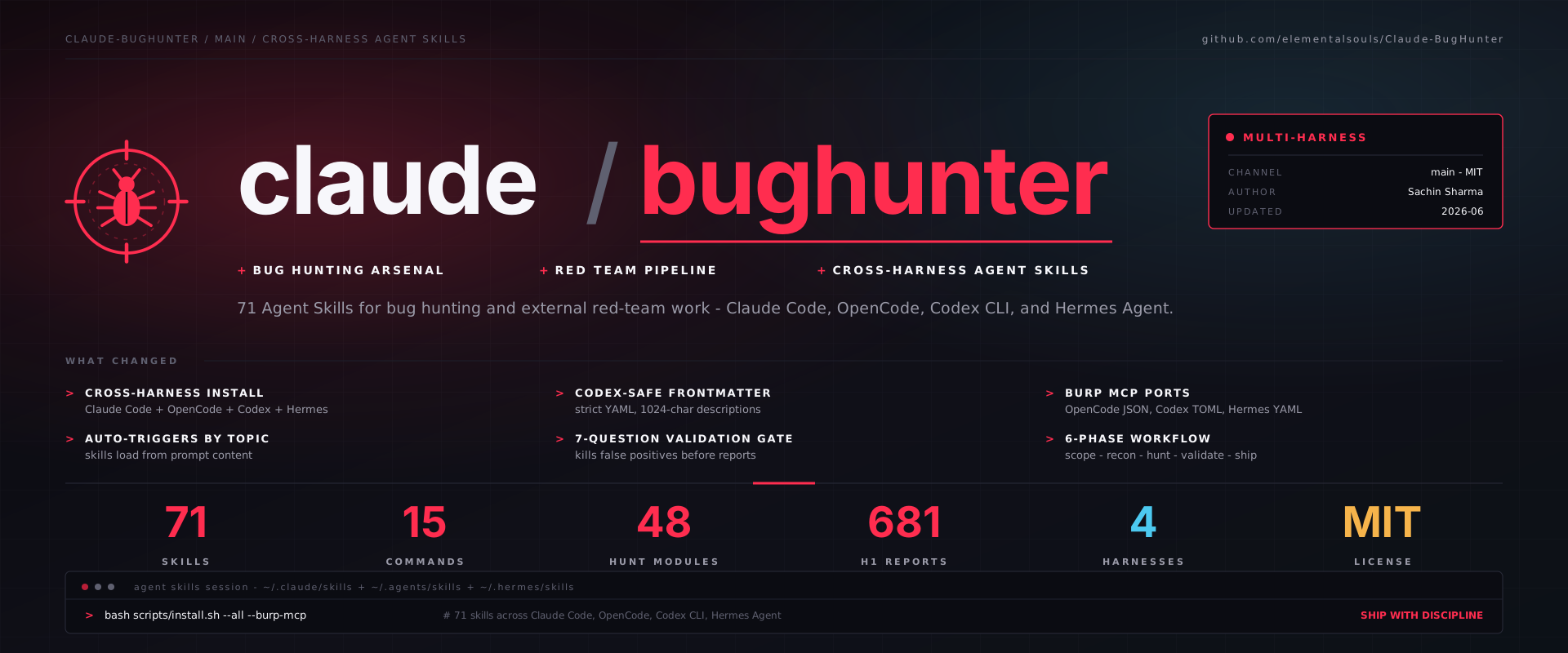
A self-contained Claude skill bundle for bug hunting and external red-team work · 82 skills · 15 slash commands · 681 disclosed-report patterns across 24 core vulnerability classes · enterprise identity + infrastructure attack matrices · engagement-folder scaffolding · Burp MCP integration · battle-tested across authorized red-team and bug-hunting engagements, plus public training platforms (DVWA, OWASP Juice Shop, Hacker101, testphp.vulnweb.com).
Built by Sachin Sharma — Bug Hunting & GenAI Security Research.
SPONSORED BY

claude-bughunter is a drop-in skill bundle for the Claude Code skills system. Install once and Claude Code stops being a chatbot and starts behaving like a senior bug-hunting researcher or red-team operator: it knows the techniques, the chain templates, the VRT mappings, the platform CVE chains, and the hygiene — and it stays in scope.
Four layers stack:
bb-methodology + redteam-mindset: the 5-phase non-linear workflow, critical-thinking framework, and red-team operator discipline.hunt-* skills curated from 681 disclosed HackerOne reports: per-class detection patterns, payloads, bypass tables, and chain templates.triage-validation + reporting + evidence-hygiene: the 7-Question Gate, VRT-aware severity, OOS rebuttals, PII redaction, and red-team deliverables.All triggered automatically by topic — describe what you're testing in plain English and the relevant skill loads. No invocation by name.
Option A — install as a Claude Code plugin (recommended). From inside Claude Code:
/plugin marketplace add elementalsouls/Claude-BugHunter
/plugin install claude-bughunter@elementalsouls
All 82 skills + 15 commands load namespaced under claude-bughunter: and update when you bump the plugin version — no files copied into ~/.claude/.
Option B — copy install (no plugin system / pin to a clone):
git clone https://github.com/elementalsouls/Claude-BugHunter.git
cd Claude-BugHunter
bash scripts/install.sh        # copies skills + commands into ~/.claude/
What each install path gives you:
| Path | 82 skills + 15 slash commands | cbh CLI | hunt scaffolder |
|---|---|---|---|
| A — plugin | ✅ namespaced under claude-bughunter: | ➕ separate pipx install | ❌ clone-only |
| B — copy install | ✅ copied into ~/.claude/ | ✅ from the clone | ✅ from the clone |
The plugin is the fastest path to the skills + slash commands. The terminal-native
cbh runner installs standalone — pipx install git+https://github.com/elementalsouls/Claude-BugHunter
— so plugin users can add it without a full clone (see cbh CLI).
The hunt engagement scaffolder ships with the clone (Option B).
That's it. Open Claude Code and describe what you're testing in plain English — the right skill loads automatically, no invocation by name:
> Testing acme.com — an in-scope HackerOne target. Run recon and rank the surface.

  ⟳ loading skills: web2-recon, offensive-osint, bb-methodology …
    → subdomain enum (subfinder + crt.sh) … 47 hosts
    → live hosts (httpx) … 12 · tech fingerprint … 6 distinct stacks
    → ranked surface: api.acme.com (GraphQL, introspection ON)  ← start here
                      auth.acme.com (OAuth, SSO)               ← hunt-oauth

  Next: want me to probe the GraphQL introspection + OAuth redirect_uri?
→ Full Installation guide · Usage guide · searchable skill catalog.
The block above is an illustrative transcript. To record a real demo of your own session:
asciinema rec demo.cast→ upload to asciinema.org and drop the badge here.
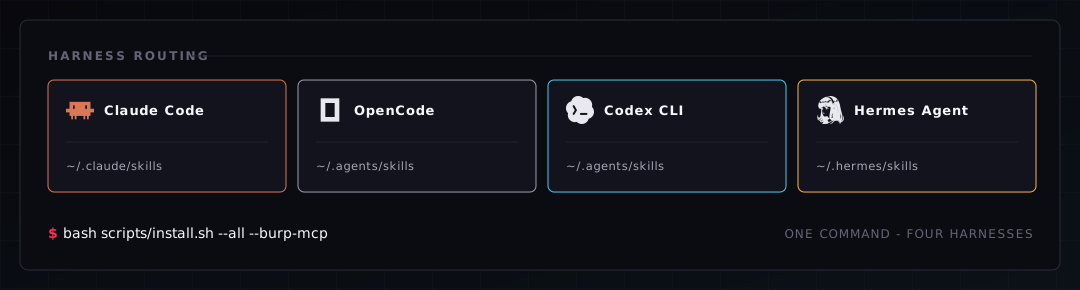
The skills are plain Agent Skills — the same SKILL.md format that Claude Code · OpenCode · OpenAI Codex CLI · Hermes Agent all load. One command installs them everywhere:
bash scripts/install.sh --all --burp-mcp
npx claudepluginhub elementalsouls/claude-bughunter --plugin claude-bughunterClaude Code skills and agents for authorized security testing, bug bounty hunting, and pentesting workflows
 transilienceai
Full penetration testing framework - 100+ attack categories covering OWASP, injection, authentication, cloud, and more
 Stickman230
The AI pentest co-pilot that actually finds bugs. Phase-chained, evidence-gated offensive security skills for bug bounty and authorized pentesting.
 kalpmodi
Teaches agents to recognize and avoid security threats during normal activity. Covers phishing detection, credential protection, domain verification, and social engineering defense. Use when building or operating agents that access email, credential vaults, web browsers, or sensitive data.
 trailofbits
OSS-only security for OWASP Top 10, pentest, vuln testing (XSS, SSRF, CSRF, business-logic, Host header), threat modeling (STRIDE, ATT&CK), Sigma rules, SAST, code audit, AI/LLM red-team, or replacing paid tools (Burp, Nessus, Splunk) with OSS.
 secondsky
Automated security vulnerability testing covering OWASP Top 10, SQL injection, XSS, CSRF, and authentication issues
 jeremylongshore
'%20stop-opacity%3D'0.16'%2F%3E%3Cstop%20offset%3D'1'%20stop-color%3D'rgb(200%2C90%2C60)'%20stop-opacity%3D'0.03'%2F%3E%3C%2FlinearGradient%3E%3C%2Fdefs%3E%3Crect%20width%3D'320'%20height%3D'200'%20fill%3D'url(%23g)'%2F%3E%3Ccircle%20cx%3D'250'%20cy%3D'56'%20r%3D'92'%20fill%3D'rgb(200%2C90%2C60)'%20fill-opacity%3D'0.06'%2F%3E%3Ccircle%20cx%3D'64'%20cy%3D'172'%20r%3D'58'%20fill%3D'rgb(200%2C90%2C60)'%20fill-opacity%3D'0.05'%2F%3E%3C%2Fsvg%3E)