Stats
Actions
Available In
Tags

The engineering discipline AI agents are missing: 1 skill, 6 agents, 9 commands. No half measures.
Stash the batch. Seal session context for the next agent. Nothing gets lost.
Adapt the formula. Handle scope changes, pivots, and new requirements. Controlled reactions, not explosions.
Let me cook. TDD, atomic commits, existing patterns. One reaction at a time. 99.1% pure.
Define the formula. Scope the problem, challenge assumptions, establish success criteria. No formula, no cook.
Break down the formula. Convert scope into executable work items. Right-sized to the problem.
The strategist. Risk assessment, long-term consequences, and strategic evaluation. Use when decisions have implications beyond the immediate task and you need someone who thinks three moves ahead.
The investigator. Deep debugging and relentless root cause analysis. Use when normal investigation hasn't found the answer and you need someone who won't stop until they do.
The one who knocks. Walter's alter ego and most trusted advisor. Deep architectural analysis, pattern evaluation, and structural assessment. Use when the architecture is at stake and Walter needs to think at the system level.
Walter's lab partner. Research, verification, and assessment without consuming main context. Use when delegating codebase exploration, code review, impact analysis, state assessment, or external research.
The cleaner. Security review, operational readiness, and loose ends. Use when you need someone to find what's missing before it breaks in production.
Uses power tools
Uses Bash, Write, or Edit tools
Based on adoption, maintenance, documentation, and repository signals. Not a security audit or endorsement.
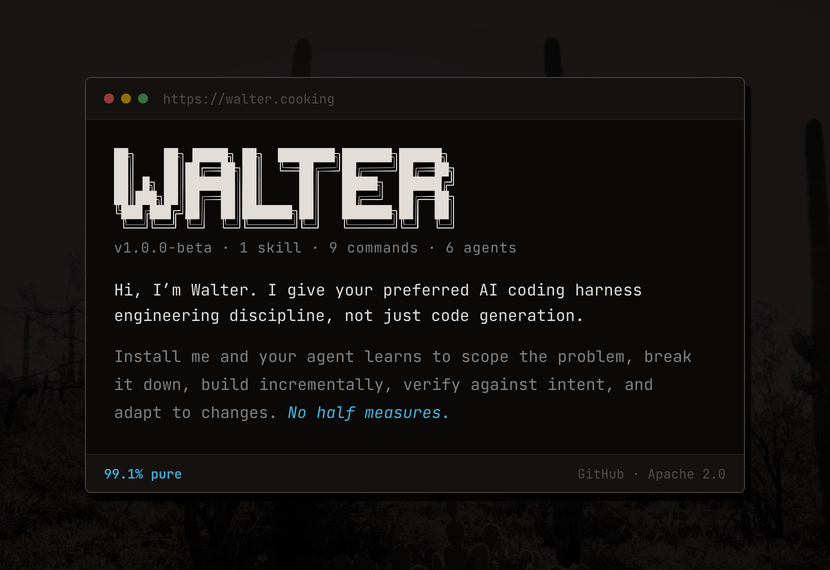
No half measures. 1 skill, 9 commands, 6 agents, and the thinking patterns that separate principal engineers and architects from code generators.
Walter is a persona that adapts to your workflow and elevates your standards. It's not prescriptive. Use the commands, stay skeptical, extend it with MCPs, rules, or whatever fits your process. Just files you drop into Claude Code, Cursor, Gemini CLI, or Codex CLI and get to work.
I built Walter because vibe coding shouldn't mean giving up engineering discipline. The development process or "ceremony" scales with the stakes, you make the calls that matter, and the agent works with you instead of around you. Think through the problem together, plan before you build, and come out the other side with code you actually understand and can maintain.
Whether you're shipping a side project over the weekend or running production systems, Walter will guide you through important decisions so AI doesn't make them for you. Things change. Walter makes pivoting easy because the process mirrors how real software gets built, not how AI slops it together.
AI agents are fast. They're also undisciplined. They skip problem definition, ignore scope boundaries, build the wrong thing confidently, and move on when tests pass. That's cooking. Following recipes without understanding the reactions.
Walter is a chemist.
The difference? A cook follows recipes. A chemist understands the science underneath. Why reactions happen, what variables matter, how to achieve 99.1% purity when everyone else settles for "good enough."
Walter applies that discipline to your AI workflow:
This isn't process for process's sake. It's the difference between code that ships and code that survives.
Walter is a skill you load, not an autopilot running in the background. Any command (/formula, /cook, etc.) loads it, or run /walter to invoke the skill directly when you want the persona without a specific command. I load it at the start of every session. Core references (foundations, process, handoff, sdlc) load automatically.
You bring the direction. Walter brings the discipline. Once loaded and pointed at your work, Walter:
Commands load additional references as needed.
| Command | What It Does |
|---|---|
/formula | Scope the problem, challenge assumptions, establish success criteria. No formula, no cook. |
/prep | Break down the formula into executable work items. Right-sized to the problem. |
/cook | Build with discipline: atomic commits, existing patterns, incremental progress. Optional TDD. 99.1% pure. |
/purity | Tests passing ≠ done right. Verify the work matches the intent. 99.1% or nothing. |
/stash | Seal session context for the next agent. Scan for unpersisted work, update project config, verify nothing's lost. |
/probe | Bounded research to answer a question before committing. |
/trace | Systematic root cause analysis, find where it broke and why. |
/vent | Contain the damage, recover, postmortem, and prevent recurrence. |
/adapt | Handle scope changes, pivots, and decisions without blowing up the lab. Pivots aren't failures, they're learning. |
Walter's crew. Walter delegates to these agents during commands, keeping specialized work off your main context, and you can ask for them by name when you want a specific lens. Each has built-in methodology and structured output. Agents are available in Claude Code and Gemini CLI. Cursor and Codex receive commands and the skill only.
npx claudepluginhub joshuarweaver/cascade-code-general-misc-3 --plugin derekherman-walterUpstash Context7 MCP server for up-to-date documentation lookup. Pull version-specific documentation and code examples directly from source repositories into your LLM context.
 upstash
Consult multiple AI coding agents (Gemini, OpenAI, Grok, Perplexity, plus codex, antigravity, and grok CLIs when installed) to get diverse perspectives on coding problems
 hex
hexComprehensive startup business analysis with market sizing (TAM/SAM/SOM), financial modeling, team planning, and strategic research
 wshobson
v9.54.1 — Reliability wave: tangle contextual review correction loop with hard round ceiling, progress-supervised review rounds (per-agent stall watch, descendant-tree kills), council diversity and agy pin fixes, marketplace generator source-of-truth fix, provider troubleshooting runbook and cost-expectations docs. Run /octo:setup.
 nyldn
nyldnComplete creative writing suite with 10 specialized agents covering the full writing process: research gathering, character development, story architecture, world-building, dialogue coaching, editing/review, outlining, content strategy, believability auditing, and prose style/voice analysis. Includes genre-specific guides, templates, and quality checklists.
 greyhaven-ai
Comprehensive .NET development skills for modern C#, ASP.NET, MAUI, Blazor, Aspire, EF Core, Native AOT, testing, security, performance optimization, CI/CD, and cloud-native applications
 wshaddix
'%20stop-opacity%3D'0.16'%2F%3E%3Cstop%20offset%3D'1'%20stop-color%3D'rgb(200%2C90%2C60)'%20stop-opacity%3D'0.03'%2F%3E%3C%2FlinearGradient%3E%3C%2Fdefs%3E%3Crect%20width%3D'320'%20height%3D'200'%20fill%3D'url(%23g)'%2F%3E%3Ccircle%20cx%3D'250'%20cy%3D'56'%20r%3D'92'%20fill%3D'rgb(200%2C90%2C60)'%20fill-opacity%3D'0.06'%2F%3E%3Ccircle%20cx%3D'64'%20cy%3D'172'%20r%3D'58'%20fill%3D'rgb(200%2C90%2C60)'%20fill-opacity%3D'0.05'%2F%3E%3C%2Fsvg%3E)