Stats
Actions
Available In
Tags

Personal experience knowledge graph for Claude Code. Build the graph by talking. Renders English resumes and Korean cover letters from the same vault.
Generate new project ideas, side-project pitches, or career-move proposals from the LockedIn vault. The skill walks the user's past work, identifies under-exploited combinations of skills and domains, and proposes concrete next moves with a one-paragraph rationale grounded in the user's actual experience. Two-turn writer/reviewer pattern; reviewer scores feasibility, novelty, evidence ground, scope match, and motivation alignment. Use when the user says any of <!-- ko-example -->"what should I work on next", "ideas for side projects", "새 프로젝트 아이디어", "next move", "career pivot ideas", "흥미로운 조합"<!-- /ko-example -->, or asks for proposals derived from their own experience. Output: 3 to 5 ideas in markdown, each one paragraph long with cited entities resolved to natural language, plus a JSON rubric score for the set.
Draft an interview answer from the LockedIn vault, in English or Korean. Uses the same two-turn writer/reviewer pattern as the resume and cover letter renderers. The user asks an interview question (behavioural, technical, or background); the writer turn pulls evidence from the vault and drafts a STAR-shaped answer; the reviewer turn checks it against a small rubric (clarity, evidence density, persona fit, conciseness, tone) before the final answer is shown. Use when the user says any of <!-- ko-example -->"interview answer", "면접 답변", "STAR 답변", "behavioral question", "tell me about a time…"<!-- /ko-example -->, or names a question and asks for an answer drawn from their experience. Output: a single answer in markdown, with cited entities resolved to natural language, plus a JSON rubric score.
Render a Korean 자기소개서 from the lockedin ontology, in 두괄식 + STAR/PAR structure, with banned-phrase filtering and self-evaluation against a 5-dimension rubric. Two-turn writer/reviewer pattern emits a JSON score so the user knows if the draft is ready to submit. Use when the user says: "자소서", "자기소개서", "render jaso", "회사 X 자소서 N번 문항", "지원동기 써줘", "성장과정 써줘", "입사 후 포부", or names a Korean company plus a 자소서 question. Input: company name, question id or text, optional 직무. Output: a Korean cover letter quoting concrete ontology slugs plus a JSON rubric score.
Render an English resume from the lockedin ontology — metric-first bullets in XYZ or CAR shape ("Accomplished X as measured by Y by doing Z" / Challenge-Action-Result), target persona (us-tech-senior / us-tech-mid / pm-product). Two-turn writer/reviewer pattern with a JSON rubric (≥80% metric density floor, action-verb diversity, no weak verbs). Use when the user says: "render resume", "make a resume", "us-tech-senior resume", "resume for [target]", "polish my resume". Output: a markdown resume quoting concrete ontology slugs plus a JSON rubric score.
Personal experience knowledge graph for Claude Code. Build and grow a markdown ontology from Q&A interviews and document ingestion (PDF, DOCX, MD, TXT), then render English resumes, Korean cover letters, and meeting notes from the same vault. Runs entirely on the user's Claude Code subscription — never calls the Anthropic API directly. Activate when the user mentions lockedin by name, asks to set up or update a personal career / experience graph, asks to render a resume / cover letter / meeting note from their own experience, drops a resume PDF or DOCX with a request to absorb it, or queries their own experience ("what projects used Rust?", "which roles taught me X"). Do NOT activate for unrelated coding, code review, or general questions.
Own this plugin?
Verify ownership to unlock analytics, metadata editing, and a verified badge. GitHub access is read-only (username + org membership).
Sign in to claimOwn this plugin?
Verify ownership to unlock analytics, metadata editing, and a verified badge. GitHub access is read-only (username + org membership).
Sign in to claimBased on adoption, maintenance, documentation, and repository signals. Not a security audit or endorsement.

English | 한국어


Before Linked In, get Locked In.
Drop a resume into Claude Code or answer a handful of questions to structure your experience once. After that, you just ask. English résumés, Korean cover letters, interview answers, and new project ideas all come out of calibrated skills.
Inside Claude Code, run three commands.
/plugin marketplace add daypunk/LockedIn
/plugin install lockedin@lockedin
/lockedin:setup
The third command runs a one-time wizard. It wires the heads-up display, picks your default interview language, and chooses where to save your experience.
LockedIn activates when you talk to Claude Code about your experience. There are no commands to memorize.
When you want to capture experience:
When you want to produce something from what is already captured:
LockedIn asks one question at a time when it needs more from you, and it stops when it has enough.
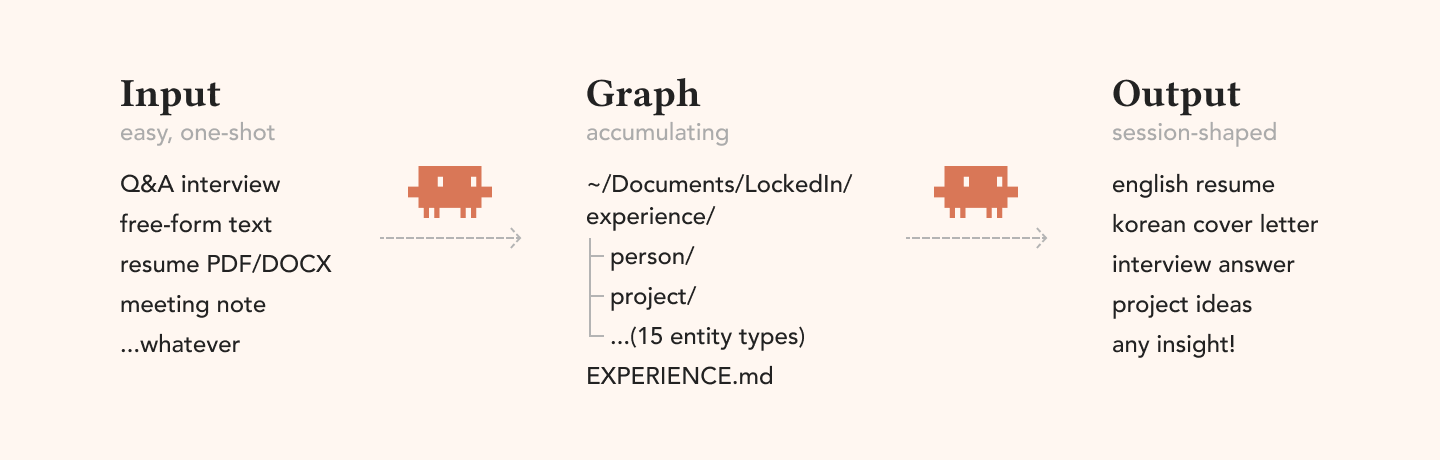
Most career tools regenerate every artifact from scratch. The artifact is the point, the source evaporates. LockedIn treats the source as the point. Your structured experience accumulates at ~/Documents/LockedIn/ as plain markdown files that you own and can carry to other tools. Resumes, cover letters, and meeting notes are artifacts of that memory, not the memory itself.
Your experiences are stored as plain markdown files with frontmatter. Every entity becomes one file. There are fifteen entity types covering people, companies, roles, projects, achievements, skills, education, certificates, publications, volunteer work, languages, documents, meetings, decisions, and topics. Relationships between entities are stored as links inside frontmatter, and the schema enforces which type can connect to which.
When you ask for a render, LockedIn queries the vault, drafts the output in one Claude turn, and then reviews the draft against a calibrated rubric in a separate Claude turn. The split prevents self-evaluation bias. When the same Claude call both writes and scores, it tends to be lenient with itself by about one point. The reviewer turn runs separately and reloads the rubric from scratch, which removes the inflation.
A master file EXPERIENCE.md is automatically maintained at the vault root (~/Documents/LockedIn/). Your entries live in per-type subfolders (person, company, role, project, and so on); instead of opening each folder, you can open this one file to scan the whole vault at a glance. If you edited markdown by hand and the master view feels stale, lockedin refresh rebuilds it.
LockedIn runs on your existing Claude Code subscription. It does not require an Anthropic API key, and it does not phone home.
npx claudepluginhub daypunk/lockedin --plugin lockedinTailored resumes with company research, branching experience discovery, and multi-format output
 varunr89
Interactive 7-level resume coaching process. Transforms generic resumes into compelling, personalized documents through recruiter perspective analysis, gap comparison, and expression discovery.
 xavierchoi
ATS-optimized resume tailoring skill that replaces generic AI resume services. Multi-stage workflow: intake, strategic questions, job-specific optimization, ATS scoring, and DOCX generation. Supports EN/US and RU/CIS locales.
 olegvg
Boutique resume agency skill. Builds, critiques, rewrites, and quality-controls resumes to 8.5+ quality with zero hallucinations. Outputs a send-ready .docx.
 stevesolun
Transforms a master resume and job description into a tailored, ATS-optimized Word document (.docx) with human-sounding bullets and deterministic table-based layout.
 SankaiAI
AI-powered resume builder with job discovery, dual ATS + HR scoring, and cover letter generation. Finds and ranks live job listings by fit, tailors your resume to any JD, auto-detects 6+ professional domains, and produces Workday-compatible DOCX output.
 jananthan30
'%20stop-opacity%3D'0.16'%2F%3E%3Cstop%20offset%3D'1'%20stop-color%3D'rgb(200%2C90%2C60)'%20stop-opacity%3D'0.03'%2F%3E%3C%2FlinearGradient%3E%3C%2Fdefs%3E%3Crect%20width%3D'320'%20height%3D'200'%20fill%3D'url(%23g)'%2F%3E%3Ccircle%20cx%3D'250'%20cy%3D'56'%20r%3D'92'%20fill%3D'rgb(200%2C90%2C60)'%20fill-opacity%3D'0.06'%2F%3E%3Ccircle%20cx%3D'64'%20cy%3D'172'%20r%3D'58'%20fill%3D'rgb(200%2C90%2C60)'%20fill-opacity%3D'0.05'%2F%3E%3C%2Fsvg%3E)