Stats
Actions
Available In
Tags

Self-evolving Claude Code system that learns from corrections, manages context, and improves every session
Show context window usage, active tier, and system stats
Create a new custom slash command
Create a new custom automation hook
Systematic debugging with hypotheses and evidence gathering
Show what the system learned and changed recently
Generates session handoff documents with project state and next steps
Deep health analysis of Evolving Lite - sentinel history, hook performance, recommendations
Checks Evolving Lite data consistency - memory structure, experience index, config validity
Fixes issues found by integrity-checker - repairs JSON, rebuilds indices, fixes permissions
Reviews and refines plans - checks for anti-patterns, missing kill criteria, vague gates
Explains how Evolving Lite works when the user asks about the system, its features, or how to use it. Triggers on questions like "how does this work", "what is evolving lite", "what hooks are running", "explain the system".
Auto-activating session startup - reads memory, orients Claude, announces status. Triggers on session start or when user says "continue", "weiter", "resume".
Executes bash commands
Hook triggers when Bash tool is used
Modifies files
Hook triggers on file write and edit operations
Uses power tools
Own this plugin?
Verify ownership to unlock analytics, metadata editing, and a verified badge. GitHub access is read-only (username + org membership).
Sign in to claimOwn this plugin?
Verify ownership to unlock analytics, metadata editing, and a verified badge. GitHub access is read-only (username + org membership).
Sign in to claimBased on adoption, maintenance, documentation, and repository signals. Not a security audit or endorsement.
Uses Bash, Write, or Edit tools
Uses Bash, Write, or Edit tools



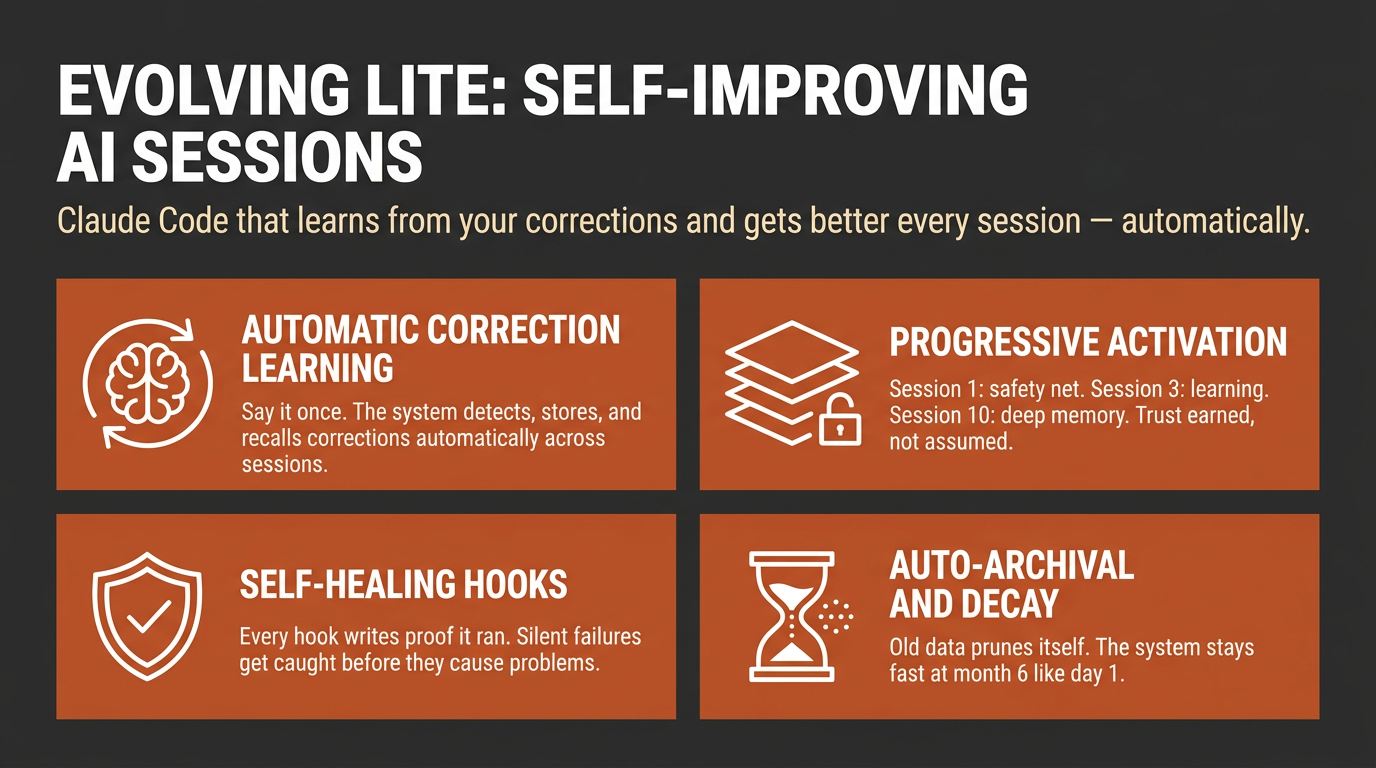
Claude Code that learns from you. Install once. Work normally. The system remembers what worked, learns from your corrections, and gets better every session — without you lifting a finger.
"I corrected Claude about checking tsconfig strict mode first. A week later, different project, similar type error — Claude checked strict mode before I said anything. That's when I stopped thinking of it as a plugin."
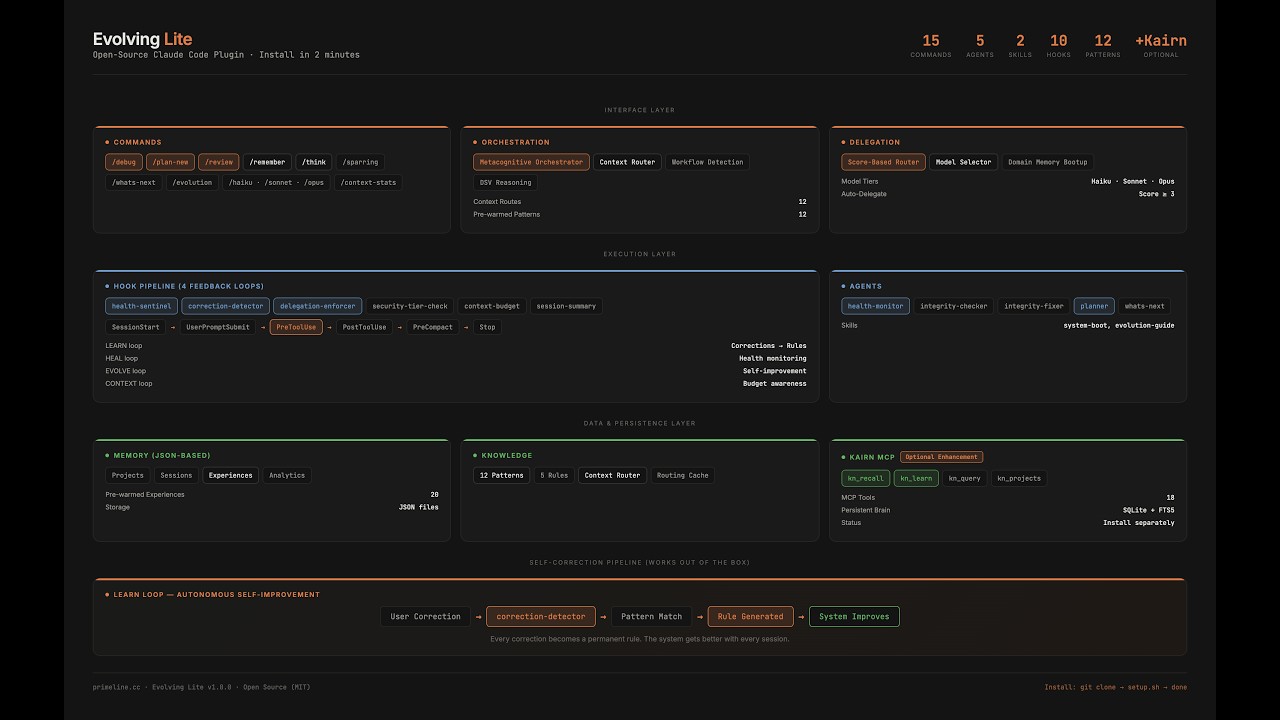
2 min demo: Claude recalls past decisions, learns from a correction, and applies it automatically — no prompt needed.
Evolving Lite prevents drift in real-time. Claude Health audits your full config on demand. Together they close the loop.
| Evolving Lite | Claude Health | |
|---|---|---|
| When | Every session (automatic) | On demand (/health) |
| How | Hooks, pulse checks, correction pipeline | 6-layer config audit with parallel diagnostics |
| Catches | Drift as it happens | Existing gaps and misconfigurations |
Most Claude Code tools add features. Evolving Lite adds feedback loops.
It learns from corrections. Say "No, check tsconfig first" once. The system detects the correction, stores it, and recalls it automatically when a similar situation comes up — across sessions, across projects.
It activates progressively. Session 1: safety net only. Session 3: learning kicks in. Session 10: deep memory. You're never overwhelmed, and each tier earns trust before the next one activates.
It heals itself. Every hook writes a sentinel file proving it ran. Run the health-monitor agent to check all sentinels — silent failures don't stay silent.
It gets leaner, not fatter. Old experiences decay. Stale sessions get archived. The system prunes itself so it stays fast at month 6 the same way it was at day 1.
# 1. Clone
git clone https://github.com/primeline-ai/evolving-lite ~/.claude-plugins/evolving-lite

# 2. Run setup (configures hook paths for your machine)
cd ~/.claude-plugins/evolving-lite && bash setup.sh

# 3. Register (add to ~/.claude/settings.json under "pluginDirectories")
{
  "pluginDirectories": [
    "~/.claude-plugins/evolving-lite"
  ]
}
# 3. Start Claude Code
claude
On first start:
Evolving Lite v1.0 | Session 1 | Tier 1 (Safety) | 20 experiences loaded
The system learns from your corrections automatically.
Day 1 — You install it and work normally. Context warnings appear at 70%. Dangerous bash commands get blocked. 20 pre-warmed experiences provide Claude Code best practices from day one. You barely notice it's there.
Week 1 (Session 3+) — The learning tier activates. When you correct Claude, the system captures it. Exploration tasks start routing to cheaper models automatically. Each session ends with an auto-generated summary of what happened and what's next.
Month 1 (Session 10+) — Deep memory kicks in. While Claude thinks, the system searches your stored experiences and injects relevant solutions before you ask. Old data gets archived automatically. Knowledge survives context compaction. It feels less like a tool and more like a colleague who remembers everything.
The system runs on 4 loops that operate in the background. You don't invoke them — they fire on Claude Code events (session start, tool use, prompt submit, session end).
LEARN    You correct Claude → correction stored → recalled automatically next time
CONTEXT  Budget hits 70% → warning → at 93% knowledge is saved → session continues seamlessly
HEAL     Session starts → sentinel check → broken hook? → you see a warning immediately
EVOLVE   Usage tracked → stale data archived → routes refined → system stays lean
| Loop | Hooks | What changes |
|---|---|---|
| Learn | correction-detector, thinking-recall | Claude stops repeating your corrections |
| Context | context-warning, precompact-extract | You never lose knowledge to context compaction |
| Heal | health-sentinel, health-monitor agent | Silent hook failures get caught via sentinel checks |
| Evolve | usage-tracker, auto-archival | The system prunes itself and stays fast |
npx claudepluginhub bunsdev/evolving-liteReliable automation, in-depth debugging, and performance analysis in Chrome using Chrome DevTools and Puppeteer
 BunsDev
AI agent skills for CopilotKit — setup, develop, integrate, debug, upgrade, and contribute to CopilotKit projects
 BunsDev
Real-time statusline HUD for Claude Code - context health, tool activity, agent tracking, and todo progress
BunsDevProduction-grade academic research pipeline for Claude Code: research → write → review → revise → finalize. 4 skills, 27 modes, 39-agent ensemble, v3.7.3 + v3.8 L3 claim-faithfulness gate, v3.9.0 cross-index triangulation, v3.10 triangulation policy layer, v3.11 deterministic citation verification gate (#182).
BunsDevHarness-native ECC operator layer - 67 agents, 278 skills, 94 legacy command shims, reusable hooks, rules, selective install profiles, and production-ready workflows for Claude Code, Codex, OpenCode, Cursor, and related agent harnesses
 affaan-m
v9.52.0 - Reliability wave: tangle contextual review correction loop with hard round ceiling, progress-supervised review rounds (per-agent stall watch, descendant-tree kills), council diversity and agy pin fixes, marketplace generator source-of-truth fix, provider troubleshooting runbook and cost-expectations docs. Run /octo:setup.
 nyldn
nyldnEvidence-gated AI coding workflow: scan → analyze → plan → TDD → execute → fix → verify → review, powered by Codebase Memory MCP >= 0.9.0 with optional Serena LSP intelligence. Includes blast-radius planning, test/cycle gates, independent review, and Windows Git Bash hook auto-resolution.
 datit309
Claude harness - A harness for solo developers (Vibecoders) to handle full-cycle contract development.
 Chachamaru127
Core skills library for Claude Code: TDD, debugging, collaboration patterns, and proven techniques
 obra
obraTools to maintain and improve CLAUDE.md files - audit quality, capture session learnings, and keep project memory current.
 anthropics
'%20stop-opacity%3D'0.16'%2F%3E%3Cstop%20offset%3D'1'%20stop-color%3D'rgb(200%2C90%2C60)'%20stop-opacity%3D'0.03'%2F%3E%3C%2FlinearGradient%3E%3C%2Fdefs%3E%3Crect%20width%3D'320'%20height%3D'200'%20fill%3D'url(%23g)'%2F%3E%3Ccircle%20cx%3D'250'%20cy%3D'56'%20r%3D'92'%20fill%3D'rgb(200%2C90%2C60)'%20fill-opacity%3D'0.06'%2F%3E%3Ccircle%20cx%3D'64'%20cy%3D'172'%20r%3D'58'%20fill%3D'rgb(200%2C90%2C60)'%20fill-opacity%3D'0.05'%2F%3E%3C%2Fsvg%3E)