Stats
Actions
Available In
Tags
Prepare, format, and submit manuscripts to Nature Geoscience by structuring abstracts, polishing prose to house style, designing figures, managing word limits, writing cover letters, planning referee strategy, and running pre-submission compliance checks.
Use when responding to Nature Geoscience referee reports or editor decisions — point-by-point reply, resubmission, and the Nature Portfolio appeal route. Structures the response and revision; does not redraft the science from scratch.
Use when deciding whether an Earth-science result clears Nature Geoscience's broad-interest, cross-disciplinary Earth-system gate, or whether it belongs in a community journal such as JGR, GRL, or Communications Earth & Environment. Diagnoses venue fit; does not write or frame the result.
Use when partitioning content between the Nature Geoscience main text and its Supplementary Information, ensuring the Article stands alone while extended data, model output, and derivations live in the SI. Organizes the SI; does not write the main text.
Use when running the final pre-submission preflight for a Nature Geoscience manuscript — word/display-item limits, format, files, online Methods, Supplementary Information, Reporting Summary, data/code availability, and Editorial Manager metadata. Verifies submission readiness; does not write content.
Use when writing the cover letter for a Nature Geoscience submission, which must convince an in-house editor that the work is a broad-interest Earth-system advance appropriate for a diverse readership. Drafts the editorial case; does not edit the manuscript itself.
Own this plugin?
Verify ownership to unlock analytics, metadata editing, and a verified badge. GitHub access is read-only (username + org membership).
Sign in to claimOwn this plugin?
Verify ownership to unlock analytics, metadata editing, and a verified badge. GitHub access is read-only (username + org membership).
Sign in to claimBased on adoption, maintenance, documentation, and repository signals. Not a security audit or endorsement.




English | 简体中文
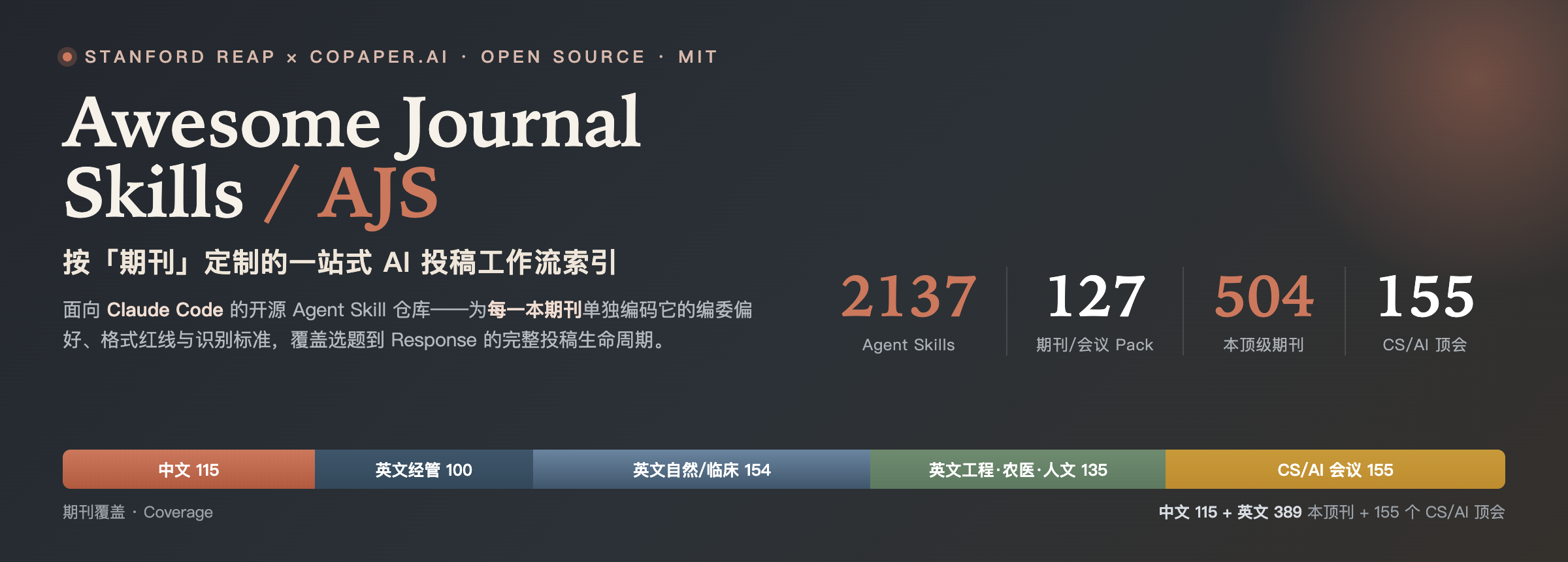
按 11 个主流学科板块覆盖
点击任一学科名可跳转到对应说明;每类下的代表子领域在正文总览中完整列出。下方封面墙按 venue 导航,完整分类见覆盖一览。
🧭 布局指南 · 📚 Skill Pack 一览 · ⚡ 如何使用 · 🧪 自动实证 Showcase(真实运行证据) · 🔎 Venue 索引(289 刊机读表) · 🗺 路线图 · 🌐 English
npx claudepluginhub brycewang-stanford/awesome-journal-skills --plugin ngeo-skillsAgent skill stack for submitting to Advanced Materials (Adv. Mater.), Wiley-VCH's flagship high-impact materials-science journal. Covers the materials-advance-plus-broad-impact scope gate, central-advance framing, multi-technique characterization rigor, cover-quality figures and the TOC graphic, Supporting Information partitioning, Wiley house style, the Communication-vs-Article length format, the impact-justifying cover letter, submission preflight, referee strategy, and revision. English docs with a bilingual zh-CN README.
 brycewang-stanford
Agent skill stack for manuscripts targeted at the Journal of International Marketing (JIM), the AMA/SAGE specialist top journal for international marketing. Twelve role skills enforce JIM's distinctive bar: cross-national theorizing as the paper's engine, multi-country designs with measurement-invariance discipline, and decision rules for firms operating across borders, from topic selection through the ScholarOne preflight and the revision round.
brycewang-stanfordAgent skill stack for submitting to Molecular Cell (Cell Press) — the flagship journal for mechanistic molecular biology (gene expression, chromatin/epigenetics, RNA biology, DNA replication/repair, signaling, proteostasis, structural mechanism). Encodes Molecular Cell's editorial bar (deep mechanism, not phenomenology, proven by multiple orthogonal approaches with physiological relevance), the Article/Short Article structure, the ~7,000-word / ~7-display-item budget, the signature Cell Press artifacts (Highlights, eTOC/In Brief blurb, Graphical Abstract), the Summary, mandatory STAR Methods with the Key Resources Table and Resource Availability, data/code deposition (GEO/PDB/PRIDE), the Cell Press numbered superscript reference style, submission preflight, and reviewer rebuttals. English-first docs with zh-CN mirror.
brycewang-stanfordAgent skill stack for manuscripts targeted at Accounting, Organizations and Society (AOS), the flagship interdisciplinary accounting journal founded by Anthony Hopwood in 1976 and published by Elsevier. AOS studies the social, organizational, behavioral and institutional aspects of accounting, so this stack is theory-first and methodologically plural: qualitative field studies, experimental/behavioral accounting, surveys, historical and critical work, and archival designs that carry organizational or social theorizing. Covers topic selection and scope fit (including the desk-reject risk of JAR/JAE-style capital-markets papers), theorizing with institutional theory, governmentality, Bourdieu, actor-network theory and practice theory, qualitative and experimental methods, analysis and reporting, Editorial Manager submission under double-anonymized review, and R&R rebuttals to interdisciplinary reviewer panels. Bilingual en / zh-CN docs.
brycewang-stanfordAgent skill stack for submitting to 《财贸经济》 (Finance & Trade Economics), a top CSSCI economics journal hosted by the National Academy of Economic Strategy, Chinese Academy of Social Sciences. Covers fiscal / tax / finance / trade / circulation / consumption topic selection, bilingual literature review, causal identification (DID / IV / RDD / DML), household- and firm-level mechanism and heterogeneity analysis, three-line tables, China-policy-anchored implications, journal house style, and R&R rebuttals. Bilingual zh-CN / en docs; templates for CNKI / CSMAR / WIND / CEIC and Chinese macro-finance data.
brycewang-stanfordAgent skill stack for manuscripts targeted at Earth and Planetary Science Letters (EPSL) — Elsevier's flagship letters journal for solid-Earth and planetary science (founded 1966, ISSN 0012-821X), submitted through Editorial Manager under editor-screened expert peer review. EPSL publishes concise, high-significance Letters on the physical, chemical and mechanical processes of the Earth and other planets (including extrasolar ones), from deep interiors to atmospheres, spanning geochemistry, geophysics, geochronology, geodynamics, petrology, paleomagnetism, cosmochemistry and planetary interiors. The stack is built around what actually decides an EPSL paper: the letters-format word budget, a process-level advance rather than a regional case study, full analytical-uncertainty reporting for isotope and geochronology data, FAIR data deposition (EarthChem, PANGAEA, IRIS/EarthScope, MagIC, NASA PDS, Zenodo), and framing that reaches a multi-disciplinary Earth-and-planets readership. Bilingual en / zh-CN docs.
brycewang-stanfordComprehensive skill pack with 66 specialized skills for full-stack developers: 12 language experts (Python, TypeScript, Go, Rust, C++, Swift, Kotlin, C#, PHP, Java, SQL, JavaScript), 10 backend frameworks, 6 frontend/mobile, plus infrastructure, DevOps, security, and testing. Features progressive disclosure architecture for 50% faster loading.
 Jeffallan
A growing collection of Claude-compatible academic workflow bundles. Covers scientific figures, manuscript writing and polishing, reviewer assessment, citation retrieval, data availability, paper reading, literature search, response letters, paper-to-PPTX conversion, and evidence-grounded Chinese invention patent drafting. Rules are organized as reusable skill folders with explicit workflows and quality checks.
 Yuan1z0825
Upstash Context7 MCP server for up-to-date documentation lookup. Pull version-specific documentation and code examples directly from source repositories into your LLM context.
 upstash
v9.54.1 — Reliability wave: tangle contextual review correction loop with hard round ceiling, progress-supervised review rounds (per-agent stall watch, descendant-tree kills), council diversity and agy pin fixes, marketplace generator source-of-truth fix, provider troubleshooting runbook and cost-expectations docs. Run /octo:setup.
 nyldn
nyldnComplete creative writing suite with 10 specialized agents covering the full writing process: research gathering, character development, story architecture, world-building, dialogue coaching, editing/review, outlining, content strategy, believability auditing, and prose style/voice analysis. Includes genre-specific guides, templates, and quality checklists.
 greyhaven-ai
'%20stop-opacity%3D'0.16'%2F%3E%3Cstop%20offset%3D'1'%20stop-color%3D'rgb(200%2C90%2C60)'%20stop-opacity%3D'0.03'%2F%3E%3C%2FlinearGradient%3E%3C%2Fdefs%3E%3Crect%20width%3D'320'%20height%3D'200'%20fill%3D'url(%23g)'%2F%3E%3Ccircle%20cx%3D'250'%20cy%3D'56'%20r%3D'92'%20fill%3D'rgb(200%2C90%2C60)'%20fill-opacity%3D'0.06'%2F%3E%3Ccircle%20cx%3D'64'%20cy%3D'172'%20r%3D'58'%20fill%3D'rgb(200%2C90%2C60)'%20fill-opacity%3D'0.05'%2F%3E%3C%2Fsvg%3E)