Stats
Actions
Available In
Tags

Orchestrate complex development workflows by decomposing tasks, delegating them to specialized agents (code review, DevOps, documentation, QA, architecture) for parallel execution, with enforcement of task dependencies and compliance rules.
Remove technical debt, improve quality, eliminate redundancy after implementation is verified. Never use before functionality works correctly.
Expert code review for best practices, quality, maintainability, and security. Use for pre-merge reviews, security audits, or quality assessment.
Understand codebase structure, patterns, dependencies, and architecture. Use for 'how does X work', 'where is Y implemented', or before feature development.
Manage Python dependencies, update packages, resolve conflicts, validate compatibility, check security vulnerabilities.
Set up environments, CI/CD pipelines, secrets management, containerization, deployment infrastructure, and developer tooling.
Matches all tools
Hooks run on every tool call, not just specific ones
Executes bash commands
Hook triggers when Bash tool is used
Own this plugin?
Verify ownership to unlock analytics, metadata editing, and a verified badge. GitHub access is read-only (username + org membership).
Sign in to claimOwn this plugin?
Verify ownership to unlock analytics, metadata editing, and a verified badge. GitHub access is read-only (username + org membership).
Sign in to claimnpx claudepluginhub barkain/claude-code-workflow-orchestration --plugin workflow-orchestratorBased on adoption, maintenance, documentation, and repository signals. Not a security audit or endorsement.
Modifies files
Hook triggers on file write and edit operations
Modifies files
Hook triggers on file write and edit operations
Uses power tools
Uses Bash, Write, or Edit tools
Uses power tools
Uses Bash, Write, or Edit tools
A hook-based framework for Claude Code that enforces task delegation to specialized agents, enabling structured workflows and expert-level task handling through intelligent orchestration.
See the delegation system in action:
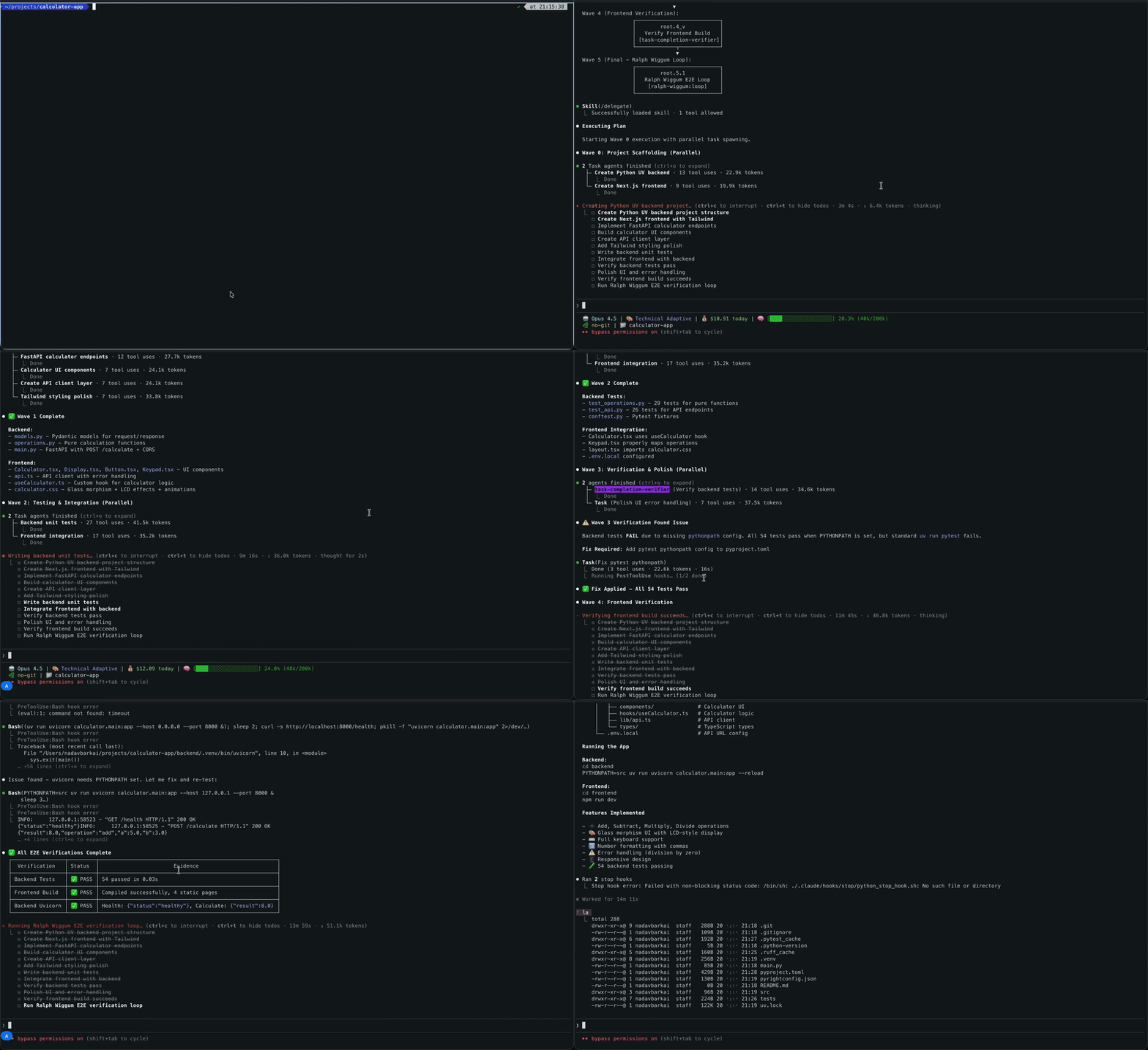
⚡ Soft Enforcement & Lean Startup — Replaces hard-blocking enforcement with adaptive per-turn nudges (silent → hint → warning → strong reminder). SessionStart injection trimmed ~6.6K tokens: stub orchestrator (~1.1KB) injected on startup, full orchestrator loaded only on first delegation. Output style loaded natively from plugin.json (no injection). Net result: lean sessions with automatic escalation when delegation is needed.
🤝 Agent Teams Integration — Native dual-mode execution: workflows automatically select between isolated subagents and collaborative Agent Teams (via TeamCreate + Agent(team_name=...) + SendMessage) based on tool availability. Teammates communicate in real-time, share task lists, and self-coordinate. Enable with CLAUDE_CODE_EXPERIMENTAL_AGENT_TEAMS=1.
This system uses Claude Code's hook mechanism to create a delegation-enforced workflow architecture that routes tasks to specialized agents for expert-level execution.
/workflow-orchestrator:delegate. Subagents immune. Nudge counter resets each turn and zeros when delegation runs.TeamCreate + Agent(team_name=...) + SendMessage for peer-to-peer collaboration, shared task lists, and coordinated multi-agent workflowsThe system uses a two-stage execution pipeline:
Stage 0: Planning & Analysis (native plan mode)
Stage 1: Execution
DONE|{path}. Context-efficient, optimal for most workflows.TeamCreate + Agent(team_name=...). Teammates share context, communicate via SendMessage, and self-coordinate through shared task lists. Requires CLAUDE_CODE_EXPERIMENTAL_AGENT_TEAMS=1.Execution Mode Selection: If TeamCreate is in available tools → execution_mode: "team". Otherwise → "subagent". Tool availability is the only signal (set CLAUDE_CODE_EXPERIMENTAL_AGENT_TEAMS=1 to enable). For subagent mode, plan mode further selects sequential (context preservation, dependencies) or parallel (time savings, independence) based on phase dependency analysis.
MCP server that orchestrates multiple Claude CLI instances as parallel workers with a real-time dashboard
 barkain
Multi-agent orchestration via li o flow and li o fanout
 ohdearquant
This skill should be used when the model's ROLE_TYPE is orchestrator and needs to delegate tasks to specialist sub-agents. Provides scientific delegation framework ensuring world-building context (WHERE, WHAT, WHY) while preserving agent autonomy in implementation decisions (HOW). Use when planning task delegation, structuring sub-agent prompts, or coordinating multi-agent workflows.
 Jamie-BitFlight
Multi-agent orchestration for complex tasks using cc-mirror tasks and TodoWrite. Use when tasks require parallel work, multiple agents, sophisticated coordination, or decomposition into parallel subtasks.
 numman-ali
Multi-agent task decomposition and coordination for Claude Code
 joelhooks
Run Claude Code dynamic-workflow scripts on a local Codex App Server — fan out Codex/GPT agents with the agent/parallel/pipeline DSL, sessionful steerable workers, supervised fleets (--multi), live viewers, and run analytics.
 scasella
Parallel task orchestration for AI coding agents - dispatch work to Codex or Claude Code workers in isolated git workspaces
 zippoxer
'%20stop-opacity%3D'0.16'%2F%3E%3Cstop%20offset%3D'1'%20stop-color%3D'rgb(200%2C90%2C60)'%20stop-opacity%3D'0.03'%2F%3E%3C%2FlinearGradient%3E%3C%2Fdefs%3E%3Crect%20width%3D'320'%20height%3D'200'%20fill%3D'url(%23g)'%2F%3E%3Ccircle%20cx%3D'250'%20cy%3D'56'%20r%3D'92'%20fill%3D'rgb(200%2C90%2C60)'%20fill-opacity%3D'0.06'%2F%3E%3Ccircle%20cx%3D'64'%20cy%3D'172'%20r%3D'58'%20fill%3D'rgb(200%2C90%2C60)'%20fill-opacity%3D'0.05'%2F%3E%3C%2Fsvg%3E)