Stats
Actions
Available In
Tags
Automate end-to-end academic research workflows: discover ideas, survey literature, run experiments, and produce venue-ready proposals with adversarial review and iteration.
<env>
Orchestrate the experiment auditor/scientist/coder/reviewer loop for a workspace.
You are a dispatcher. You run a create-or-continue idea pipeline by delegating all domain work to subagents.
Run proposal refine/review/deep-lit loops in parallel until proposals are ready.
<role>
Check whether the system environment satisfies prerequisites for running the research system.
Audit an experiment workspace's plan, code, results, and operations; find blockers and require the next response.
Implement, deploy, monitor, sync, and debug experiments from the STATE.md Runs table.
Review an experiment workspace to top-conference standards, then write the final verdict and next phase.
Research-mindset catalog distilled from ARIS skills, for subagent Read on demand.
This skill should be used when the user asks to "search for papers", "get paper info", "download LaTeX source", "generate BibTeX citation", "find citing papers", or provides an arXiv ID or arXiv URL.
Use when checking novelty of a research idea or proposal. Extract core claims, do multi-source arxiv / Scholar / S2 search, grade each claim HIGH/MEDIUM/LOW. 基本就是 ARIS novelty-check skill, 但去掉了 cross-model verification 和 report schema.
Use when you need project-specific compute/server notes to pick a server or confirm a running task, if the project has filled its server manual or monitoring hooks.
Research-persona catalog distilled from Sibyl prompts, for subagent Read on demand. 与 ARIS 互补 — ARIS 按阶段组织, Sibyl 按人格视角组织.
Uses power tools
Uses Bash, Write, or Edit tools
Has parse errors
Some configuration could not be fully parsed
Own this plugin?
Verify ownership to unlock analytics, metadata editing, and a verified badge. GitHub access is read-only (username + org membership).
Sign in to claimOwn this plugin?
Verify ownership to unlock analytics, metadata editing, and a verified badge. GitHub access is read-only (username + org membership).
Sign in to claimBased on adoption, maintenance, documentation, and repository signals. Not a security audit or endorsement.
English | 中文
Agon (paper) is an automated research system. It keeps the workflow minimal and explicit: topic -> idea -> proposal -> experiment.
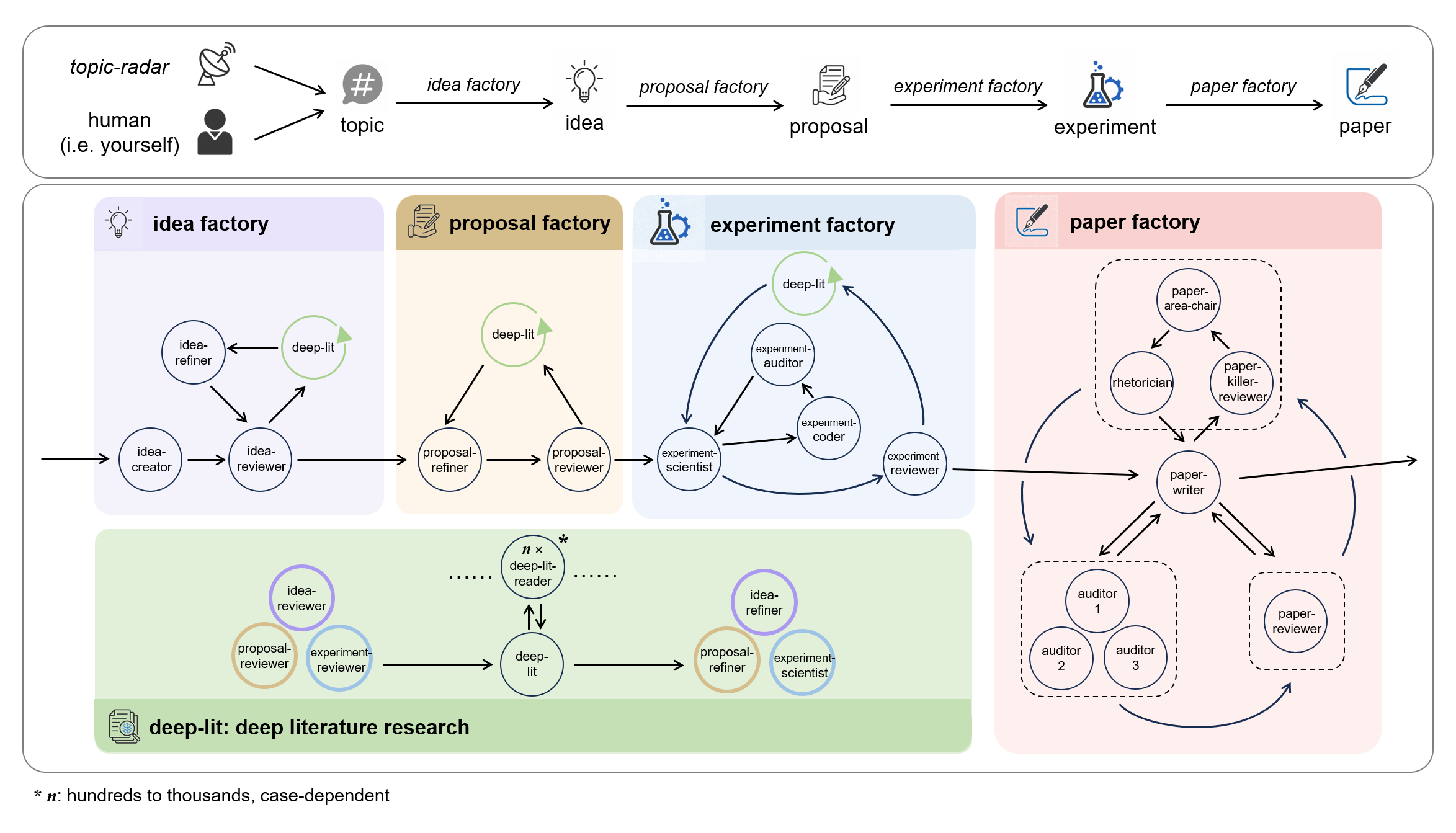
Clone Agon and agon-artifacts:
git clone https://github.com/AutoResearch-Factory/Agon.git
git clone https://github.com/AutoResearch-Factory/agon-artifacts.git
Put the two directories side by side:
.
├── Agon/
└── agon-artifacts/
Then run Claude Code from the artifacts repository:
cd agon-artifacts
claude --plugin-dir ../Agon --dangerously-skip-permissions --model claude-sonnet-5[1m]
In Claude Code, use these commands to move the research forward:
/idea-tick: create, review, refine, and literature-check ideas for a topic./proposal-tick: turn selected ideas into reviewed proposals./experiment-tick: coordinate scientist, coder, auditor, and reviewer roles for one workspace./deep-lit-tick: run the shared deep literature loop used by the other stages./deep-lit-tick Exhaustively survey the literature on <topic>, and write the result to topics/mmdd-<slug>-landscape.md.
/idea-tick <topic-slug> <topic> is becoming important. Brainstorm several research ideas.
/idea-tick <idea-slug> I have a vague idea about <topic>. Create the topic file, create the idea file, and refine the idea.
/proposal-tick <idea-1> <idea-2> <idea-3> Generate proposals for these ideas.
/experiment-tick <slug> Start the experiment.
/experiment-tick <slug> This is a debugging run. First explain the full procedure, then pause for my approval after each agent call.
Agon itself is a Claude Code plugin. Run it from a separate data workspace, commonly named agon-artifacts, so prompts/code and research data can evolve independently.
Expected data workspace layout:
agon-artifacts/
├── topics/
├── ideas/
└── workspace/
Optional local settings live at .settings.toml. Start from .settings.example.toml when you need to customize model routing or parallelism.
claude-ds is DeepSeek-backed Claude Code.
Before first launch, create an empty ~/.claude-ds/ and only handle symlinks. Claude will generate the rest on first launch:
CLAUDE.md mcp-needs-auth-cache.json memory/ plugins/ settings.json settings.local.json skills/backups/ cache/ downloads/ ide/ stats-cache.json projects/ sessions/ session-env/ file-history/ history.jsonl paste-cache/ shell-snapshots/ .claude.jsonclaude and claude-ds share skills, MCP, and pluginsAdd the claude-ds() function to ~/.bashrc:
claude-ds() {
  CLAUDE_CONFIG_DIR="$HOME/.claude-ds" \
  ANTHROPIC_BASE_URL="https://api.deepseek.com/anthropic" \
  ANTHROPIC_AUTH_TOKEN="$DEEPSEEK_API_KEY" \
  ANTHROPIC_MODEL="deepseek-v4-pro[1m]" \
  ANTHROPIC_SMALL_FAST_MODEL="deepseek-v4-flash" \
  claude --effort max "$@"
}
Notes:
# If not running interactively guard, so non-interactive shells such as Claude Code's Bash tool can see it[1m] suffix to the model ID to unlock 1M contextclaude-ds| Item | Purpose |
|---|---|
DISABLE_TELEMETRY | Disable Statsig telemetry (usage stats, no code or file paths) |
CLAUDE_CODE_EXPERIMENTAL_AGENT_TEAMS | Let the main agent resume background/asynchronous subagents, and let subagents message each other |
cleanupPeriodDays: 3650 | Keep session history under ~/.claude/projects/ (default cleanup is after 30 days); set this at the top level of ~/.claude/settings.json |
Configure statusline
Tell claude or claude-ds: "call statusline-setup, I want [5h:6% 7d:69%(2d17h)] Ctx:7% Opus 4.6 (1M context)"
npx claudepluginhub autoresearch-factory/agonOh My Paper research harness: memory system, Codex delegation, and pipeline commands for academic research projects.
 LigphiDonk
Autonomous, personalized research loops for Claude Code. Set a topic, walk away, come back to a quality-gated report adapted to your projects.
 primeline-ai
Strategic research thinking agents — idea evaluation, project triage, and structured brainstorming inspired by Carlini's research methodology
 andrehuang
Semi-automated research assistant for academic research and software development, with skills for literature review, experiments, analysis, writing, and project knowledge management
 Galaxy-Dawn
Autonomous research loops with 10 commands. Generalizes Karpathy's autoresearch loop to any domain with mechanical evaluation, overnight persistence, and zero dependencies.
 wjgoarxiv
PhD-level research capabilities: literature review, multi-source investigation, critical analysis, hypothesis-driven exploration, quantitative/qualitative methods
 poemswe
'%20stop-opacity%3D'0.16'%2F%3E%3Cstop%20offset%3D'1'%20stop-color%3D'rgb(200%2C90%2C60)'%20stop-opacity%3D'0.03'%2F%3E%3C%2FlinearGradient%3E%3C%2Fdefs%3E%3Crect%20width%3D'320'%20height%3D'200'%20fill%3D'url(%23g)'%2F%3E%3Ccircle%20cx%3D'250'%20cy%3D'56'%20r%3D'92'%20fill%3D'rgb(200%2C90%2C60)'%20fill-opacity%3D'0.06'%2F%3E%3Ccircle%20cx%3D'64'%20cy%3D'172'%20r%3D'58'%20fill%3D'rgb(200%2C90%2C60)'%20fill-opacity%3D'0.05'%2F%3E%3C%2Fsvg%3E)