Stats
Actions
Available In
Tags

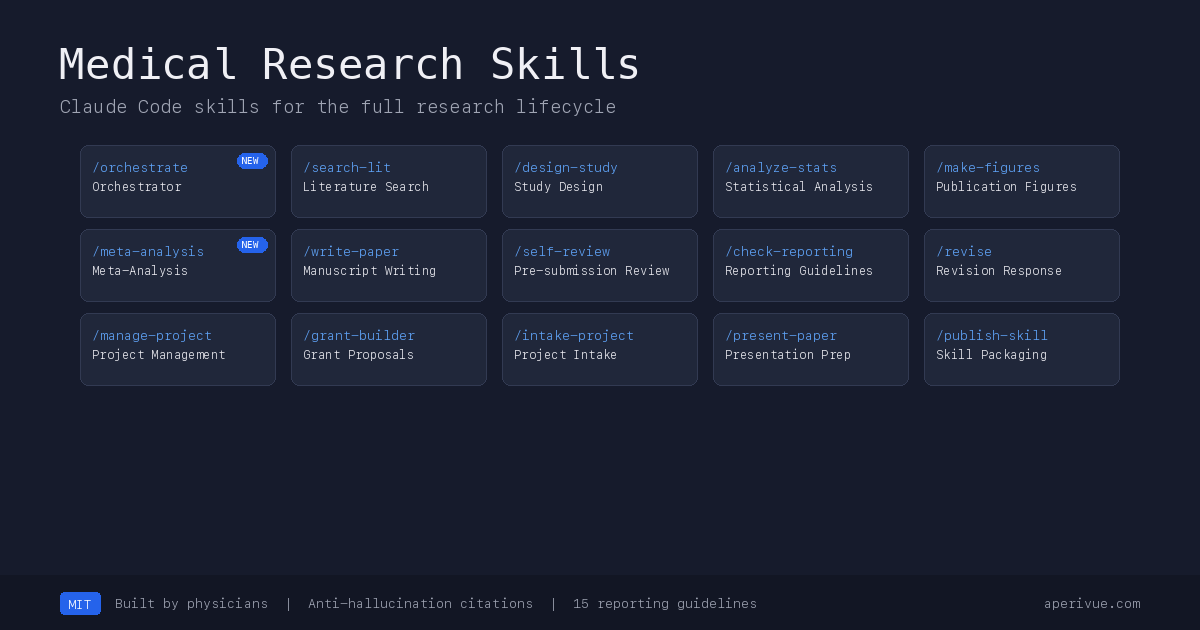
Orchestrate medical research workflows: intake projects, discover meta-analysis topics, audit study designs, generate reproducible analyses, check manuscript compliance with reporting guidelines, and prepare submission-ready documents.
Medical AI paper optimization for AI search engines (Perplexity, ChatGPT web, Elicit, Consensus, SciSpace) and RAG-based literature tools. Applies when drafting or reviewing titles, abstracts, structured summary boxes (Key Points / Research in Context / Plain-Language Summary), manuscripts for high-impact medical AI journals (Lancet Digital Health, Radiology, Radiology-AI, npj Digital Medicine, Nature Medicine), preprints (medRxiv/arXiv), GitHub README + CITATION.cff + Zenodo archives, and Hugging Face model/dataset cards. Integrates TRIPOD+AI, CLAIM 2024, STARD-AI, TRIPOD-LLM, DECIDE-AI reporting requirements with generative engine optimization (GEO) principles. Produces a visible pass/fail checklist.
Add a new journal to the MedSci Skills profile database. Extracts metadata from author guidelines, generates write-paper (detailed) and find-journal (compact) profiles in canonical format with quality gates.
Statistical analysis for medical research papers. Generates reproducible Python/R code with publication-ready tables and figures. Supports diagnostic accuracy, inter-rater agreement, meta-analysis, survival analysis, survey data, group comparisons, regression, propensity score, and repeated measures.
Choose a model architecture for a medical-imaging research question before scaffolding. Maps the task (classification, segmentation, detection, transfer), modality and dimensionality, labelled-data scale, and class imbalance to a shortlist of architectures, each grounded in its source paper with a when-to-use, a medical-imaging use, a reference implementation, the typical validation setup, and the matching model-scaffold template. Covers the foundational curriculum (ResNet, DenseNet, EfficientNet, ViT, Swin; U-Net, 3-D U-Net, Attention/Residual U-Net, nnU-Net (+ ResEnc/MedNeXt/STU-Net), Mask R-CNN; SAM/MedSAM, nnInteractive/VISTA3D interactive-3D, TotalSegmentator, BiomedCLIP, DINO/MAE/SimCLR; and graph neural nets — GCN/GraphSAGE/GAT/GIN/BrainGNN — for brain connectomes). It teaches archetypes and the task-to-architecture logic (including the "scale the CNN, new≠better" rigour caveat), not a live SOTA leaderboard.
Offer your local changes back to the project — a journal profile you added, a checklist item you fixed, a skill you adapted to your department — as a pull request or an issue, without ever typing a git command. Detects what you changed against the installed version, scans it for patient data and identifiers, shows you every line, and sends nothing until you confirm. Also files feedback: a detector that fired wrongly, a step that failed on your file.
Own this plugin?
Verify ownership to unlock analytics, metadata editing, and a verified badge. GitHub access is read-only (username + org membership).
Sign in to claimOwn this plugin?
Verify ownership to unlock analytics, metadata editing, and a verified badge. GitHub access is read-only (username + org membership).
Sign in to claimBased on adoption, maintenance, documentation, and repository signals. Not a security audit or endorsement.
Executables (bin/) — files in this plugin's bin/directory are added to the Bash tool's PATH while the plugin is enabled.
58 skills that actually work. Built by a physician-researcher, tested on real publications.
MedSci Skills is an end-to-end research tool for physician and medical-engineering researchers — design → scaffold → validate → publish — for the clinical manuscript and the medical-AI model behind it. Its moat is the compliance layer — 47 reporting guidelines and risk-of-bias tools, reference/citation verification, and deterministic integrity gates before peer review — now extended by a model-engineering lane that scaffolds reproducible, leakage-safe training repos and audits model validation. Clinical AI model research engineering is in scope; a general AI-scientist platform is not. It competes on clinical submission reliability, not skill count.











Topic Discovery → Literature Search → Full-Text Retrieval → Study Design → Sample Size → Protocol → De-identification → Data Cleaning → Statistics → Figures → Writing → Humanize → Compliance → Journal Selection → Peer Review → Revision → Presentation
Created & maintained by Yoojin Nam, MD
Department of Radiology and Research Institute of Radiology, University of Ulsan College of Medicine, Asan Medical Center, Seoul, Republic of Korea

npx claudepluginhub aperivue/medsci-skills --plugin medsci-presentationScientific writing, citations, grants, posters, and academic career (13 skills)
 AlterLab-IEU
A growing collection of Claude-compatible academic workflow bundles. Covers scientific figures, manuscript writing and polishing, reviewer assessment, citation retrieval, data availability, paper reading, literature search, response letters, paper-to-PPTX conversion, and evidence-grounded Chinese invention patent drafting. Rules are organized as reusable skill folders with explicit workflows and quality checks.
 Yuan1z0825
Scientific research brainstorming partner: survey the literature, find good problems, and shape concrete research ideas together
 QuantumBFS
Specialized research analysis agents for critical thinking, evidence verification, synthesis, and parallel paper analysis
 rpatrik96
General-purpose assistant for writing scientific papers, research, and technical documentation with academic rigor. Improves clarity and structure of scholarly work.
 K-Dense-AI
深度研究 — 13 agent 协作:研究问题定义、系统性检索、偏差评估、综合分析、引用编译
 Imbad0202
'%20stop-opacity%3D'0.16'%2F%3E%3Cstop%20offset%3D'1'%20stop-color%3D'rgb(200%2C90%2C60)'%20stop-opacity%3D'0.03'%2F%3E%3C%2FlinearGradient%3E%3C%2Fdefs%3E%3Crect%20width%3D'320'%20height%3D'200'%20fill%3D'url(%23g)'%2F%3E%3Ccircle%20cx%3D'250'%20cy%3D'56'%20r%3D'92'%20fill%3D'rgb(200%2C90%2C60)'%20fill-opacity%3D'0.06'%2F%3E%3Ccircle%20cx%3D'64'%20cy%3D'172'%20r%3D'58'%20fill%3D'rgb(200%2C90%2C60)'%20fill-opacity%3D'0.05'%2F%3E%3C%2Fsvg%3E)


