Stats
Actions
Available In
Tags

Local-first vulnerability confirmation and remediation pipeline for Claude Code: context, x-ray, PASTA threat model, CVE threat-intel, SAST/taint, invariant testing, adversarial hunting, memory exploitability, fuzz proof, rule synthesis, SARIF, and PoC⁺ patch validation behind a hardened policy plane. Operates on source you have on disk, with no hosted service, live target, proxy, or traffic capture.
Authorization-model review. For each endpoint / object-access candidate, determine whether an authorization + ownership check actually protects the action — find missing authz (CWE-862), IDOR / broken object-level authz (CWE-639), privilege escalation, and broken ownership. Assign finding / candidate / rejected with file:line evidence. Read-only — promotes verdicts into .kuzushi/findings.json (source 'authz').
Read-only static triage of compiled binaries (ELF / PE / Mach-O). For each detected binary and its read-only signals (dangerous imported symbols, writable+executable segments, hardening gaps from nm/readelf/objdump), judge whether the signal is a real exposure in context and tie it to source. Assign finding / candidate / rejected with the binary path as evidence. Assessment only — no execution, no exploit-oriented disassembly. Promotes into .kuzushi/findings.json (source 'binary-recon').
Proactive attack-path engine. SEARCHES for ordered entry→…→asset paths where each step is enabled by a finding — composing even sub-threshold (candidate/lead) primitives into a critical chain — using the threat-model assets, the attacker-reachable entry points, and the reachability graph. Also composes already-confirmed findings (precondition → pivot → impact). Does NOT invent findings or change their status; it overlays chains on the findings index.
Deep system-understanding pass BEFORE vulnerability work. Reads the codebase line-by-line where it matters and builds a grounded model — modules, entry points, actors, trust boundaries, data stores, and system invariants — with file:line evidence. Context only: it never finds vulns, proposes fixes, or assigns severity. Writes .kuzushi/deep-context.json.
Crypto-misuse review: non-constant-time comparison of secrets (timing side-channels), missing or compiler-elidable zeroization of secrets, and non-cryptographic RNG used to mint secrets. For each candidate, confirm the value is secret-derived, assess the leak/weakness, and assign finding / candidate / rejected with file:line evidence. Read-only — promotes verdicts into .kuzushi/findings.json (source 'crypto-review').
Authorization-model review. Scans endpoints + object-access-by-id sites; the authz-reviewer agent finds missing authorization (CWE-862), IDOR / broken object-level authz (CWE-639), privilege escalation, and broken ownership, and promotes them into .kuzushi/findings.json (source "authz"). Complements /threat-hunt (which hunts named threats) with a dedicated authz pass.
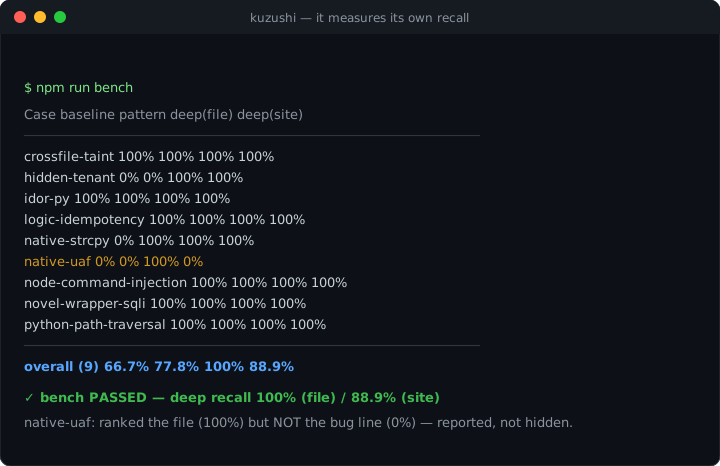
Measure recall / precision / false-proof rate of the pipeline against a ground-truth manifest. Scores either the bundled planted-vulnerability corpus (regression) or a live run's findings.json against a manifest you supply. Deterministic — no agent, no network. Use to prove a change to the producers helps rather than hurts.
Read-only static triage of compiled binaries (ELF / PE / Mach-O). Detects them by magic bytes, then surfaces dangerous imported symbols, writable+executable segments, and hardening gaps via on-PATH binutils (nm / readelf / objdump). Assessment only — no execution, no exploit-oriented disassembly. Promotes verdicts into .kuzushi/findings.json (source "binary-recon").
Build the heavy semantic indexes the codeql/joern backends query — a CodeQL database (per detected language) and a Joern CPG — under .kuzushi/. Runs asynchronously in the background (doesn't block the session); installs the CLI first if missing. Pass "codeql" or "joern" to build just one.
Proactive attack-path engine. The chain-finder agent SEARCHES for ordered entry→…→asset attack paths where each step is enabled by a finding — composing even sub-threshold (candidate/lead) primitives into a critical chain — using the threat-model assets, attacker-reachable entry points, and the reachability graph. Records each path (ordered narrative + member fingerprints) in .kuzushi/chains.json and attaches a `chains` ref onto each member (status unchanged). Needs ≥2 live findings.
Admin access level
Server config contains admin-level keywords
Executes bash commands
Hook triggers when Bash tool is used
Executables (bin/) — files in this plugin's bin/directory are added to the Bash tool's PATH while the plugin is enabled.
Modifies files
Hook triggers on file write and edit operations
Modifies files
Hook triggers on file write and edit operations
Uses power tools
Uses Bash, Write, or Edit tools
Uses power tools
Uses Bash, Write, or Edit tools
Based on adoption, maintenance, documentation, and repository signals. Not a security audit or endorsement.
npx claudepluginhub allsmog/kuzushi-security-plugin --plugin kuzushi-security-pluginHarness-native ECC operator layer - 67 agents, 278 skills, 94 legacy command shims, reusable hooks, rules, selective install profiles, and production-ready workflows for Claude Code, Codex, OpenCode, Cursor, and related agent harnesses
 affaan-m
Evidence-gated AI coding workflow: scan → analyze → plan → TDD → execute → fix → verify → review, powered by Codebase Memory MCP >= 0.9.0 with optional Serena LSP intelligence. Includes blast-radius planning, test/cycle gates, independent review, and Windows Git Bash hook auto-resolution.
 datit309
Comprehensive skill pack with 66 specialized skills for full-stack developers: 12 language experts (Python, TypeScript, Go, Rust, C++, Swift, Kotlin, C#, PHP, Java, SQL, JavaScript), 10 backend frameworks, 6 frontend/mobile, plus infrastructure, DevOps, security, and testing. Features progressive disclosure architecture for 50% faster loading.
 Jeffallan
Comprehensive .NET development skills for modern C#, ASP.NET, MAUI, Blazor, Aspire, EF Core, Native AOT, testing, security, performance optimization, CI/CD, and cloud-native applications
 wshaddix
AI-powered whitebox penetration testing plugin for Claude Code. 9 languages, 27 skills, 8 autonomous agents. STRIDE threat modeling, hotspot-aware findings, SARIF output, and polyglot monorepo support.
 allsmog
AI-first compliance assessment plugin for Claude Code. Runs prompt-orchestrated ISO 27001 Annex A and NIST SP 800-53 Rev 5 assessments with enterprise evidence packs, evidence-backed findings, cold review rounds, and durable run artifacts.
 allsmog
AI-powered PASTA threat modeling plugin for Claude Code. Walks through the 7-stage Process for Attack Simulation and Threat Analysis with STRIDE classification, MITRE ATT&CK mapping, DFD generation, and evidence-anchored threat scenarios.
allsmogComprehensive SEO analysis plugin for Claude Code. 25 sub-skills (21 core + 1 orchestrator + 1 framework + 2 extension mirrors) and 18 sub-agents cover technical SEO, content quality, schema, sitemaps, Core Web Vitals, local SEO, backlinks, AI/GEO, ecommerce, hreflang, SXO, clustering, drift monitoring, and Google APIs. Includes optional MCP extensions, SPA-aware rendering, portability, and hardened SSRF/DNS-rebinding safe fetchers.
 AgriciDaniel
Lazy senior dev mode. Forces the simplest, shortest solution that actually works: YAGNI, stdlib first, no unrequested abstractions.
 DietrichGebert
Own this plugin?
Verify ownership to unlock analytics, metadata editing, and a verified badge. GitHub access is read-only (username + org membership).
Sign in to claimOwn this plugin?
Verify ownership to unlock analytics, metadata editing, and a verified badge. GitHub access is read-only (username + org membership).
Sign in to claim



'%20stop-opacity%3D'0.16'%2F%3E%3Cstop%20offset%3D'1'%20stop-color%3D'rgb(200%2C90%2C60)'%20stop-opacity%3D'0.03'%2F%3E%3C%2FlinearGradient%3E%3C%2Fdefs%3E%3Crect%20width%3D'320'%20height%3D'200'%20fill%3D'url(%23g)'%2F%3E%3Ccircle%20cx%3D'250'%20cy%3D'56'%20r%3D'92'%20fill%3D'rgb(200%2C90%2C60)'%20fill-opacity%3D'0.06'%2F%3E%3Ccircle%20cx%3D'64'%20cy%3D'172'%20r%3D'58'%20fill%3D'rgb(200%2C90%2C60)'%20fill-opacity%3D'0.05'%2F%3E%3C%2Fsvg%3E)