Stats
Actions
Available In
Tags

User-facing surface for Ruflo's self-learning system: 6 neural_* + 10 hooks_intelligence_* + 9 routing/meta hooks + 4 SONA/MicroLoRA tools (29 total). Implements the 4-step pipeline (RETRIEVE → JUDGE → DISTILL → CONSOLIDATE) and IPFS-based cross-project pattern transfer.
Route tasks via the 3-tier model selector and learned patterns; emits a routing rationale via hooks_explain
Publish or fetch learned patterns across projects via IPFS (Pinata) -- the cross-project pattern transfer that hooks_transfer enables
Train SONA + MicroLoRA neural patterns from successful task completions; runs the DISTILL + CONSOLIDATE phases of the 4-step pipeline
Uses power tools
Uses Bash, Write, or Edit tools
Own this plugin?
Verify ownership to unlock analytics, metadata editing, and a verified badge. GitHub access is read-only (username + org membership).
Sign in to claimOwn this plugin?
Verify ownership to unlock analytics, metadata editing, and a verified badge. GitHub access is read-only (username + org membership).
Sign in to claimBased on adoption, maintenance, documentation, and repository signals. Not a security audit or endorsement.







Multi-agent AI orchestration for Claude Code
Orchestrate 100+ specialized AI agents across machines, teams, and trust boundaries. Ruflo adds coordinated swarms, self-learning memory, federated comms, and enterprise security to Claude Code — so agents don't just run, they collaborate.
Claude Flow is now Ruflo — named by
rUv, who loves Rust, flow states, and building things that feel inevitable. The "Ru" is the rUv. The "flo" is working until 3am. Underneath, powered byCognitum.Oneagentic architecture, running a supercharged Rust based AI engine, embeddings, memory, and plugin system.
One npx ruvflo init gives Claude Code a nervous system: agents self-organize into swarms, learn from every task, remember across sessions, and — with federation — securely talk to agents on other machines without leaking data. You keep writing code. Ruflo handles the coordination.
Self-Learning / Self-Optimizing Agent Architecture

User --> Ruflo (CLI/MCP) --> Router --> Swarm --> Agents --> Memory --> LLM Providers
                          ^                           |
                          +---- Learning Loop <-------+
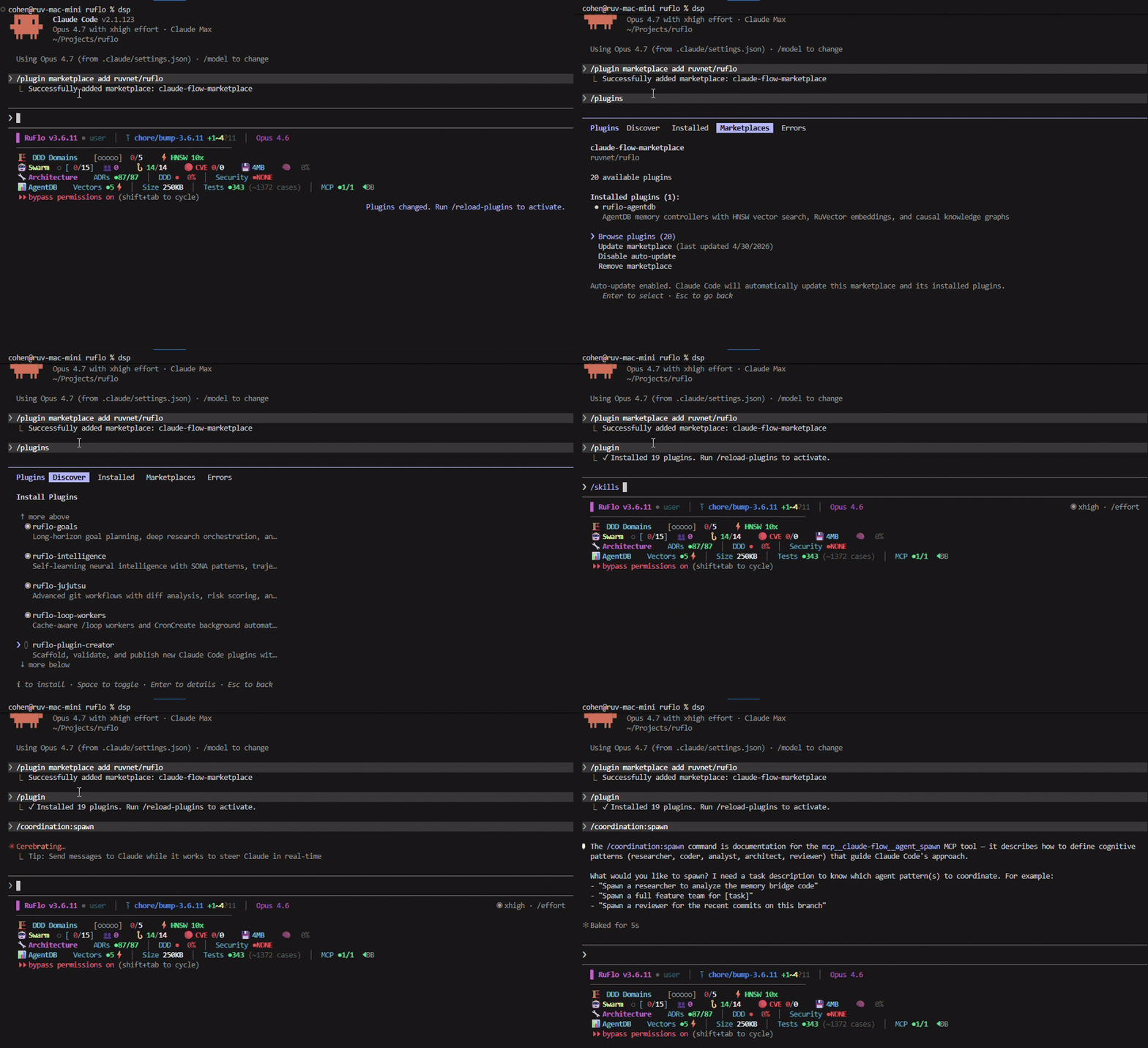
New to Ruflo? You don't need to learn 314 MCP tools or 26 CLI commands. After
init, just use Claude Code normally -- the hooks system automatically routes tasks, learns from successful patterns, and coordinates agents in the background.
npx claudepluginhub p/ali7040-ruflo-intelligence-plugins-ruflo-intelligenceDomain-Driven Design scaffolding — bounded contexts, aggregate roots, domain events, value objects, repositories, and anti-corruption layers; navigable domain graph stored in AgentDB
 Ali7040
Advanced git workflows with diff analysis, risk scoring, change classification (feature/bugfix/refactor/...), and reviewer recommendations — wraps 6 analyze_* MCP tools (diff, diff-risk, diff-classify, diff-reviewers, file-risk, diff-stats)
Ali7040AI safety scanning, PII detection, prompt injection defense, and adaptive threat learning
Ali7040Substrate plugin for Ruflo memory: AgentDB controller bridge (15 agentdb_* MCP tools), RuVector ONNX embeddings (10 embeddings_* tools incl. RaBitQ 32x quantization), and WASM HNSW pattern router (3 ruvllm_hnsw_* tools)
Ali7040Foundation plugin — registers the ruflo MCP server (300+ tools across memory/agentdb/embeddings/hooks/aidefence/neural/autopilot/browser/agent/swarm), provides 3 generalist agents (coder/researcher/reviewer), 3 first-run skills, and a curated plugin-discovery catalog
Ali7040Comprehensive feature development workflow with specialized agents for codebase exploration, architecture design, and quality review
 anthropics
Harness-native ECC operator layer - 67 agents, 277 skills, 93 legacy command shims, reusable hooks, rules, selective install profiles, and production-ready workflows for Claude Code, Codex, OpenCode, Cursor, and related agent harnesses
 affaan-m
Upstash Context7 MCP server for up-to-date documentation lookup. Pull version-specific documentation and code examples directly from source repositories into your LLM context.
 upstash
A growing collection of Claude-compatible academic workflow bundles. Covers scientific figures, manuscript writing and polishing, reviewer assessment, citation retrieval, data availability, paper reading, literature search, response letters, paper-to-PPTX conversion, and evidence-grounded Chinese invention patent drafting. Rules are organized as reusable skill folders with explicit workflows and quality checks.
 Yuan1z0825
Comprehensive skill pack with 66 specialized skills for full-stack developers: 12 language experts (Python, TypeScript, Go, Rust, C++, Swift, Kotlin, C#, PHP, Java, SQL, JavaScript), 10 backend frameworks, 6 frontend/mobile, plus infrastructure, DevOps, security, and testing. Features progressive disclosure architecture for 50% faster loading.
 Jeffallan
Tools to maintain and improve CLAUDE.md files - audit quality, capture session learnings, and keep project memory current.
anthropics'%20stop-opacity%3D'0.16'%2F%3E%3Cstop%20offset%3D'1'%20stop-color%3D'rgb(200%2C90%2C60)'%20stop-opacity%3D'0.03'%2F%3E%3C%2FlinearGradient%3E%3C%2Fdefs%3E%3Crect%20width%3D'320'%20height%3D'200'%20fill%3D'url(%23g)'%2F%3E%3Ccircle%20cx%3D'250'%20cy%3D'56'%20r%3D'92'%20fill%3D'rgb(200%2C90%2C60)'%20fill-opacity%3D'0.06'%2F%3E%3Ccircle%20cx%3D'64'%20cy%3D'172'%20r%3D'58'%20fill%3D'rgb(200%2C90%2C60)'%20fill-opacity%3D'0.05'%2F%3E%3C%2Fsvg%3E)

