Stats
Actions
Available In
Tags
Conducts focused literature searches for specific domains in research. Searches SEP, IEP, PhilPapers, Semantic Scholar, OpenAlex, CORE, arXiv and produces accurate BibTeX bibliography files with rich content summaries and metadata for synthesis agents.
Plans comprehensive literature review structure for research proposals. Analyzes research ideas and creates domain decomposition with search strategies.
Plans the structure and narrative arc for focused, insight-driven literature reviews. Designs tight outlines (800-1500 words) emphasizing key debates and critical papers. Reads BibTeX bibliography files. Use after domain research phase completes.
Writes focused, analytical, and descriptive literature reviews from structured outlines and BibTeX bibliography files. Emphasizes analytical depth over comprehensive coverage. Supports section-by-section writing for context efficiency. Use during synthesis phase of literature review.
Coordinate comprehensive literature reviews on any research topic in philosophy. Manages 6-phase workflow including domain decomposition, literature search, and synthesis. Use proactively when user requests a literature review.
Search philosophy literature across SEP, IEP, PhilPapers, Semantic Scholar, OpenAlex, CORE, arXiv, and NDPR. Supports paper discovery, citation traversal, content enrichment, and recommendations. Verifies citations via CrossRef. Use when searching for philosophy papers or encyclopedia entries, verifying that a citation exists, or collecting literature for a review.
One-time PhilLit workspace setup — checks uv and jq, scaffolds .env (pre-filling keys already set in the environment), and merges the permission rules into this directory's settings so literature reviews run without per-command prompts. Use when a user first runs PhilLit in a directory, or when reviews prompt repeatedly for Bash.
Executes bash commands
Hook triggers when Bash tool is used
Modifies files
Hook triggers on file write and edit operations
Uses power tools
Uses Bash, Write, or Edit tools
Own this plugin?
Verify ownership to unlock analytics, metadata editing, and a verified badge. GitHub access is read-only (username + org membership).
Sign in to claimOwn this plugin?
Verify ownership to unlock analytics, metadata editing, and a verified badge. GitHub access is read-only (username + org membership).
Sign in to claimBased on adoption, maintenance, documentation, and repository signals. Not a security audit or endorsement.
Executables (bin/) — files in this plugin's bin/directory are added to the Bash tool's PATH while the plugin is enabled.




Read the blog post · Sign up for our research study
PhilLit generates analytical literature reviews with verified bibliographies for philosophy research. Give it a topic description, and it searches academic databases, collects and checks references, and writes a structured review — typically in half an hour.
PhilLit is free and open-source. You only pay Anthropic for using Claude. This is a research project evaluating AI-generated literature reviews for philosophy (see below).
PhilLit itself is free. Running it requires Claude Code, which needs a subscription or API access. Each literature review uses roughly $9 to $13 in API credits, depending on whether you use Sonnet or Opus.
What you need:
uv and jq on your PATH — PhilLit runs its Python through uv and parses JSON with jq1. Install the plugin in Claude Code:
/plugin marketplace add AI-4-Phi/PhilLit
/plugin install phillit@phillit
2. Set up a working directory — create or open the folder where your reviews will live, then run once:
/phillit:setup
This creates a .phillit/ marker and a .env for your API keys, and merges PhilLit's permission rules into that directory's .claude/settings.json (see Trust model). Then add your keys to .env. If Claude Code asks whether you trust this folder, accept — the merged permission rules only take effect in trusted folders.
3. Request a review — describe your topic and PhilLit does the rest (~45 minutes):
I need a literature review on [topic].

[Describe the topic in 1-5 paragraphs]
Updating: plugins from third-party marketplaces do not auto-update by default. To get the newest version:
/plugin marketplace update phillit
/plugin update phillit@phillit
Or enable auto-update for the phillit marketplace in the /plugin → Marketplaces tab to pick up new versions at startup.
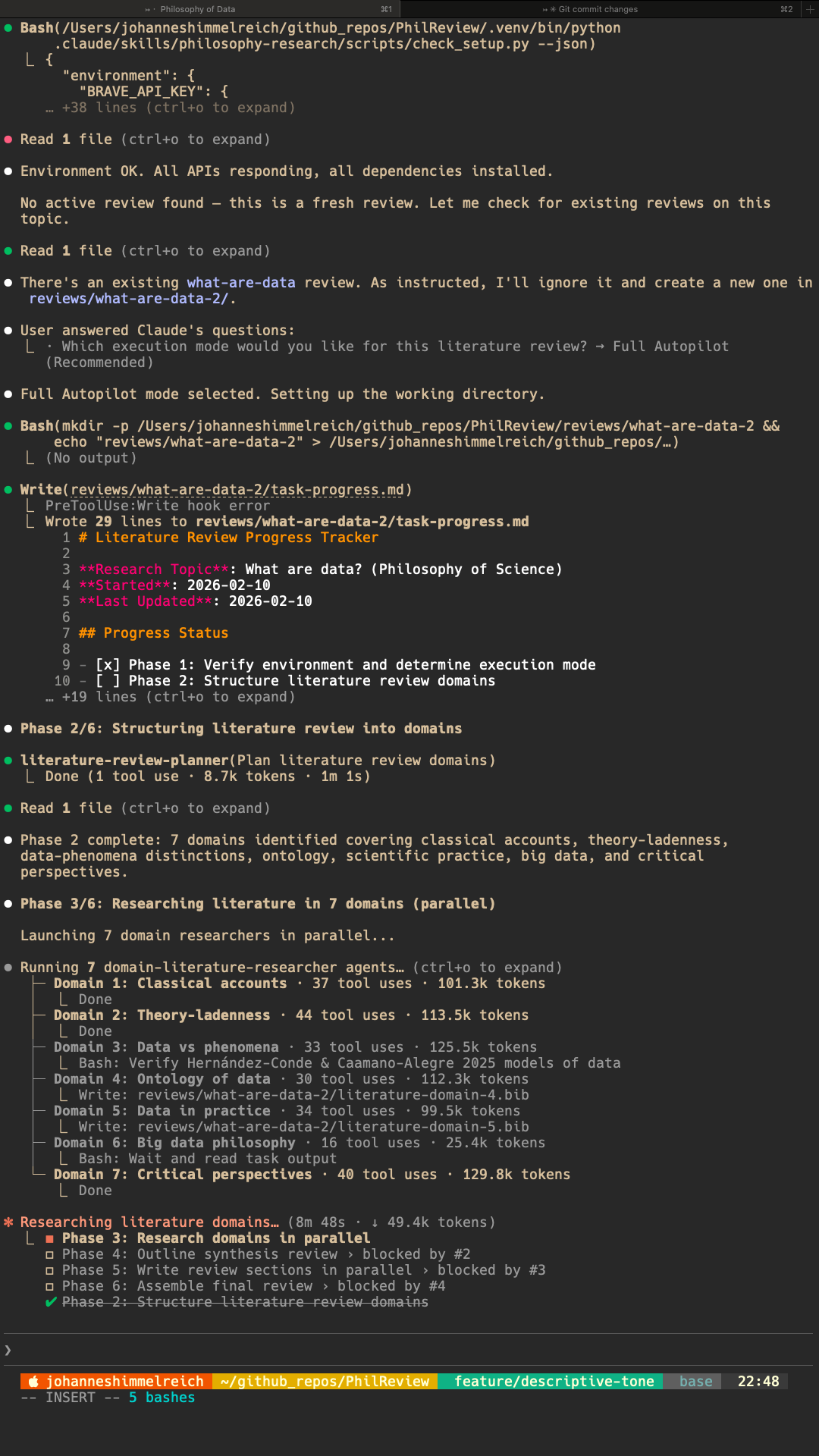
PhilLit running a literature review. The system decomposes the topic into research domains and searches multiple academic databases in parallel.
PhilLit runs as a Claude Code plugin, so its skills, agents, and hooks execute with the same shell privileges as Claude Code itself.
npx claudepluginhub ai-4-phi/phillitSpecialized research analysis agents for critical thinking, evidence verification, synthesis, and parallel paper analysis
 rpatrik96
PhD-level research capabilities: literature review, multi-source investigation, critical analysis, hypothesis-driven exploration, quantitative/qualitative methods
 poemswe
深度研究 — 13 agent 协作:研究问题定义、系统性检索、偏差评估、综合分析、引用编译
 Imbad0202
Multi-agent orchestrator for academic writing: 12 specialist agents and 30 writing principles for review, research, drafting, polishing, bibliography auditing, and literature surveys.
 andrehuang
Semi-automated research assistant for academic research and software development, with skills for literature review, experiments, analysis, writing, and project knowledge management
 Galaxy-Dawn
A research infrastructure for AI agents. Search, read, and analyze papers from your local knowledge base while coding. Includes arXiv discovery, layered reading, ingestion, topic modeling, citation graphs, insights analytics, Office document inspection, scientific tool docs, and academic writing workflows. Requires Python 3.10+ and pip install.
 ZimoLiao
'%20stop-opacity%3D'0.16'%2F%3E%3Cstop%20offset%3D'1'%20stop-color%3D'rgb(200%2C90%2C60)'%20stop-opacity%3D'0.03'%2F%3E%3C%2FlinearGradient%3E%3C%2Fdefs%3E%3Crect%20width%3D'320'%20height%3D'200'%20fill%3D'url(%23g)'%2F%3E%3Ccircle%20cx%3D'250'%20cy%3D'56'%20r%3D'92'%20fill%3D'rgb(200%2C90%2C60)'%20fill-opacity%3D'0.06'%2F%3E%3Ccircle%20cx%3D'64'%20cy%3D'172'%20r%3D'58'%20fill%3D'rgb(200%2C90%2C60)'%20fill-opacity%3D'0.05'%2F%3E%3C%2Fsvg%3E)