Stats
Actions
Available In
Tags
Idea-to-ship development suite: architecture grilling, spec + tickets, lazy TDD implementation, a configurable review rig, and a full PM/delivery layer on GitHub Projects.
Design-planning agent. Takes an idea, a feature request, or a foggy problem and produces the buildable plan: sharpened understanding, domain terms and ADRs where decisions harden, a spec, and tracer-bullet tickets on the board backlog. Dispatch it with the idea and any source material. Not for implementing (engineer) or for pure research legwork (researcher).
The Delivery Lead — dispatched for process work with an explicit mandate: draft a ritual agenda, check flow health and WIP, prepare a preset recommendation, assemble a cadence report. Facilitation with humans happens in-loop (the delivery-lead skill); dispatch only the prep and analysis around it. Not for what-to-build decisions (product-manager).
End-to-end implementation agent for one ticket or spec. Implements test-first and lazily, typechecks and tests as it goes, closes with a code review, and commits to the current branch. Dispatch it one Ready ticket at a time — fresh context per ticket. Do not use for design work (Architect skills) or for review-only passes (reviewer agent).
The Navigator — dispatched to orient: read the board, the repo docs, and the iteration clock, and report where the work stands and what the possible next moves are. Talks and routes only; never executes work or mutates anything. Dispatch when a session needs a factory-state picture or a routing plan.
The Product Manager — dispatched for backlog work with an explicit mandate: capture a brief into backlog tickets, triage inbound, propose a priority order, audit board health. Owns the board's contents; stays strictly inside the dispatched mandate and proposes anything beyond it. Not for process or rituals (delivery-lead) or design (architect).
Groom the top of the backlog until enough items are Ready — labelled, sized, unblocked, epic-assigned, and implementable without a follow-up question.
Operate the company delivery board (GitHub Project) — add items, move status, assign iterations, build epics, query the backlog. Use whenever a skill or agent needs to read or write the board, or the user mentions the board, backlog, epics, or iterations.
Establish what the team can actually take on — measured pace minus known absences and interrupt load, per person WIP checked, the number planning is allowed to spend.
Review the changes since a fixed point (commit, branch, tag, or merge-base) along two axes — Standards (does the code follow this repo's documented coding standards?) and Spec (does the code match what the originating issue/PRD asked for?). Runs both reviews in parallel sub-agents and reports them side by side. Use when the user wants to review a branch, a PR, work-in-progress changes, or asks to "review since X".
Shared vocabulary for designing deep modules. Use when the user wants to design or improve a module's interface, find deepening opportunities, decide where a seam goes, make code more testable or AI-navigable, or when another skill needs the deep-module vocabulary.
Uses power tools
Uses Bash, Write, or Edit tools
Own this plugin?
Verify ownership to unlock analytics, metadata editing, and a verified badge. GitHub access is read-only (username + org membership).
Sign in to claimOwn this plugin?
Verify ownership to unlock analytics, metadata editing, and a verified badge. GitHub access is read-only (username + org membership).
Sign in to claimBased on adoption, maintenance, documentation, and repository signals. Not a security audit or endorsement.
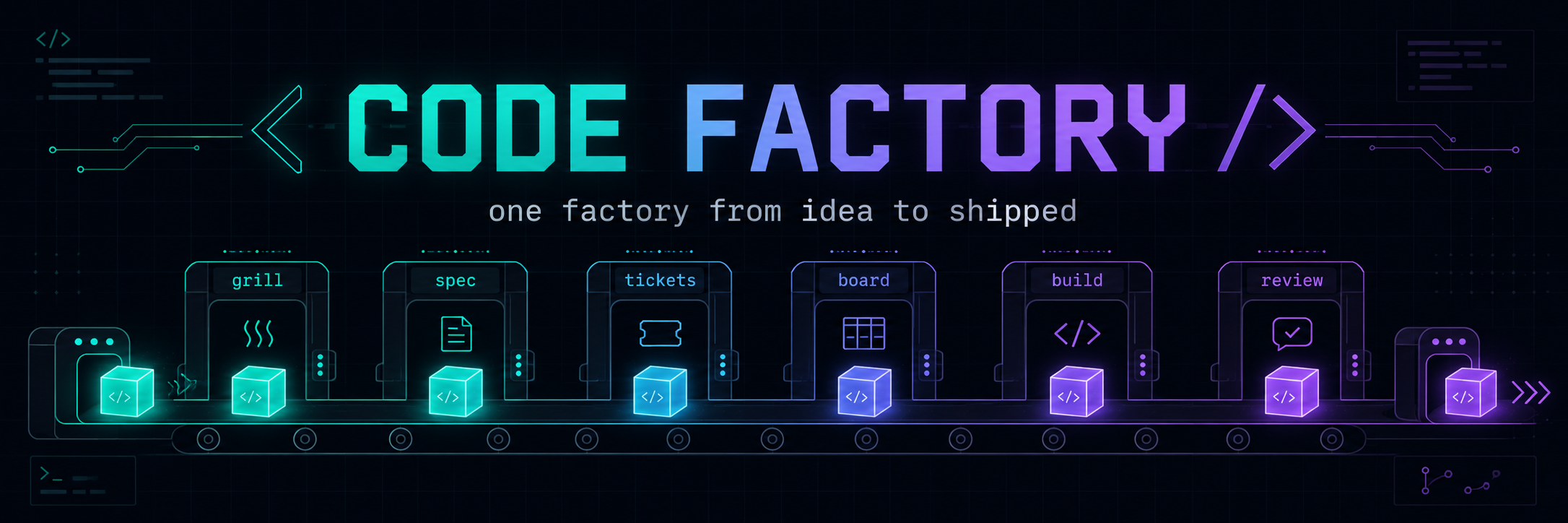



A complete development methodology as an installable plugin — architecture grilling, specs and tracer-bullet tickets, lazy test-first implementation, a configurable review rig, and a PM/delivery layer that keeps every piece of work visible on one company board.
Most agent skill sets nail idea→ship engineering but have no delivery layer: work gets built the moment it's imagined, nothing lands on a board, and the team can't see what's happening. Code Factory adds the missing half — and welds both halves into one flow with a hard seam:
Nothing is implemented until it's scheduled. Tickets land on the board as suggestions; the Product Manager pulls them into an epic + iteration; only Ready work gets built.
flowchart LR
    subgraph Architect["🏗 Architect (in-loop)"]
        G["/grill-with-docs"] --> S["/to-spec"] --> T["/to-tickets"]
    end
    subgraph Delivery["📋 PM + Delivery Lead"]
        B[("Board backlog")] --> E["epic + iteration"] --> R["Ready"]
    end
    subgraph Execution["⚙️ Agents (own context)"]
        ENG["engineer<br/>tdd + lazy"] --> REV["reviewer<br/>review-rig"]
    end
    T -->|suggestions| B
    R -->|one ticket, fresh context| ENG
    REV --> DONE(["done — team-visible"])
    W["/wayfinder<br/>big foggy work"] -.-> S
    TR["/triage<br/>raw inbound"] -.-> B
    D["/diagnosing-bugs<br/>something broken"] -.-> ENG
One way in: /navigator knows every skill and routes you — obvious cases route, unclear
cases get one clarifying question.
Every role ships as an agent in both runtimes — agents/<role>.md for Claude Code,
codex-agents/cf_<role>.toml for Codex — plus an in-loop skill where the role is
conversation-shaped. Skills hold the behaviour; agents are thin role wrappers that compose them.
| Role | Sandbox | Wields |
|---|---|---|
| Navigator | read-only | the whole map — routes, never executes |
| Architect | write | grill* · wayfinder · domain-modeling · codebase-design · to-spec · to-tickets · prototype |
| Product Manager | write | backlog health · prioritization · epics · roadmap · triage |
| Delivery Lead | write | delivery presets (Scrum / Kanban / Scrumban) · all 10 rituals · flow health · coaching |
| Engineer | write | implement · tdd · lazy — one Ready ticket per dispatch |
| Reviewer | read-only | the review rig |
| Researcher | write (docs) | primary-source research → cited findings file |
Skills are shared across roles, not owned 1:1. Every agent returns a structured JSON result, so dispatches can be chained by a composer.
Evidence first, judgement second:
diff → deterministic pre-pass ─ fallow static analysis
                              └ codebase-memory blast radius     → evidence pack
     → dimension sub-agents (toggle on/off):
         Standards · Spec · Correctness · Tests · Laziness · Boundaries
     → synthesize (no cross-dimension reranking)
     → graded verdict vs review.schema.json → optional auto-fix
ultra mode widens the same backbone to a per-subsystem × per-dimension grid for
whole-mission branches.
Ten rituals, each its own skill, fired on demand or by the preset's cadence:
/planning · /standup · /retro · /refinement · /iteration-review · /roadmap ·
/estimation · /prioritization-session · /dependency-risk · /capacity
Fastest — any agent, via skills.sh:
npx skills add AaronAbuUsama/code-factory        # pick skills + target agents interactively
npx skills add AaronAbuUsama/code-factory --all  # everything, everywhere, no prompts
Claude Code (plugin, includes the agents + MCP)
claude plugin marketplace add AaronAbuUsama/code-factory
claude plugin install code-factory
Codex — .codex-plugin/ carries the skills; install the seven role agents with:
cp codex-agents/cf_*.toml ~/.codex/agents/
Pi — plugin.yaml.
codebase-memory MCP — the plugin invokes codebase-memory-mcp from your PATH
(mcp/mcp-servers.json). Install the binary on each machine; without it, graph-backed features
degrade to grep and everything else still works.
/setup
npx claudepluginhub aaronabuusama/code-factoryAccess thousands of AI prompts and skills directly in your AI coding assistant. Search prompts, discover skills, save your own, and improve prompts with AI.
 f
fEvidence-gated AI coding workflow: scan → analyze → plan → TDD → execute → fix → verify → review, powered by Codebase Memory MCP >= 0.9.0 with optional Serena LSP intelligence. Includes blast-radius planning, test/cycle gates, independent review, and Windows Git Bash hook auto-resolution.
 datit309
Consult multiple AI coding agents (Gemini, OpenAI, Grok, Perplexity, plus codex, antigravity, and grok CLIs when installed) to get diverse perspectives on coding problems
 hex
hexComplete developer toolkit for Claude Code
 rohitg00
Reliable automation, in-depth debugging, and performance analysis in Chrome using Chrome DevTools and Puppeteer
 ChromeDevTools
Production-grade engineering skills for AI coding agents — covering the full software development lifecycle from spec to ship.
 addyosmani
'%20stop-opacity%3D'0.16'%2F%3E%3Cstop%20offset%3D'1'%20stop-color%3D'rgb(200%2C90%2C60)'%20stop-opacity%3D'0.03'%2F%3E%3C%2FlinearGradient%3E%3C%2Fdefs%3E%3Crect%20width%3D'320'%20height%3D'200'%20fill%3D'url(%23g)'%2F%3E%3Ccircle%20cx%3D'250'%20cy%3D'56'%20r%3D'92'%20fill%3D'rgb(200%2C90%2C60)'%20fill-opacity%3D'0.06'%2F%3E%3Ccircle%20cx%3D'64'%20cy%3D'172'%20r%3D'58'%20fill%3D'rgb(200%2C90%2C60)'%20fill-opacity%3D'0.05'%2F%3E%3C%2Fsvg%3E)
