Stats
Actions
Available In
Tags

Run full agile workflow per Git repo: scaffold Obsidian vault setup, research/groom features into milestone plans with estimates/DoD, implement via sub-agent delegation, review code diffs against checklists, generate sprint retrospectives from logs, extract lessons to customize skills/agents.
Developer worker for booping. Implements one milestone group at a time from a plan, briefed by the orchestrator. See `~/Claude/{project}/_booping/agent_booping-developer.md` for project-specific stack details.
Researcher for booping. Encapsulates heavy reads (many files, web pages, repo histories) and returns a focused summary so the orchestrator's context stays clean. Use when the answer requires processing more material than the orchestrator should ingest directly.
Context-aware chat about the project: discuss plans, retros, lessons, and code; navigate the vault; and handle chores (frontmatter tweaks, status flips, inline plan or code edits) without invoking the heavier skills. Opens every session with a vault status summary.
Review changed code (diff, files, or directory) against layered, stack-aware checklists plus plan- and lesson-aware dynamic checks. Stateless side-skill — chat-only output, no plan-lifecycle status, no persistent report.
Execute a groomed plan milestone-by-milestone via sub-agents. Use after /groom produces a plan file that is ready to implement.
Deep-research a feature, bug, or refactor and produce a specified, estimated plan with Definition of Done. Cross-validates architecture with a second model when useful. Use when the user describes a new piece of work that needs to be shaped before implementation.
Show what booping is, the available commands, and how to use them. Use when the user asks for help, wants a tour of the plugin, or is onboarding.
Uses power tools
Uses Bash, Write, or Edit tools
Own this plugin?
Verify ownership to unlock analytics, metadata editing, and a verified badge. GitHub access is read-only (username + org membership).
Sign in to claimOwn this plugin?
Verify ownership to unlock analytics, metadata editing, and a verified badge. GitHub access is read-only (username + org membership).
Sign in to claimBased on adoption, maintenance, documentation, and repository signals. Not a security audit or endorsement.
A self-learning, project-scoped sprint workflow for Claude Code. booping turns a feature idea into a durable, on-disk loop — groom → develop → retro → learn — that effectively utilizes sub-agents to avoid context rot and cross-validates each plan against Gemini before development begins. Every artifact (plans, retros, lessons, sprint snapshots) lives under ~/Claude/{project}/, one folder per codebase, so weeks-long programs stay legible long after the session ends.
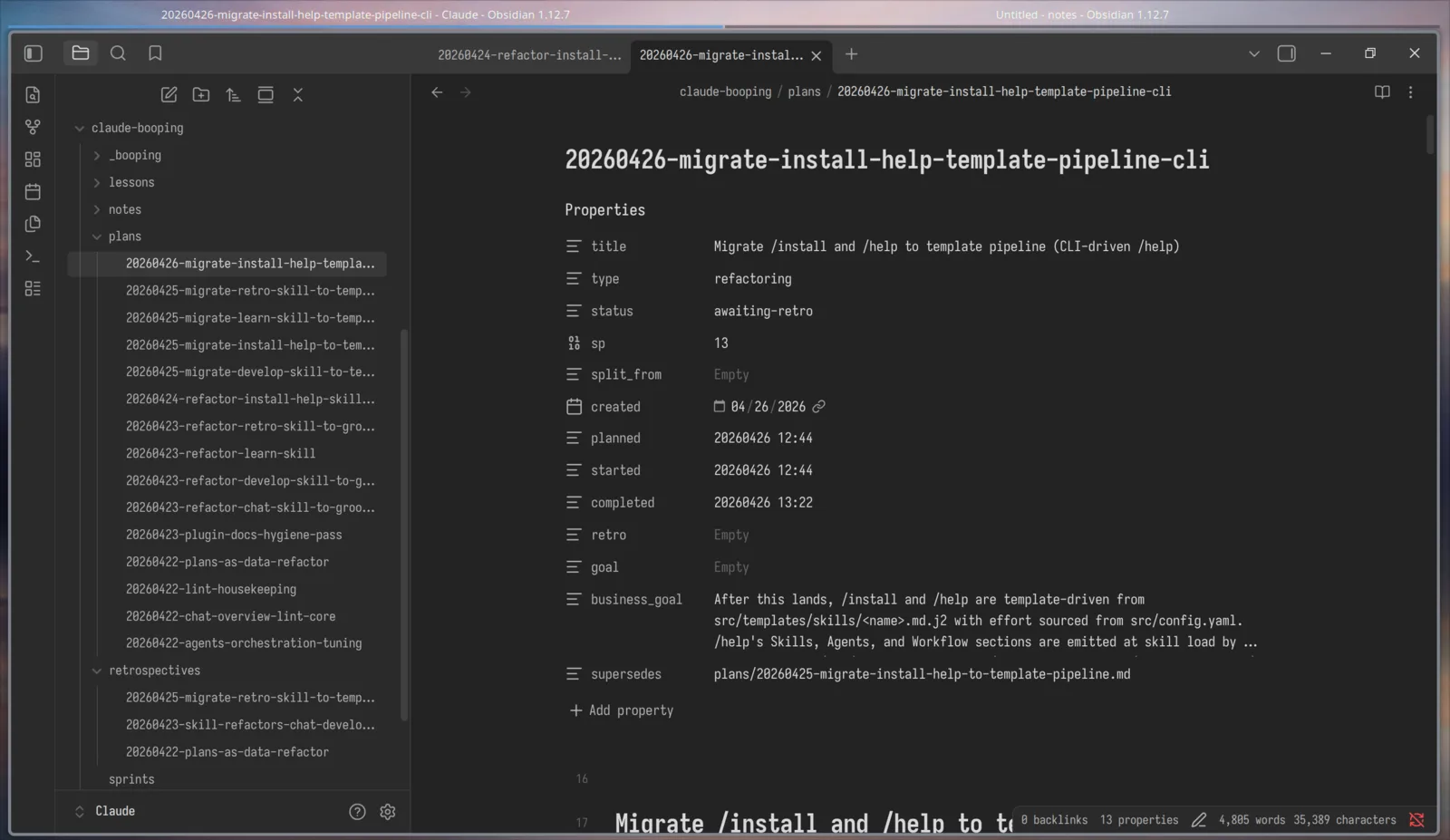
Each project's vault is a plain Obsidian-friendly folder of markdown files.
The vault at ~/Claude/{project}/ is markdown-only with YAML frontmatter that Obsidian renders natively as Properties. One vault per project, side-by-side with whatever else you keep in ~/Claude/. No proprietary database, no lock-in — just files you can grep, version, and edit by hand.
booping is aimed at experienced developers and tech leads — people comfortable making architectural calls, decomposing work, and reviewing code critically. The skills assume you can tell a sharp plan from a vague one and a sound diff from a sloppy one.
It's built for iterative, agile-style development: maintenance, incremental features, or growing a project sprint by sprint. It is not a waterfall tool — don't hand it a whole-project spec and expect a finished product. One plan is one sprint; the loop compounds across many.
The framework is in beta. Per-project configuration is now live: place a ~/Claude/{project}/config.yaml file in your vault and it deep-merges over the plugin's src/config.yaml at render time — the lifecycle, sprint scale, and agent wiring are the natural targets for per-project tuning. The /code-review skill is now available as a side-route for stack-aware review of in-progress diffs against the active plan.
Required: uv and git. Optional: GEMINI_API_KEY environment variable for /groom cross-validation against Gemini.
# macOS
brew install uv git

# Linux (Debian/Ubuntu)
sudo apt install -y git
curl -LsSf https://astral.sh/uv/install.sh | sh
Inside Claude Code, register the marketplace once, then install the plugin:
/plugin marketplace add A/claude-booping
/plugin install booping@booping
Update later via /plugin update booping (or from the /plugin UI).
After installing, cd into the target repo and run /install. That single step scaffolds ~/Claude/{project}/ (with plans/, retrospectives/, lessons/, notes/, _booping/).
For a hand-holding walkthrough and per-command reference, see the docs site.
The full loop is five commands. Run them in order:
# Inside the target repo, once:
/install

# Spec a feature, bug, or refactor — free-text description.
# The more detailed your brief, the sharper the resulting plan:
/groom Add per-tenant rate limiting to the public API

# Execute the next ready plan (auto-claims from the queue):
/develop
# …or target a specific one (path relative to ~/Claude/{project}/):
/develop plans/20260426-per-tenant-rate-limiting.md

# Retrospect on what shipped:
/retro plans/20260426-per-tenant-rate-limiting.md

# Fold the retro's findings into durable rules:
/learn retrospectives/20260426-per-tenant-rate-limiting.md
The skills will list candidates if you forget the exact filename.
A plan moves through a small set of statuses. /groom shapes the spec and waits for explicit user approval before handing off; /develop claims the next ready plan and executes milestone by milestone; /retro compares what shipped to the original spec; /learn distils the retrospective into rules that bind the next sprint.
The status vocabulary below is the canonical set in src/config.yaml plan.statuses:
/groom    backlog → in-spec → awaiting-plan-review → ready-for-dev
          (loopback: awaiting-plan-review → in-spec)
          (parking: in-spec → backlog)
          (cancellation: backlog/in-spec/awaiting-plan-review → cancelled)

/develop  ready-for-dev → in-progress → awaiting-retro
          (failure: in-progress → fail)

/retro    awaiting-retro → awaiting-learning
          (skip: awaiting-retro → done)

/learn    awaiting-learning → done

Terminal states: cancelled · done · fail
A plan carries one of the following statuses in its frontmatter. Terminal states are marked.
npx claudepluginhub a/claude-booping --plugin boopingHarness-native ECC plugin for engineering teams - 67 agents, 271 skills, 92 legacy command shims, reusable hooks, rules, MCP conventions, and operator workflows for Claude Code plus adjacent agent harnesses
 affaan-m
v9.44.1 — Patch release for Gemini environment/version detection and qwen auth gating. Run /octo:setup.
 nyldn
nyldnSuperpowers Plus core skills library for Claude Code: planning, execution routing, TDD, debugging, and collaboration workflows
 xhyqaq
AI-powered development tools for code review, research, design, and workflow automation.
 EveryInc
Unity Development Toolkit - Expert agents for scripting/refactoring/optimization, script templates, and Agent Skills for Unity C# development
 Dev-GOM
Claude harness - A harness for solo developers (Vibecoders) to handle full-cycle contract development.
 Chachamaru127
'%20stop-opacity%3D'0.16'%2F%3E%3Cstop%20offset%3D'1'%20stop-color%3D'rgb(200%2C90%2C60)'%20stop-opacity%3D'0.03'%2F%3E%3C%2FlinearGradient%3E%3C%2Fdefs%3E%3Crect%20width%3D'320'%20height%3D'200'%20fill%3D'url(%23g)'%2F%3E%3Ccircle%20cx%3D'250'%20cy%3D'56'%20r%3D'92'%20fill%3D'rgb(200%2C90%2C60)'%20fill-opacity%3D'0.06'%2F%3E%3Ccircle%20cx%3D'64'%20cy%3D'172'%20r%3D'58'%20fill%3D'rgb(200%2C90%2C60)'%20fill-opacity%3D'0.05'%2F%3E%3C%2Fsvg%3E)