Stats
Actions
Available In
Tags

Run a structured design cognition loop: frame UI problems, study measured references, commit to a structure, critique renders, and lint for AI-generated slop. Ships a deterministic design linter and Figma-to-code pipeline.
Writes and repairs the evidence-traceable copy deck before interface structure begins.
Converts sanitized evidence into a durable, fresh page-composition contract before sketches.
Blindly critiques anonymous renders or selects a structural sketch; never edits.
Interrogates a design brief and records an evidence-backed framing before drawing.
Reads only squint renders and reports their immediate visual hierarchy.
Read the project's check history and tell the user what they keep getting wrong, what is improving, and what to study next. Skill, not taste — it never reads preferences. Use when the user asks how their design is trending, what mistakes repeat, or wants a review of accumulated findings. Triggers: 코치, 내가 뭘 반복해서 틀리지, 디자인 실력, 추세, coach, what do I keep getting wrong, design habits.
Critique a design without changing it. Runs the deterministic linter, groups the findings by root cause, and judges the result against the project's primary generator. Use when the user asks for a design review, asks why a screen feels wrong, wants an accessibility or consistency pass, or says 비평/리뷰/왜 별로야/개선점. Triggers: critique, review, 비평, 리뷰, 디자인 리뷰, 개선점, accessibility, 접근성, 일관성.
Rewrite chat, assistant replies, UI copy, pages, essays, and documentation into natural, situation-aware discourse without changing facts. Repairs mechanical prose locally or reconstructs a misshapen message from verified facts and its voice contract. Triggers: humanize, 사람같이, 사람처럼 써, AI티 빼줘, 자연스럽게 바꿔, 글 다듬어, make it sound human, de-AI, rewrite naturally.
Implement a Figma design end to end: pull the file, synthesize the design system, build each frame pixel-faithfully with an iterative diff loop, match responsive pairs, and ship with a fidelity report. Use when a figma.com link is present in the brief — the design decisions were already made in Figma; the job here is faithful implementation and systematization, not concept invention. Triggers: 피그마, figma link, 피그마 그대로 구현, any figma.com URL in the brief.
Build a measured LEGO reference inventory without designing anything: whole pages for feel, tight selectors for component anatomy, typography studies, motion studies, image refs for the unrenderable. Use when the user asks for references, inspiration, benchmarks, or "how do good sites do X" — standalone, before or without a build — and also when the request is to fix or improve the UX of an existing surface: research how strong products solve that same UX problem before proposing changes, instead of applying generic rules from memory. Triggers: 레퍼런스 찾아줘, 레퍼런스 수집, 참고 사이트, 벤치마킹, UX 고쳐줘, UX 개선, 이 페이지 UX 개선해줘, find references, inspiration board, how do other sites do, fix/improve the UX.
Uses power tools
Uses Bash, Write, or Edit tools
Own this plugin?
Verify ownership to unlock analytics, metadata editing, and a verified badge. GitHub access is read-only (username + org membership).
Sign in to claimOwn this plugin?
Verify ownership to unlock analytics, metadata editing, and a verified badge. GitHub access is read-only (username + org membership).
Sign in to claimBased on adoption, maintenance, documentation, and repository signals. Not a security audit or endorsement.
Executables (bin/) — files in this plugin's bin/directory are added to the Bash tool's PATH while the plugin is enabled.
A design process for coding agents — not a visual style. OMD makes the model earn each decision: question the brief, gather evidence, write real copy, prove typography, compose deliberately, build once, inspect the render, and reframe.
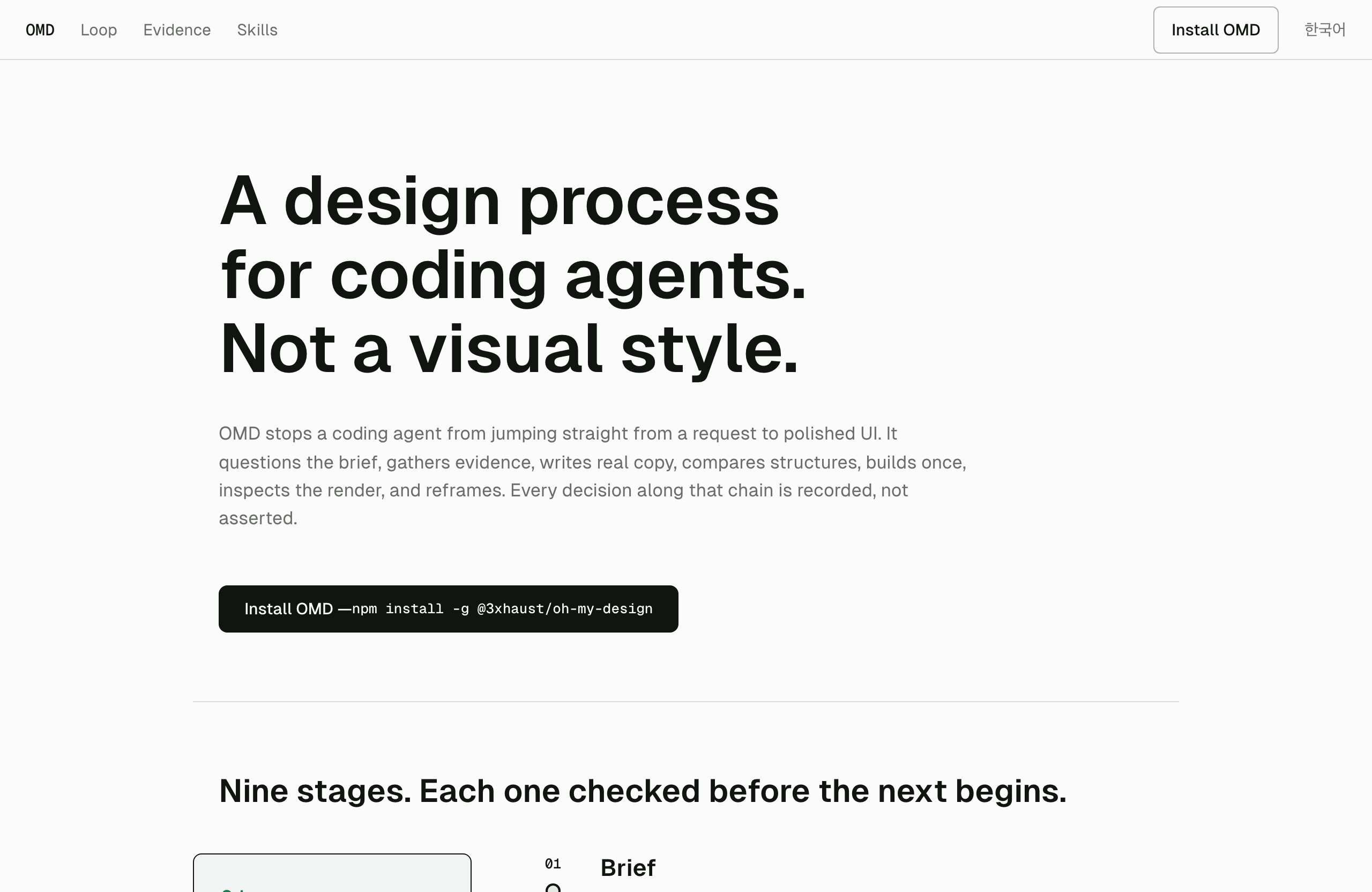
The landing page above was generated by OMD itself from a single one-shot prompt — the visual output was not hand-tuned. It is live at 3x-haust.github.io/oh-my-design, and its source is in example/.
Here, “design like a human” means accountable judgment, not a signature look. The goal is a repeatable process; the result can be quiet, expressive, conventional, or strange. What stays constant is the chain of decisions behind it.
Oh My Design (OMD) keeps a coding agent from jumping straight from a request to polished UI. It asks what problem is being solved, records evidence, separates writing from layout, compares anonymous structures, and critiques the rendered output without exposing the reviewer to the builder’s rationale.
The durable loop is:
brief → evidence → copy → typography proof → composition contract → isolated structure → one production build
      → rendered critique and interaction evidence → reframe
OMD runs inside Codex and Claude Code. It ships six user-facing skills, nine internal pipeline agents, a local omd CLI, design theory and recipe packs, and a durable project record under .omd/.
npm install -g @3xhaust/oh-my-design
oh-my-design install    # copy skills + agents into every detected host and patch its config
oh-my-design doctor     # verify the host install
omd doctor              # verify the runtime, Chromium, project write access, and the theory pack
oh-my-design install --host claude|codex scopes install, doctor, and uninstall to one host. uninstall reverses exactly what install did and never touches your .omd/ directory. Host installation also attempts browser-rs afterward and reports present, installed, unsupported, or failed; a browser-rs failure does not roll back an otherwise healthy OMD/Playwright host installation.
Install the scoped package
@3xhaust/oh-my-design. The unscopedoh-my-designon npm is an unrelated project.
/plugin marketplace add 3x-haust/oh-my-design
/plugin install oh-my-design@omd
Then open a session and run /ultradesign.
git clone https://github.com/3x-haust/oh-my-design
cd oh-my-design
npm install
node bin/omd-install.ts install    # copy skills + agents into detected hosts
node bin/omd.ts doctor
After globally installing @3xhaust/oh-my-design, OMD prefers the browser-rs MCP provider for interactive reference research, user-directed region captures, and visual QA. It is a deliberately narrow v0.1.10 integration, not a claim of universal browser compatibility:
| Platform | browser-rs state | Exact SHA-256 |
|---|---|---|
| Darwin arm64 | Supported; default interactive provider when healthy | 9a5895fc2f07b1010226d30f081d678fa2edcc15dd6f24cdf10074cfe1573749 |
| Linux x64 | Supported; default interactive provider when healthy | 792ca76e5ce0423968763556e110900a3aa65737fc6227724914aa137e972589 |
| Any other platform | Unsupported; no browser-rs download | Use the Playwright + Chromium fallback below. |
The managed binary, when installed, is $HOME/.local/share/oh-my-design/browser-rs/v0.1.10/browser-rs with a verified receipt.json. OMD verifies the exact checksum before publishing it. Resolution is OMD_BROWSER_RS_BIN, then browser-rs on PATH, then that receipt-owned target. OMD never overwrites a foreign override/PATH binary or an unreceipted/tampered managed-target file, and oh-my-design browser uninstall removes only matching OMD-owned receipt-and-digest bytes.
# Explicit provider lifecycle. `doctor` exits 1 when the selected provider is not healthy.
oh-my-design browser install
oh-my-design browser doctor --json

# After global package installation, provide your own equivalent local HTML fixture.
oh-my-design browser smoke --fixture /absolute/path/to/local-probe.html --out /tmp/omd-browser-rs-smoke.png
npx claudepluginhub 3x-haust/oh-my-design --plugin omdDesign workflow for coding agents: discovery, research, strategy, inclusive design, critique, and handoff — enforced automatically
 Owl-Listener
Connect Claude Code to TypeUI MCP for curated design systems, UI prompts, and layout variations.
 bergside
Open-source, skills-based version of Claude Design (claude.ai/design) for Claude Code. HTML pages, slide decks, interactive prototypes, UI kits, and brand systems — with taste, context-matching, and anti-slop discipline.
 manalkaff
Gogh is a source cited Obsidian operating brain that turns six frontend design skills into one advisable stack for AI coding agents.
 AgriciDaniel
Design fluency for frontend development. 1 skill with 23 commands (/impeccable polish, /impeccable audit, /impeccable critique, etc.) and curated anti-pattern detection.
 pbakaus
Design engineering skill + system for AI coding agents: anti-slop UI, outcome recipes, spec-driven design, design-review + a11y agents, MCP quality gates.
 educlopez
'%20stop-opacity%3D'0.16'%2F%3E%3Cstop%20offset%3D'1'%20stop-color%3D'rgb(200%2C90%2C60)'%20stop-opacity%3D'0.03'%2F%3E%3C%2FlinearGradient%3E%3C%2Fdefs%3E%3Crect%20width%3D'320'%20height%3D'200'%20fill%3D'url(%23g)'%2F%3E%3Ccircle%20cx%3D'250'%20cy%3D'56'%20r%3D'92'%20fill%3D'rgb(200%2C90%2C60)'%20fill-opacity%3D'0.06'%2F%3E%3Ccircle%20cx%3D'64'%20cy%3D'172'%20r%3D'58'%20fill%3D'rgb(200%2C90%2C60)'%20fill-opacity%3D'0.05'%2F%3E%3C%2Fsvg%3E)