Stats
Actions
Available In
Tags

Enforce production-grade security guards, quality gates, and continuous QA across AI agent sessions, with structured agent modes (TDD, debugging, sprint) and end-of-session evaluation with handoff artifacts.
Structured work modes for agent sessions. Set LACP_CONTEXT_MODE to activate: tdd (red-green-refactor), debugging (4-phase root cause), sprint (pre-agreed criteria), verification (evidence-before-claims), brainstorm (design first), think (pause-and-reflect), orchestrate (task decomposition). Each mode injects behavioral rules at session start.
Production quality gate for agent sessions. Activates on session stop to evaluate work quality using 4-dimension weighted scoring (completeness, honesty, deferral ratio, work evidence). Catches rationalization patterns, verifies test claims, and generates handoff artifacts for session continuity. Use sprint contracts to define done-criteria before building.
Production hardening for agent sessions. Includes pretool guards (blocks rm -rf, co-author injection, publishing without approval, data exfiltration), continuous QA (runs tests every N file writes), and session context injection (git state, focus brief, handoff artifacts). Activates automatically via hooks.
Executes bash commands
Hook triggers when Bash tool is used
Modifies files
Hook triggers on file write and edit operations
Based on adoption, maintenance, documentation, and repository signals. Not a security audit or endorsement.
Control-plane-grade agent harness for Claude, Codex & Hermes.
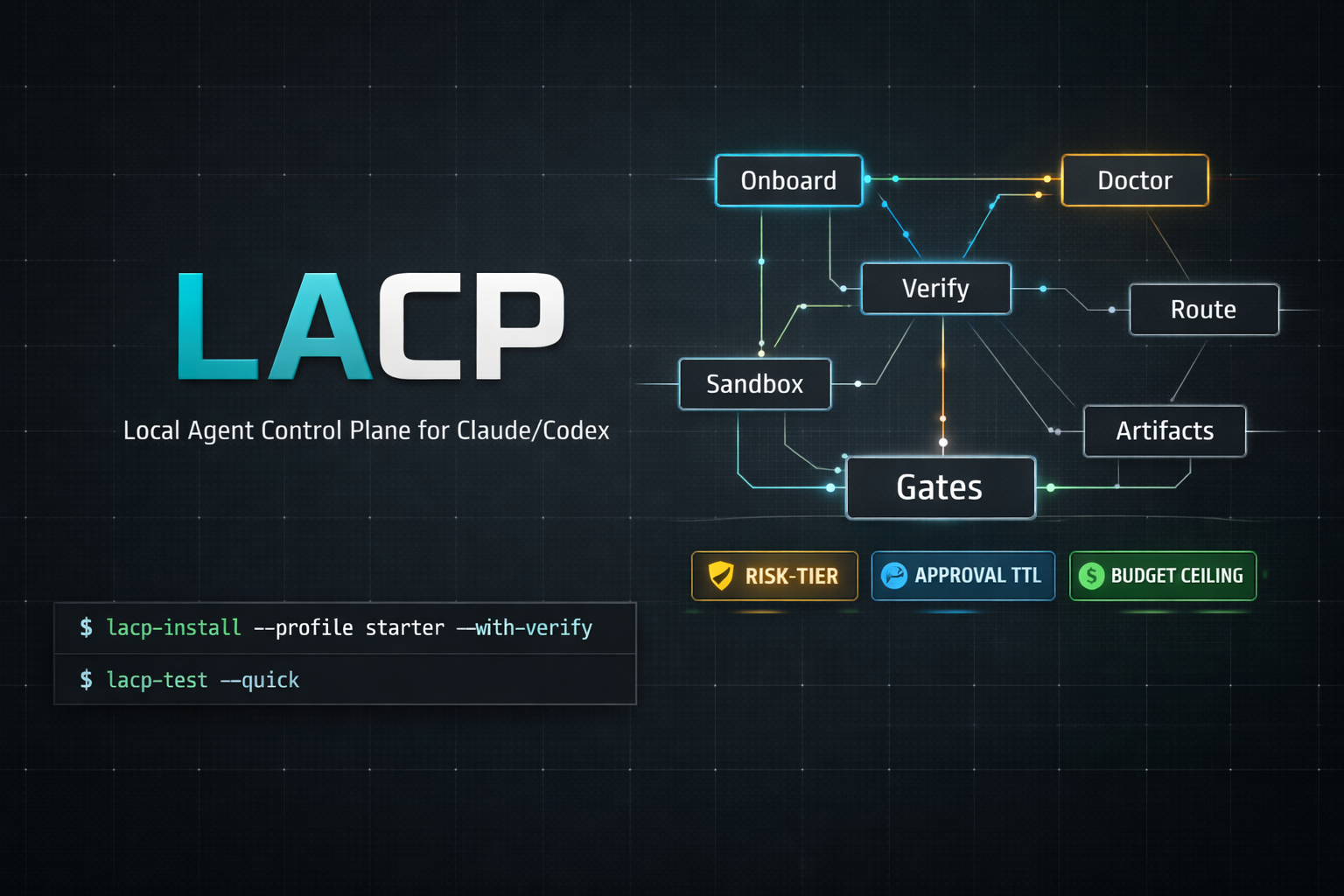
LACP is a harness-first execution framework with policy-gated operations, verification/evidence loops, 5-layer memory, and auditable agent workflows — all local-first, zero external dependencies.





Alpha Release — LACP v0.9.0 is under active development. The native REPL, multi-provider routing, hermes-style tool display, and memory system are functional but evolving fast. APIs and CLI interfaces may change between releases. Report issues.
LACP is an agent harness with control-plane governance:
This keeps the core value clear: not just generating output, but producing auditable, policy-compliant outcomes.
| Policy gates | Risk tiers (safe/review/critical), budget ceilings, context contracts, and session fingerprints — every agent invocation is gated and auditable. |
| 5-layer memory | Session memory, Obsidian knowledge graph, ingestion pipeline, code intelligence (GitNexus), and agent identity with hash-chained provenance. |
| Hook pipeline | Modular Python hooks for Claude Code — session context injection, pretool guards, write validation, and stop quality gates with local LLM eval. |
| Obsidian brain | First-class vault management, mycelium-inspired memory consolidation, QMD indexing, and config-as-code with auto-optimization. |
| Multi-agent orchestration | dmux/tmux session management, git worktree isolation, swarm workflows, and Claude native worktree backend. |
| Local-first security | Zero external CI by default, no secrets in config, environment-driven credentials, TTL approval tokens for remote execution. |
| Execution tiers | trusted_local, local_sandbox, and remote_sandbox (Daytona/E2B) with policy-driven routing and provider override. |
| Evidence pipelines | Browser e2e, API e2e, smart-contract e2e harnesses with manifest evidence, auth checks, and PR preflight gates. |
# Homebrew (recommended)
brew tap 0xNyk/lacp && brew install lacp

# or cURL bootstrap
curl -fsSL https://raw.githubusercontent.com/0xNyk/lacp/main/install.sh | bash
lacp bootstrap-system --profile starter --with-verify
lacp doctor --json | jq '.ok,.summary'
After bootstrap: .env is created, dependencies installed, directories scaffolded, Obsidian vault wired, and verification artifacts produced.
For the full setup and daily operator flow, start with the Runbook and Local Dev Loop.
# Route a task through LACP policy gates
lacp run --task "hello world" --repo-trust trusted -- echo "LACP is working"

# Make claude/codex/hermes default to LACP routing (reversible)
lacp adopt-local --json | jq
npx claudepluginhub 0xnyk/lacp --plugin lacp-hardening18 AI personas deliberate your hardest decisions — structured multi-round deliberation (blind analysis, anonymized cross-examination, weighted verdict) with genuine model diversity across providers.
 0xNyk
0xNykBattle-tested Claude Code plugin for engineering teams — 38 agents, 156 skills, 72 legacy command shims, production-ready hooks, and selective install workflows evolved through continuous real-world use
 mrebrahim
Agents for code review, security audits, debugging, and quality assurance
 davepoon
Analyze and enforce best practices for AI coding agent projects. Assess codebase readiness across 8 pillars with /readiness, then scaffold enforcement with /setup: TDD, secret scanning, file size limits, auto-generated docs, and git hooks.
 jrenaldi79
Evaluate AI agent setups for best practices, redundancy, security, and cross-component issues.
 redhat-community-ai-tools
Agents specialized in security engineering and threat mitigation. Focuses on secure architecture, vulnerability assessment, and compliance.
 TheBushidoCollective
Reference implementation of the Ironclad standard — multi-agent dev harness for Claude Code.
 qwerfunch
'%20stop-opacity%3D'0.16'%2F%3E%3Cstop%20offset%3D'1'%20stop-color%3D'rgb(200%2C90%2C60)'%20stop-opacity%3D'0.03'%2F%3E%3C%2FlinearGradient%3E%3C%2Fdefs%3E%3Crect%20width%3D'320'%20height%3D'200'%20fill%3D'url(%23g)'%2F%3E%3Ccircle%20cx%3D'250'%20cy%3D'56'%20r%3D'92'%20fill%3D'rgb(200%2C90%2C60)'%20fill-opacity%3D'0.06'%2F%3E%3Ccircle%20cx%3D'64'%20cy%3D'172'%20r%3D'58'%20fill%3D'rgb(200%2C90%2C60)'%20fill-opacity%3D'0.05'%2F%3E%3C%2Fsvg%3E)
