Stats
Actions
Available In
Tags

Enforces an AI-augmented product development framework (UNDERSTAND → ENVISION → DELIVER → REFLECT) with 37 skills across research, design, engineering, and pack building, enabling structured UX discovery, design system reverse-engineering, and automated quality validation for Claude Code packs
Socratic questioner — helps clarify the real problem before jumping to solutions.
Systems thinker — sees boundaries, trade-offs, and second-order consequences.
Methodical investigator — follows evidence, resists guessing, finds root causes.
Pragmatic implementation persona — values working software, simplicity, and TDD.
Adversarial reviewer — skeptical of claims, reads code not reports, finds what others miss.
Audit findings, Evaluation report, Severity scores
Corrects the 13 most common API design mistakes agents make — grounded in Geewax, Amundsen, Ousterhout, Kleppmann, and Gough/Bryant
Architecture Decision Records, System spec, Milestone plan
**Layer 1 — Domain Foundation**
Brief (medium+ tasks), Spec, Implementation plan
Modifies files
Hook triggers on file write and edit operations
Uses power tools
Uses Bash, Write, or Edit tools
Own this plugin?
Verify ownership to unlock analytics, metadata editing, and a verified badge. GitHub access is read-only (username + org membership).
Sign in to claimOwn this plugin?
Verify ownership to unlock analytics, metadata editing, and a verified badge. GitHub access is read-only (username + org membership).
Sign in to claimBased on adoption, maintenance, documentation, and repository signals. Not a security audit or endorsement.
An intelligent skills framework for AI agents.

Think clearly. Work thoroughly. Deliver excellence.
Sage is a skills framework that makes AI agents think before they act, stay focused under complexity, and deliver outcomes you can trust. Built for product and engineering teams, open to any domain.
Most AI frameworks skip from request to implementation. Sage's navigator thinks first — mapping every request to an intent spectrum (UNDERSTAND → ENVISION → DELIVER → REFLECT) and detecting what's missing before work begins.
It starts with a framing round: surface the pain, challenge the premises, and arrive at a chosen framing — before any solutioning happens. Building without research? It tells you what 15 minutes of discovery would prevent, then lets you decide. Gap detection, not gatekeeping.
Routing is deterministic first, intelligent second: keywords match workflows before any LLM judgment. When keywords don't match, a focused sub-agent classifier picks the right phase. Every routing decision is confirmed with the user before proceeding. Smart enough to route accurately. Humble enough to ask when unsure.
AI agents drift silently — skipping steps, hallucinating imports, building the wrong thing confidently. Sage catches this at every stage:
Before implementation:
During implementation:
After implementation:
Four independent sub-agent review points. The agent that writes the code never reviews its own work alone.
Most frameworks dump all instructions into the context window and hope for the best. Sage loads in two layers: the eager layer (process rules, workflow gates, engineering principles — ~200 lines, always in context) enforces what must never be skipped. The lazy layer (capabilities like TDD discipline, coding principles, systematic debugging, build-loop orchestration — loaded when the workflow step needs them) adds depth without bloating context. A focused agent with the right 500 tokens outperforms a distracted agent with 50,000 tokens of everything.
Close your IDE, hit a context limit, come back tomorrow — Sage picks up
exactly where you left off. A cycle manifest captures state, context
summary, decisions, open questions, and handoff guidance at every
checkpoint. Type /continue and Sage reads the manifest, routes to the
correct workflow, and preserves the judgment context that would otherwise
be lost.
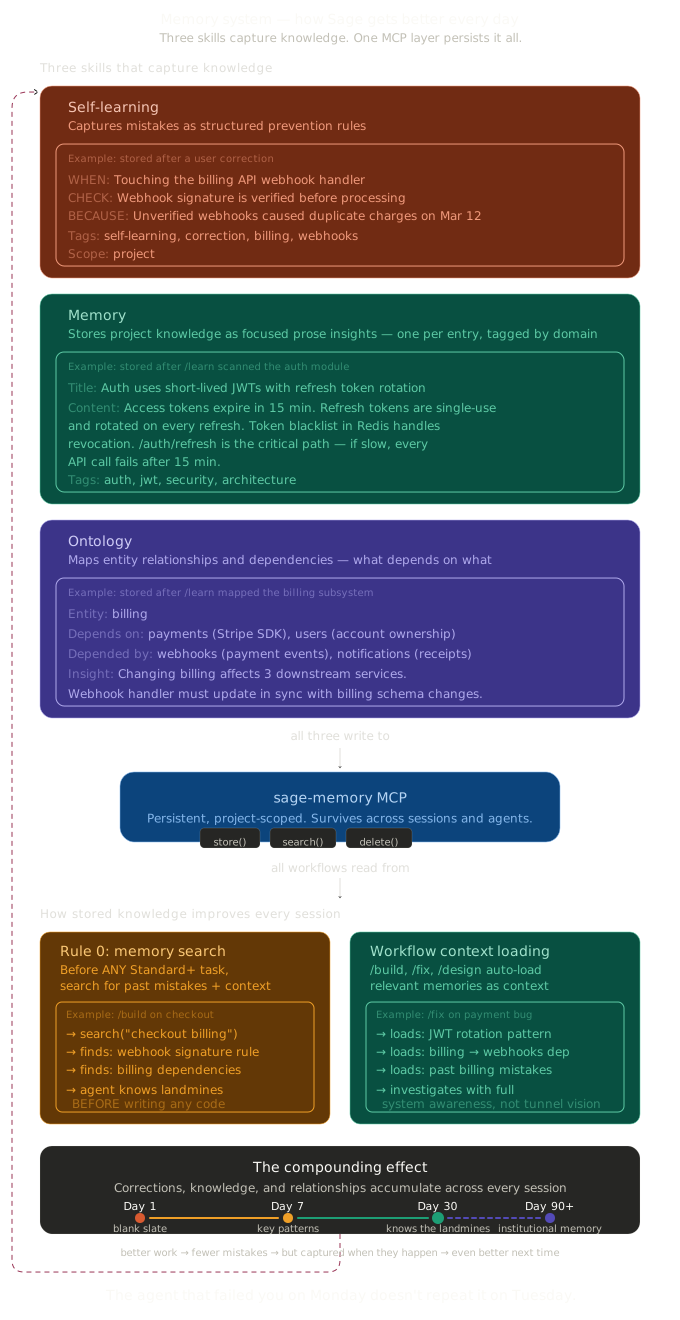
Most agent frameworks are stateless. The agent that made a mistake yesterday makes it again today. Sage has three skills that build institutional memory — all backed by sage-memory MCP:
npx claudepluginhub xoai/sage --plugin sageAI skills framework: UNDERSTAND → ENVISION → DELIVER → REFLECT. Process enforcement, 14 workflows, 37 skills, 5 agent personas.
 xoai
xoaiAI skills framework: UNDERSTAND → ENVISION → DELIVER → REFLECT. Process enforcement, 14 workflows, 37 skills, 5 agent personas.
xoai面向 AI coding agents 的生产级工程 skills — 覆盖从 spec 到 ship 的完整软件开发生命周期。
 vinvcn
Theory-grounded product-thinking discipline for AI agents. 49 skills, 15 theory gates, six diamond scales (Purpose to Market). Discovery to delivery with evidence gates that block on insufficient evidence.
 haabe
haabemaenifold-enabled product team
 msbrettorg
You work with me (Claude) - I guide your workflow and suggest next actions.
 h315uk3
Harness-native ECC operator layer - 67 agents, 277 skills, 92 legacy command shims, reusable hooks, rules, selective install profiles, and production-ready workflows for Claude Code, Codex, OpenCode, Cursor, and related agent harnesses
 affaan-m
'%20stop-opacity%3D'0.16'%2F%3E%3Cstop%20offset%3D'1'%20stop-color%3D'rgb(200%2C90%2C60)'%20stop-opacity%3D'0.03'%2F%3E%3C%2FlinearGradient%3E%3C%2Fdefs%3E%3Crect%20width%3D'320'%20height%3D'200'%20fill%3D'url(%23g)'%2F%3E%3Ccircle%20cx%3D'250'%20cy%3D'56'%20r%3D'92'%20fill%3D'rgb(200%2C90%2C60)'%20fill-opacity%3D'0.06'%2F%3E%3Ccircle%20cx%3D'64'%20cy%3D'172'%20r%3D'58'%20fill%3D'rgb(200%2C90%2C60)'%20fill-opacity%3D'0.05'%2F%3E%3C%2Fsvg%3E)