statewright
Agents are suggestions, states are laws.
State machine guardrails that control which tools your AI agent can use in each phase. Define a workflow once, enforce it across Claude Code, Codex, Cursor, opencode, and Pi. Full docs →
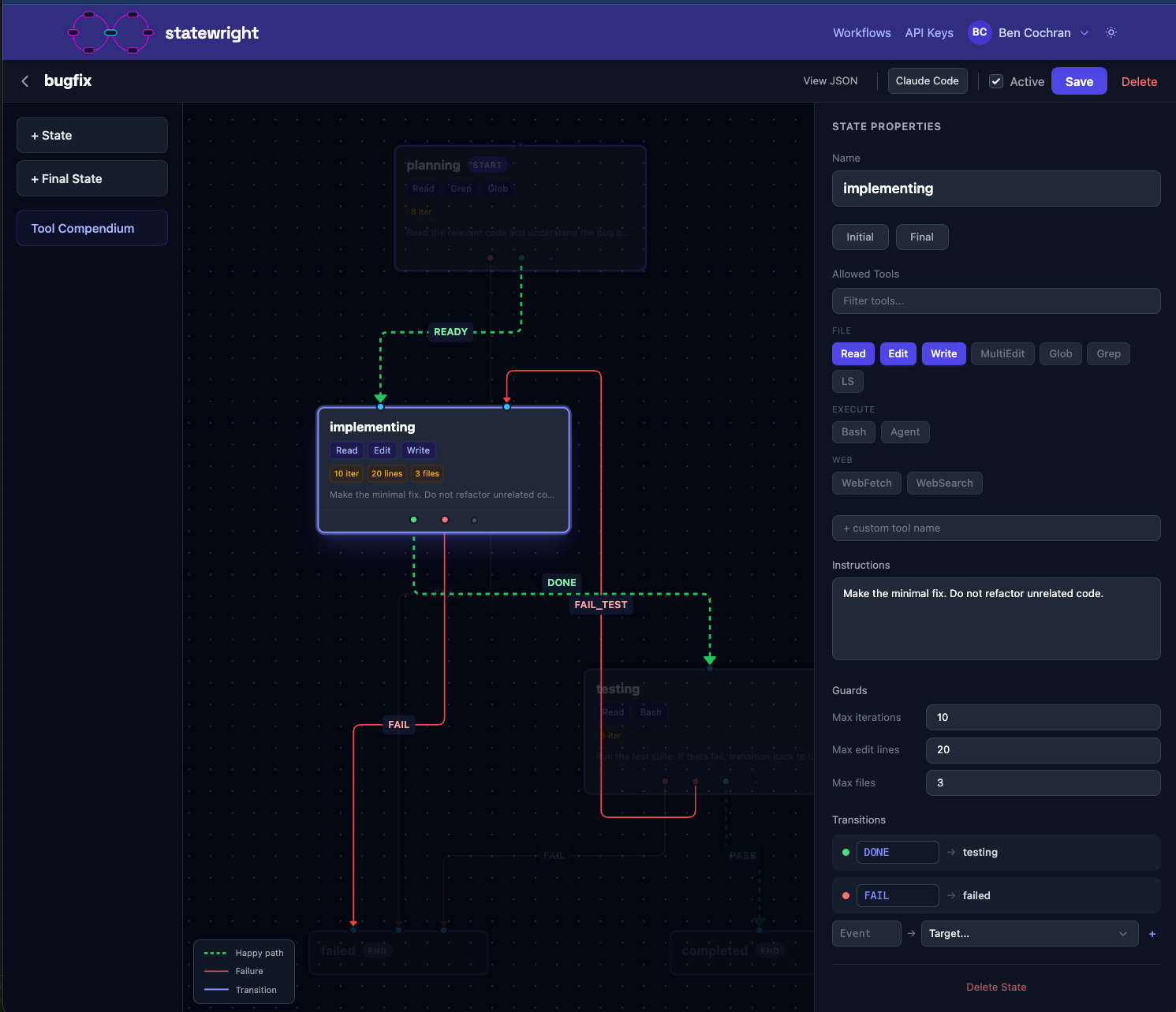
The problem
AI agents are brittle. Give a model 40+ tools and an open-ended problem and it re-reads the same file five times, calls Edit during review, deploys before tests pass. The common fix is bigger models and longer prompts... it helps sometimes. Observability tells you what went wrong after the fact; it doesn't prevent it.
The approach
Instead of making the model bigger, make the problem smaller.
State machines constrain the tool and solution spaces so the model reasons in a focused context at each step. A planning state gets read-only tools. When the agent transitions to implementation, edit tools unlock with limited shell access. Write-via-redirect and destructive ops are still blocked even when Bash is allowed. Testing only permits designated test commands.
Call a tool that's not in the current phase and you get rejected with a message telling you what IS available and how to transition. State machines loop and retry (unlike DAGs), which is what agentic work actually needs.
Works on frontier and local models alike. Below 13GB, models can produce tool calls but can't retain enough file content to make accurate edits. Above that threshold, the guardrails start turning failures into completions.
Quickstart
Install into Claude Code:
/plugin marketplace add statewright/statewright
/plugin install statewright
Your browser opens → sign up at statewright.ai → generate a key → paste it → done.
Then start a workflow:
❯ start the bugfix workflow — fix the failing tests in calc.py

◆ statewright — statewright_start (workflow: bugfix)
◆ [statewright] Workflow activated: bugfix

◆ statewright — statewright_get_state (MCP)

◆ Current phase: planning. Let me read the code first.

  Read 2 files

  [statewright] planning => implementing

◆ statewright — statewright_transition (READY)

  Edit calc.py: 1 line changed

  [statewright] implementing => testing

◆ statewright — statewright_transition (DONE)

  Bash: pytest -x — 7 passed

  [statewright] testing => completed
◆ [statewright] Workflow complete. 46 seconds.
You can also use the slash command directly: /statewright start bugfix.
Research results
In our 5-task SWE-bench subset (not the full 2294-instance benchmark), two local models went from 2 of 10 attempts passing to 10 of 10 with statewright constraints. Same tasks, same hardware.
| Model | Size | Bug Fix (26 lines) | SWE-bench (5 tasks) |
|---|
| gemma3 | 3.3GB | FAIL | FAIL |
| gemma4:e2b | 7.2GB | PASS* | FAIL |
| gpt-oss:20b | 13.8GB | PASS | PASS (5/5) |
| gemma4:31b | 19.9GB | PASS | PASS (5/5) |
| llama3.3 | 42.5GB | PASS | PASS (2/2)† |
*with specialized edit_line tool adaptation
†tested on 2 of the 5 tasks (added after initial experiment run)
The floor is around 13GB. Below that, models identify bugs correctly but can't serialize surgical edits (they rewrite entire files). That's a model limitation, not ours.
The structural win on larger models is breaking read-loop death spirals and keeping the tool space small enough that the model reasons instead of flailing. Research brief →
How it works
Architecture
Three layers, each independently useful:
-
Engine (crates/engine) — Pure Rust state machine evaluator. States, transitions, guards, tool restrictions. Deterministic. No LLM in the loop. No runtime dependencies.
-
Agent binary (crates/cli, binary: sw-agent) — Direct-to-Ollama agent executor. Loads a workflow, runs the LLM in a constrained loop, enforces tool access, and streams structured JSONL events. Supports per-state model routing via --config, and single-state execution via --state (the TUI or MCP gateway orchestrates, sw-agent executes one state at a time and exits).
-
Plugin layer (crates/mcp-gateway + plugins/) — MCP gateway that integrates with coding agents (Claude Code, Codex, Pi, etc.). When you activate a workflow, hooks enforce tool restrictions per state. The model sees 5 tools instead of 30. It gets clear instructions for the current phase and transitions when conditions are met. The statewright_run_agent MCP tool spawns the Rust binary for states that benefit from direct Ollama execution.
The TUI (crates/tui, binary: statewright) is a ratatui terminal interface that spawns sw-agent as a subprocess and renders its JSONL event stream in real time. It handles keyboard input, demo mode, and fixture selection.
Per-state model routing

 corca-ai
 lvlup-sw
 devsforge
 hellowind777
 berrzebb
 scasella
'%20stop-opacity%3D'0.16'%2F%3E%3Cstop%20offset%3D'1'%20stop-color%3D'rgb(200%2C90%2C60)'%20stop-opacity%3D'0.03'%2F%3E%3C%2FlinearGradient%3E%3C%2Fdefs%3E%3Crect%20width%3D'320'%20height%3D'200'%20fill%3D'url(%23g)'%2F%3E%3Ccircle%20cx%3D'250'%20cy%3D'56'%20r%3D'92'%20fill%3D'rgb(200%2C90%2C60)'%20fill-opacity%3D'0.06'%2F%3E%3Ccircle%20cx%3D'64'%20cy%3D'172'%20r%3D'58'%20fill%3D'rgb(200%2C90%2C60)'%20fill-opacity%3D'0.05'%2F%3E%3C%2Fsvg%3E)