Entrix
Shift quality from manual review to executable change guardrails.



Install
Choose one installation path:
Claude Code Plugin (recommended)
/plugin marketplace add phodal/entrix
/plugin install entrix@entrix
Restart Claude Code after plugin installation.
Standalone CLI (uv or pip)
uv tool install entrix
# or
pip install entrix

entrix --help
If you want Claude Code MCP integration in the current repository after installing the CLI:
entrix install --repo .
Requires Python 3.10+. uv is only needed for the uv / uvx workflow.
What it does
- codify quality gates and architecture constraints as reusable guardrail specs
- run checks by
fast / normal / deep tiers
- run change-aware checks on diffs with weighted scoring and hard gates
- route risky changes to deeper validation with
review-trigger
- optionally add graph-based impact, test-radius, and review context analysis
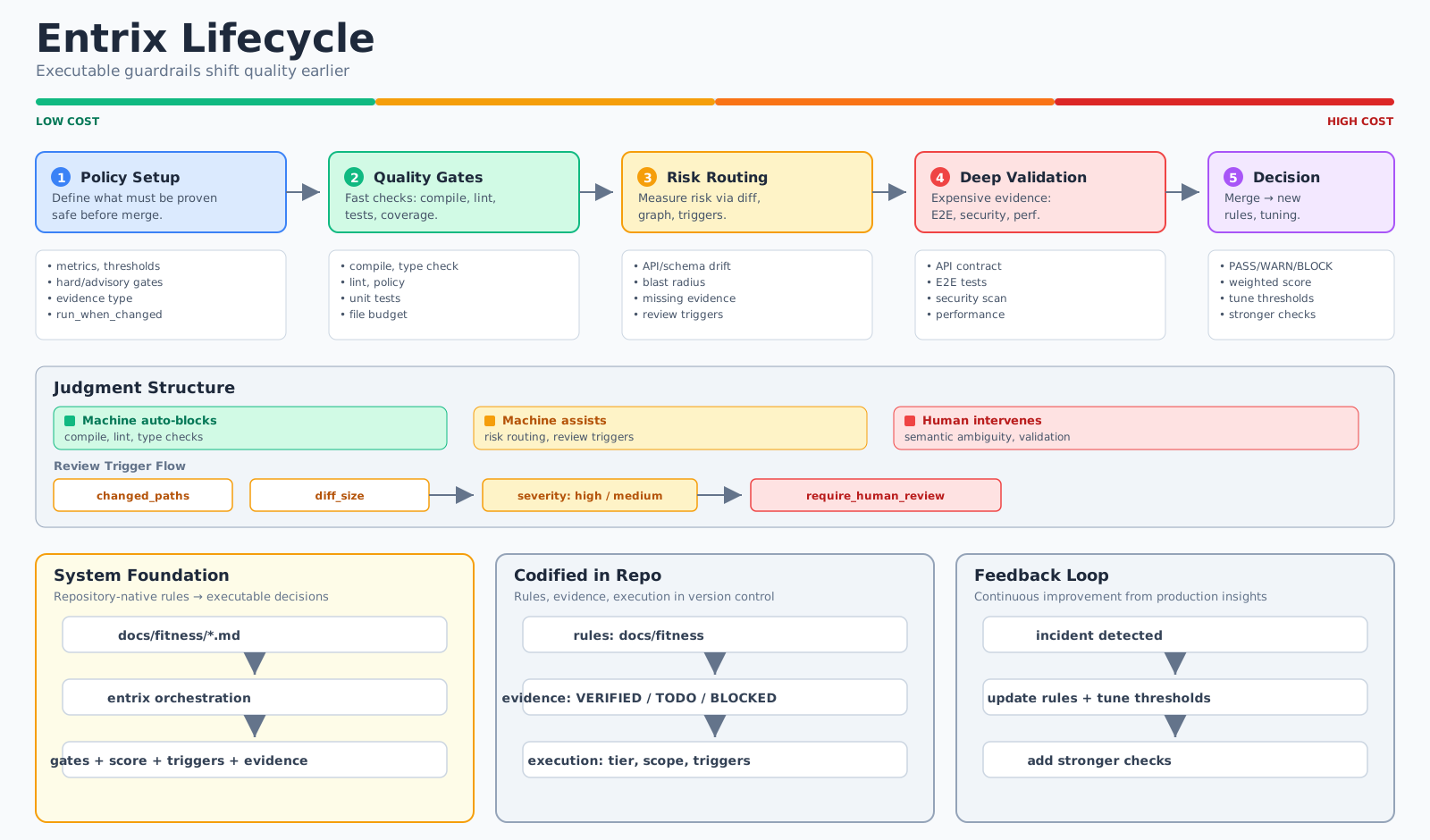
Guardrails in the change lifecycle
- checks run before risky code lands
- each run generates evidence
- policy can hard-stop, warn, or escalate to human review automatically
Lifecycle View
Additional design context:
tools/entrix/docs/adr/README.md: Entrix architecture decisions and rationale
Terminology
Entrix uses fitness in the evolutionary architecture sense: a fitness
function is an executable check that measures whether a codebase still satisfies
a quality or architecture goal. In product-facing language, you can think of
these as versioned quality guardrails.
Requirements
- Python 3.10+
- Git repository context for commands that use
--base HEAD~1
Optional:
uv for uv tool install ... and uvx ...pip install entrix[graph] for graph commands
Advanced Installation
Alternate CLI Invocations
CLI invocation options
uv tool install entrix
# or
pip install entrix

uvx entrix --help
uvx entrix run --tier fast
uvx entrix run --tier normal --stream failures
uvx entrix run --tier normal --stream all
uvx entrix review-trigger --base HEAD~1
Optional extras
pip install entrix[graph]
pip install entrix[mcp]
pip install entrix[dev]

uvx entrix install --repo .
First Run
1. Create a guardrail spec
By default, entrix run looks for specs under the current project's:
docs/fitness/*.md
When docs/fitness/manifest.yaml is present, Entrix uses the manifest as the
source of truth. That allows nested evidence files such as
docs/fitness/runtime/observability.md and docs/fitness/runtime/performance.md.
Example docs/fitness/code-quality.md:
---
dimension: code_quality
weight: 20
threshold:
  pass: 90
  warn: 80
metrics:
  - name: lint
    command: npm run lint 2>&1
    hard_gate: true
    tier: fast
    description: ESLint must pass

  - name: unit_tests
    command: npm run test:run 2>&1
    pattern: "Tests\\s+\\d+\\s+passed"
    hard_gate: true
    tier: normal
    description: unit tests must pass
---

# Code Quality

Narrative evidence, rules, and ownership notes can live below the frontmatter.
Advanced metric fields
Beyond the basic fields shown above, each metric in the frontmatter supports additional options:
metrics:
  - name: api_contract
    command: npm run test:contract 2>&1
    hard_gate: false
    tier: normal
    description: API contract tests

    # Execution scope — where this metric is authoritative
    # Values: local, ci, staging, prod_observation
    execution_scope: ci

    # Timeout in seconds (null = no limit)
    timeout_seconds: 120

    # Gate severity: hard, soft, advisory
    gate: soft

    # Evidence type: command, test, probe, sarif, manual_attestation
    evidence_type: test

    # Confidence level: high, medium, low, unknown
    confidence: high

    # Signal stability: deterministic, noisy
    stability: deterministic

    # Fitness kind: atomic (single check) or holistic (system-wide)
    kind: atomic

 hrconsultnj
 markus41
 sentrux
 dean0x
 TheBushidoCollective
 mbwsims
'%20stop-opacity%3D'0.16'%2F%3E%3Cstop%20offset%3D'1'%20stop-color%3D'rgb(200%2C90%2C60)'%20stop-opacity%3D'0.03'%2F%3E%3C%2FlinearGradient%3E%3C%2Fdefs%3E%3Crect%20width%3D'320'%20height%3D'200'%20fill%3D'url(%23g)'%2F%3E%3Ccircle%20cx%3D'250'%20cy%3D'56'%20r%3D'92'%20fill%3D'rgb(200%2C90%2C60)'%20fill-opacity%3D'0.06'%2F%3E%3Ccircle%20cx%3D'64'%20cy%3D'172'%20r%3D'58'%20fill%3D'rgb(200%2C90%2C60)'%20fill-opacity%3D'0.05'%2F%3E%3C%2Fsvg%3E)