Stats
Actions
Available In
Tags

Conduct and manage Data Protection Impact Assessments (DPIAs) under GDPR Article 35 and related frameworks, covering risk scoring, stakeholder consultation, threshold screening, and mitigation planning across diverse contexts like AI systems, biometrics, cloud migration, and marketing analytics.
Guides the combined DPIA and AI Act conformity assessment for AI systems processing personal data. Covers EDPB-EDPS Joint Opinion 5/2021, training data lawfulness under Art. 6 and Art. 9, Art. 22 automated decision-making, algorithmic bias detection, and NIST AI RMF MAP function. Keywords: AI privacy, DPIA, AI Act, algorithmic bias, automated decision-making, Art. 22, training data, NIST AI RMF.
Guides DPIA for biometric processing systems including facial recognition, fingerprint, voice, iris, and gait analysis. Covers Art. 9 special category requirements, Art. 35(3)(b) mandatory DPIA triggers for large-scale biometric processing, and EDPB Guidelines 3/2019 on video surveillance. Keywords: biometric, facial recognition, fingerprint, DPIA, Art. 9, special category, EDPB Guidelines 3/2019.
Guides DPIA for migrating personal data to cloud infrastructure covering controller-processor analysis under Art. 28, international transfer assessment, encryption requirements, and shared responsibility model evaluation. Activate for cloud adoption, SaaS procurement, or data centre migration projects. Keywords: cloud migration, DPIA, Art. 28, processor, encryption, shared responsibility, SaaS, IaaS, PaaS.
Compares PIA/DPIA methodologies: CNIL PIA tool, ICO DPIA template, NIST Privacy Framework, and ISO 29134. Provides methodology selection criteria based on regulatory jurisdiction, organisation maturity, processing complexity, and resource availability. Covers regulatory acceptance, tool features, and cross-methodology mapping. Keywords: PIA methodology, CNIL, ICO, NIST Privacy Framework, ISO 29134, DPIA comparison, assessment.
Guides the end-to-end GDPR Data Protection Impact Assessment process under Article 35, including mandatory trigger identification per Art. 35(3), DPIA content requirements per Art. 35(7), and EDPB WP248rev.01 methodology. Activate for systematic profiling, large-scale special category processing, or large-scale public monitoring. Keywords: DPIA, Article 35, impact assessment, WP248, data protection, risk assessment.
Based on adoption, maintenance, documentation, and repository signals. Not a security audit or endorsement.
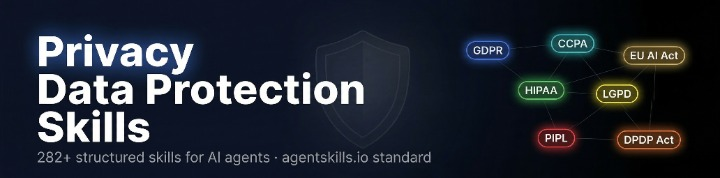
The first structured, machine-readable privacy skills database for AI agents. 282+ open-source privacy compliance procedures covering GDPR, CCPA, EU AI Act, HIPAA, LGPD, PIPL, and India's DPDP Act — following the agentskills.io open standard. Works with Claude Code, GitHub Copilot, OpenAI Codex CLI, Cursor, Gemini CLI, and 26+ AI platforms.






git clone https://github.com/mukul975/Privacy-Data-Protection-Skills.git
cd Privacy-Data-Protection-Skills/skills/privacy/conducting-gdpr-dpia
cat SKILL.md
Or install via Claude Code Plugin Marketplace:
/plugin marketplace add mukul975/Privacy-Data-Protection-Skills
/plugin install privacy-skills-complete@privacy-data-protection-skills
| Jurisdiction | Regulation | Skills | Status |
|---|---|---|---|
| EU | GDPR (Regulation 2016/679) | 50+ | Full |
| EU | EU AI Act (Regulation 2024/1689) | 15+ | Full |
| EU | ePrivacy Directive | 12+ | Full |
| US | CCPA/CPRA | 13+ | Full |
| US | HIPAA Privacy and Security Rules | 11+ | Full |
| US | 13 State Privacy Laws | 13+ | Full |
| Brazil | LGPD | 3+ | Yes |
| China | PIPL | 3+ | Yes |
| India | DPDP Act 2023 | 3+ | Yes |
| Japan | APPI | 3+ | Yes |
| South Korea | PIPA | 3+ | Yes |
| Singapore | PDPA | 3+ | Yes |
| Thailand | PDPA | 3+ | Yes |
| South Africa | POPIA | 3+ | Yes |
| Australia | Privacy Act 1988 | 3+ | Yes |
| Canada | PIPEDA | 3+ | Yes |
| Cross-border | APEC CBPR, SCCs, BCRs, EU-US DPF | 12+ | Full |
AI agents are increasingly used for privacy compliance tasks but operate with zero structured knowledge of privacy regulations, leading to:
Each skill provides structured, verified regulatory knowledge that AI agents load on demand, replacing hallucination with precision.
Real-world use cases:
Disclaimer: These skills are educational reference materials, not legal advice. Consult qualified legal counsel for compliance decisions.
| Category | Skills | Example |
|---|---|---|
| GDPR Compliance | 18 | gdpr-compliance-audit |
| Privacy Impact Assessment | 18 | conducting-gdpr-dpia |
| Data Subject Rights | 15 | dsar-processing |
| AI Privacy Governance | 15 | ai-dpia |
| Consent Management | 14 | gdpr-valid-consent |
| Privacy Engineering | 14 | differential-privacy-prod |
| Privacy by Design | 13 | implementing-homomorphic-encryption |
| Data Breach Response | 13 | breach-72h-notification |
| US State Privacy Laws | 13 | ccpa-cpra-compliance |
| Cross-Border Transfers | 12 | scc-implementation |
| Cookie and Consent | 12 | tcf-v2-implementation |
| Data Classification | 12 | pii-detection-pipeline |
| Data Retention | 12 | retention-schedule |
| Global Regulations | 12 | china-pipl |
| Vendor Management | 11 | vendor-risk-scoring |
| Healthcare Privacy | 11 | hipaa-risk-analysis |
| Employee Privacy | 11 | employee-monitoring-dpia |
| Privacy Audit | 11 | iso-27701-pims |
| Records of Processing | 10 | controller-ropa-creation |
| Children's Privacy | 10 | coppa-compliance |
Every skill follows the agentskills.io open standard:
npx claudepluginhub mukul975/privacy-data-protection-skills --plugin privacy-impact-assessment-skills817 cybersecurity skills covering web security, pentesting, DFIR, threat intelligence, cloud security, malware analysis, and more.
 mukul975
Complete collection of 282+ privacy and data protection skills covering GDPR, CCPA, HIPAA, LGPD, PIPL, and 15+ regulations
mukul97511 healthcare privacy skills: HIPAA Privacy/Security Rules, risk analysis, BAA management, de-identification, telehealth
mukul97514 consent management skills: valid consent, consent withdrawal, preference centers, consent for research, children, mobile apps
mukul97513 US state privacy law skills: CCPA/CPRA, VCDPA, CPA, CTDPA, TDPSA, multi-state compliance, universal opt-out
mukul97518 GDPR compliance skills: audit, gap analysis, accountability, DPO, certification, DPA drafting, supervisory authority cooperation
mukul975GDPR compliance assistant — code and system audits, privacy notice drafting, DPAs, DPIAs, data flow reviews, and authoritative article-cited Q&A.
 Sushegaad
Conjunto modular e orquestrado de skills para Claude que cobre, ponta-a-ponta, conformidade com a LGPD (Lei 13.709/2018), resoluções da ANPD aplicáveis e o ECA Digital (Lei 15.211/2025). Inclui 1 skill maestro (lgpd-audit) que orquestra 18 sub-skills especializadas: base legal, mapeamento de dados, ROPA, RIPD, consentimento, DSAR, resposta a incidentes, encarregado, criptografia, retenção, DPA, transferência internacional e proteção de menores.
 goul4rt
GDPR Plugin - EU General Data Protection Regulation with DPIA, data subject rights, and 72-hour breach notification
 GRCEngClub
Implement GDPR-compliant data handling with consent management, data subject rights, and privacy by design. Use when building systems that process EU personal data, implementing privacy controls, or conducting GDPR compliance reviews.
 wshobson
Ultra-compressed communication mode. Cuts 65% of output tokens (measured) while keeping full technical accuracy by speaking like a caveman.
 JuliusBrussee
'%20stop-opacity%3D'0.16'%2F%3E%3Cstop%20offset%3D'1'%20stop-color%3D'rgb(200%2C90%2C60)'%20stop-opacity%3D'0.03'%2F%3E%3C%2FlinearGradient%3E%3C%2Fdefs%3E%3Crect%20width%3D'320'%20height%3D'200'%20fill%3D'url(%23g)'%2F%3E%3Ccircle%20cx%3D'250'%20cy%3D'56'%20r%3D'92'%20fill%3D'rgb(200%2C90%2C60)'%20fill-opacity%3D'0.06'%2F%3E%3Ccircle%20cx%3D'64'%20cy%3D'172'%20r%3D'58'%20fill%3D'rgb(200%2C90%2C60)'%20fill-opacity%3D'0.05'%2F%3E%3C%2Fsvg%3E)