Stats
Actions
Available In
Tags

Build, debug, and deploy walkerOS event data pipelines: create sources, destinations, and transformers; validate and map events; bundle and test flows; manage projects via API.
Use when creating a new walkerOS CMP (consent management platform) source. Structured fill-in-the-blanks workflow that turns any CMP's consent API into a walkerOS source package. Covers CookieFirst, Usercentrics, CookiePro/OneTrust patterns and generalizes to any CMP.
Use when creating a new walkerOS destination. Example-driven workflow starting with research and examples before implementation.
Use when creating a new walkerOS source. Example-driven workflow starting with research and examples before implementation.
Use when creating a new walkerOS transformer. Example-driven workflow for validation, enrichment, or redaction transformers.
Use when walkerOS events aren't reaching destinations, debugging event flow, or troubleshooting mapping issues. Covers common problems and debugging strategies.
Requires secrets
Needs API keys or credentials to function
Own this plugin?
Verify ownership to unlock analytics, metadata editing, and a verified badge. GitHub access is read-only (username + org membership).
Sign in to claimOwn this plugin?
Verify ownership to unlock analytics, metadata editing, and a verified badge. GitHub access is read-only (username + org membership).
Sign in to claimBased on adoption, maintenance, documentation, and repository signals. Not a security audit or endorsement.






From browser to BigQuery and ad platforms - warehouse-native, and ready for AI agents via MCP.
GA4, custom tags, ad pixels - each one a separate setup, none of them agreeing on the same numbers. When something breaks, you can't see where.
walkerOS is one collection layer for all of them.
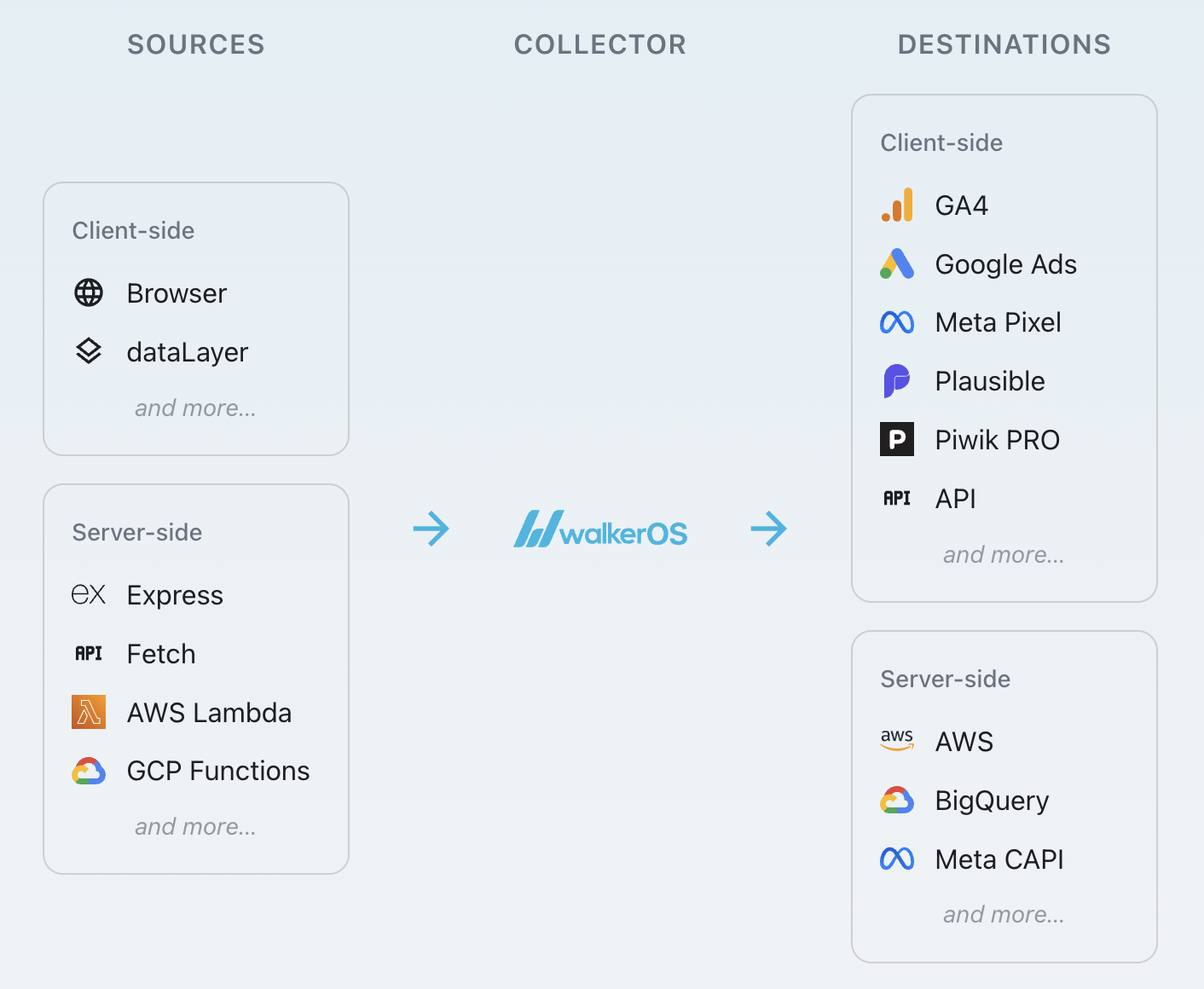
Choose one based on your workflow and integration possibilities:
| Mode | Description | Best For |
|---|---|---|
| Integrated | Import directly into your TypeScript application | React/Next.js apps, TypeScript projects |
| Bundled | Build a standalone script from JSON config with npx walkeros | Static sites, Docker deployments, CI/CD |
Integrated (import into your app):
import { startFlow } from '@walkeros/collector';
import { sourceBrowser } from '@walkeros/web-source-browser';
import { destinationGtag } from '@walkeros/web-destination-gtag';

await startFlow({
  sources: {
    browser: {
      code: sourceBrowser,
      config: { settings: { pageview: true } },
    },
  },
  destinations: {
    ga4: {
      code: destinationGtag,
      config: {
        settings: { ga4: { measurementId: 'G-XXX' } },
      },
    },
  },
});
Bundled (build from JSON config):
{
  "flows": {
    "default": {
      "sources": {
        "browser": {
          "package": "@walkeros/web-source-browser",
          "config": { "settings": { "pageview": true } }
        }
      },
      "destinations": {
        "ga4": {
          "package": "@walkeros/web-destination-gtag",
          "config": {
            "settings": { "ga4": { "measurementId": "G-XXX" } }
          }
        }
      }
    }
  }
}
Then: npx walkeros bundle flow.json
walkerOS exposes a Model Context Protocol (MCP) interface. AI agents can read your event schema, suggest tracking definitions, and generate integration code - making your event layer programmable, not just configurable.
⭐️ Help us grow and star us. See our Contributing Guidelines to get involved.
npx claudepluginhub elbwalker/walkerosAI agent skills that make SaaS products data-ready for product analytics — from codebase scan to tracking plan to working instrumentation code.
 Accoil
Comprehensive Google Analytics 4 guide covering property setup, events, custom events, recommended events, ecommerce, BigQuery, Measurement Protocol, and privacy compliance
 henkisdabro
Treasure Studio-specific skills including workspace document management, skill creation, scheduled task management, and UI rendering formats for grid dashboards and action reports
 treasure-data
Implement event-driven APIs with message queues and event streaming
 jeremylongshore
Access PostHog analytics, feature flags, experiments, error tracking, and insights directly from your AI coding tool. Optionally capture Claude Code sessions to PostHog LLM Analytics.
 PostHog
A growing collection of Claude-compatible academic workflow bundles. Covers scientific figures, manuscript writing and polishing, reviewer assessment, citation retrieval, data availability, paper reading, literature search, response letters, paper-to-PPTX conversion, and evidence-grounded Chinese invention patent drafting. Rules are organized as reusable skill folders with explicit workflows and quality checks.
 Yuan1z0825