Stats
Actions
Available In
Tags

Reverse-engineer any codebase into structured, verifiable documentation organized by layers (API, database, domain, frontend, infrastructure). Enables rebuilding the codebase in a new target stack while preserving contracts and business rules, guided by a knowledge graph and interactive dashboard.
Use after unwind:uw-plan to EXECUTE the rebuild — interview the user about scope/order/target, dispatch technology-agnostic per-layer builder agents that reproduce the [MUST] contracts in the target stack, hold rebuild state in a local file, and maintain a source→target verification graph that measures completeness. Supports a loop-until-verified mode.
Use after uw-verify to fix all gaps found. Reads gaps.md and adds missing documentation.
Use to visually explore the rebuild knowledge graph. Builds and launches the Unwind dashboard (React + React Flow + ELK) pointed at docs/unwind/rebuild-graph.json with coverage, priority, and contract views.
Use after scanning (and ideally coverage verification) to emit the rebuild knowledge-graph artifact. Joins the manifest, coverage diff, and layer docs into docs/unwind/rebuild-graph.json for the dashboard.
Use when starting any reverse engineering task - establishes how to find and use Unwind skills for codebase analysis, service mapping, and documentation
Own this plugin?
Verify ownership to unlock analytics, metadata editing, and a verified badge. GitHub access is read-only (username + org membership).
Sign in to claimOwn this plugin?
Verify ownership to unlock analytics, metadata editing, and a verified badge. GitHub access is read-only (username + org membership).
Sign in to claimBased on adoption, maintenance, documentation, and repository signals. Not a security audit or endorsement.
Skills library for reverse engineering codebases. Produces complete, machine-readable documentation and phased rebuild plans to reliably re-build the service or application in a new technology or modernised framework.
Generate documentation that enables an AI agent to rebuild your system in a different language or framework while maintaining:
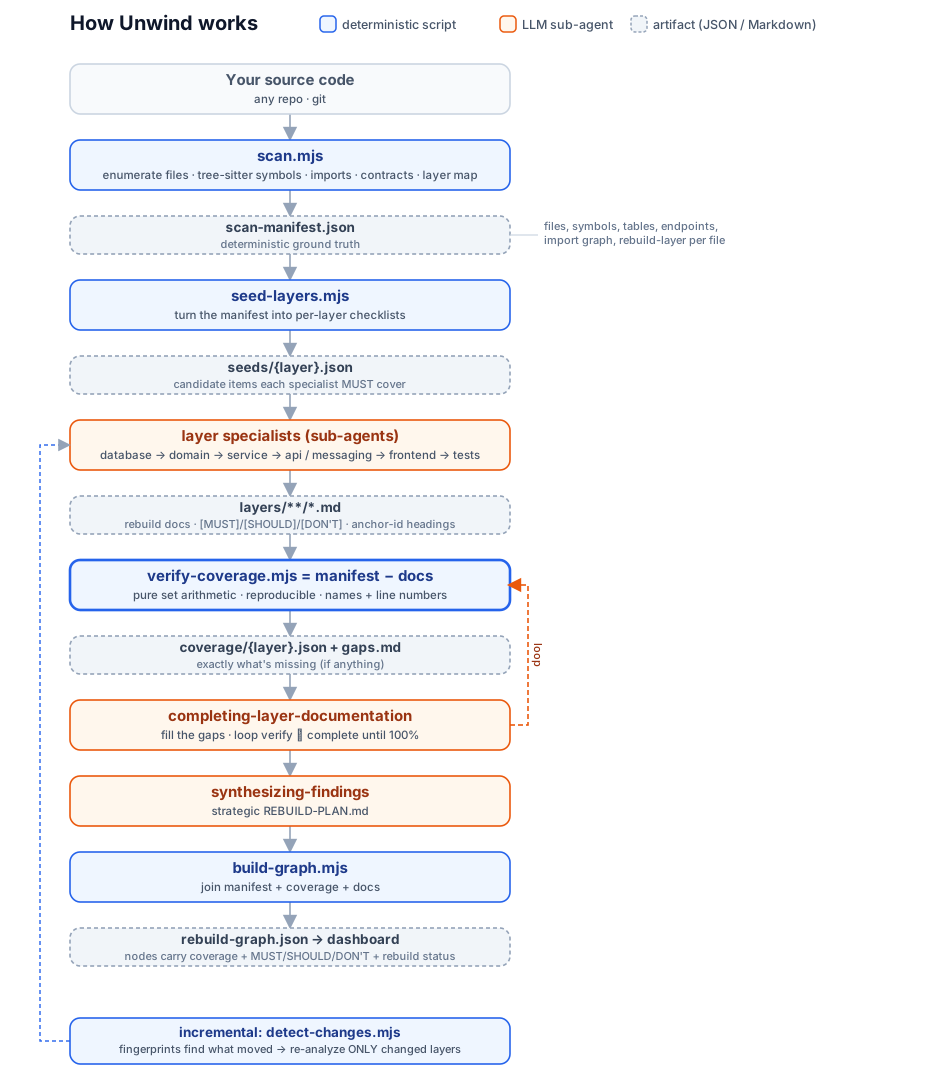
Unwind is hybrid: a deterministic scanner (@unwind/core, built on
tree-sitter) produces the verifiable ground truth — file inventory, structural
symbols, import graph, and a first-pass layer assignment — and LLM specialists add
the semantic rebuild documentation. Completeness is then verified by set
arithmetic (scan − docs), not asserted. Symbol extraction supports
TypeScript/JavaScript, Python, Rust, Java, and C#; other languages get file-level
coverage, and if Node/pnpm is unavailable Unwind falls back to a pure-LLM flow.
It can also execute the rebuild: uw-build interviews you about scope and
order, dispatches technology-agnostic builder agents that reproduce each layer's
[MUST] contracts in the target stack, then re-scans the rebuilt repo and diffs
it against the source to measure completeness — a before/after picture, again by
set arithmetic rather than assertion.
/plugin marketplace add nearform/unwind
/plugin install unwind@nearform
Restart Claude Code after installation.
New here? Just run the entry point:
Use unwind:uw-start # orients you, checks prereqs, drives the whole pipeline
Or run the phases manually:
1. Use unwind:uw-scan              # deterministic scan → architecture.md (+ scan-manifest.json)
2. Use unwind:uw-dashboard   # visualize it — works straight after the scan
3. Review docs/unwind/architecture.md
4. Use unwind:uw-analyze # seed → analyze → verify coverage → complete
5. Use unwind:uw-plan   # → REBUILD-PLAN.md
6. Use unwind:uw-dashboard   # re-open to explore coverage, priorities & contracts
7. Use unwind:uw-build   # execute the rebuild in the target stack (+ verification graph)
You can run unwind:uw-dashboard any time after step 1 — right after the
scan it shows the structural graph (everything scanned); after analysis it fills
in coverage and the MUST/SHOULD/DON'T priorities.
The first run builds the scanner automatically (pnpm install && pnpm build via
ensure_unwind_core). It needs Node + pnpm; without them, Unwind falls back to a
pure-LLM flow.
Output:
docs/unwind/REBUILD-PLAN.md - Strategic rebuild approachdocs/unwind/layers/*/ - Detailed layer analysis (folder per layer)docs/unwind/rebuild-graph.json - Knowledge graph for the dashboarddocs/unwind/rebuild-verification-graph.json - Source→target completeness (after uw-build)docs/unwind/.cache/ - Deterministic artifacts: scan-manifest.json (ground truth), seeds/ (per-layer checklists), coverage/ (per-layer coverage reports), rebuild-state.json (rebuild ledger)/plugin marketplace update nearform
/plugin uninstall unwind
/plugin install unwind@nearform
Unwind interleaves deterministic scripts (which own the verifiable facts) with LLM sub-agents (which add semantic judgment). The deterministic layer is what makes "did we document everything?" a checkable question instead of a hopeful one.
npx claudepluginhub nearform/unwind --plugin unwindAccess official Microsoft documentation, API references, and code samples for Azure, .NET, Windows, and more.
 MicrosoftDocs
Full API lifecycle management for Claude Code. Sync collections, generate client code, discover APIs, run tests, create mocks, publish docs, and audit security. Powered by the Postman MCP Server.
 Postman-Devrel
Markdown documentation skills and linting with markdownlint.
 TheBushidoCollective
Upstash Context7 MCP server for up-to-date documentation lookup. Pull version-specific documentation and code examples directly from source repositories into your LLM context.
 upstash
Build and maintain an LLM-curated personal knowledge base in your project — Andrej Karpathy's LLM Wiki pattern, designed to scale to thousands of pages without becoming a context bottleneck. Now with an optional compiled graph layer for typed, provenance-backed relationships.
 praneybehl
Connect to Atlassian products including Jira and Confluence. Search and create issues, access documentation, manage sprints, and integrate your development workflow with Atlassian's collaboration tools.
 atlassian
'%20stop-opacity%3D'0.16'%2F%3E%3Cstop%20offset%3D'1'%20stop-color%3D'rgb(200%2C90%2C60)'%20stop-opacity%3D'0.03'%2F%3E%3C%2FlinearGradient%3E%3C%2Fdefs%3E%3Crect%20width%3D'320'%20height%3D'200'%20fill%3D'url(%23g)'%2F%3E%3Ccircle%20cx%3D'250'%20cy%3D'56'%20r%3D'92'%20fill%3D'rgb(200%2C90%2C60)'%20fill-opacity%3D'0.06'%2F%3E%3Ccircle%20cx%3D'64'%20cy%3D'172'%20r%3D'58'%20fill%3D'rgb(200%2C90%2C60)'%20fill-opacity%3D'0.05'%2F%3E%3C%2Fsvg%3E)